
Manufacturing enterprises generally do not lack product information. Product pictures, CAD profiles, BOM, process routings, costing data, and historical patterns accumulated over the past years are often well stored.
But when a customer actually sends a new product, enterprises often need to reconfirm: Has there been any such product in the past, where historical information has been placed, which BOM can be consulted, whether the original process routing is applicable, which paragraph has been changed several times in the past, and which information should be used at this time?
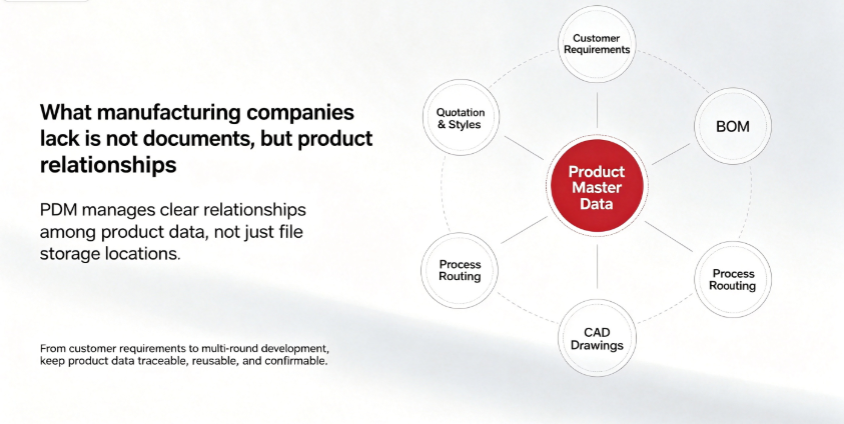
So what many enterprises really lack is not the number of documents, but the clear product relationship between them.
This is also the most important entry point for understanding PDM. The real management of PDM is not just where the product information exists, but whether there is a clear relationship between the entry of a product from the customer's needs to the formation of BOM, process routings and the subsequent multiple development iterations.
This is particularly important for manufacturing companies with a large number of product types, frequent material changes and the development of a complex sub-cycle.
What Is PDM?
PDM, product data management.
For manufacturing companies, a product is not just a picture, a schematic or a product number. It continues to be associated with materials, BOM, process routings, development iterations, different colours, historical similar products and costing information.
If these elements are in the hands of different folders, forms or persons, even though the enterprise has accumulated a great deal of historical information, it is possible to re-examine, confirm and collate each new development.
Thus, the real need for PDM is not “how many products do enterprises have”, but whether there is a sustainable relationship between these product data. The clearer the information on what products are, what materials are needed, how they are manufactured, what has been modified in the past and what is being developed, the easier it is to base the latter offers, resource planning and production on the same product.
ii. Why is PDM an issue for the boss?
PDM appears to be used mainly by engineering and product development departments, but it does not affect just slotting management.
The old version of BOM may continue to be used for follow-up operations if the product is modified by the client and the different development iterations are not clearly distinguished. Where there are multiple colours in the same product, the risk of misdirected information and duplicated identification can be increased if there is no clear relationship between the corresponding material.
These problems ultimately affect not just one post in the engineering sector, but offers, materials preparation, planning, production connection and delivery stability.
So what the boss really needs to look at is not how each of the drawings should be maintained, but whether the product information currently used by the firm is clear, whether BOM and the process information will continue to be appropriate after the product changes, whether past product experience is still in the hands of a small number of older employees, and whether the product data will need to be re-explained by different departments once they have entered the business.
The clearer the data at the product development stage, the easier it is to base its operations and production on the same product.
This is also an important reason for PDM to move further from engineering sector tools to the manufacturing company data base.
III. How does Sangely.PDM move from customer demand to product development?
When a new product is sent by a client, it is often not “how to re-create a set of information”, but whether or not a similar product has been produced in the past.
Sangely.PDM continues to extend the product data entry to the customer demand side. In the context of the entry of a client's picture into the enterprise, the DXF vector document can be created by AI, allowing external product information further into subsequent product data processing.
At the same time, businesses can start with historical information. Sangely.PDM supports the search of existing profiles by keywords, and can also help staff to compare different candidate products by means of image comparison for historical similar products and, further, by means of similar-image comparison.
These capabilities address different issues. Keyword retrieval is better suited to the situation where staff already have some of the information on the products; pictures compare to those that help enterprises find potentially similar formulas from historical products when they do not know the specific paragraph and file name; and similar-image comparison further help staff to compare the differences between candidate products.
Ultimately, which section of history is most relevant and is still identified by the operational and engineering staff who are truly familiar with the product in the context of current needs.
Therefore, Sangely.PDM is not a system that replaces people ' s professional judgement, but helps staff to find a more valuable starting point for development from historical data already accumulated by the enterprise.
From “Remembered file name” to “Find and compare similar products”
Traditional product information search is highly dependent on human memory. Know the name of the client, you can look for the client; you can search for the number of the payment; you can know the name of the document or you can find the information directly.
However, these conditions are often absent from the development of new products. Clients may send only one picture of the product, and business people do not know whether the enterprise has made a similar product in the past or what the name of the historical document is.
At this point, the more it has accumulated in the past, the more difficult it may be to find it.
In addition to supporting keyword search of historical profiles, Sangely.PDM can also identify potentially similar products by means of a photo comparison, which in turn helps staff to further compare different candidates by means of a similar comparison.
In this way, the product search can no longer rely solely on “I remember what this document is called”, but rather, it can be found in historical products without knowing the specific document name.
This is important for manufacturing companies that have accumulated large amounts of money over a long period of time, since the real value of the historical product presupposes, first of all, that it is rediscovered.
Five, when you find a similar paragraph, the real value is the manufacturing data behind it.
If the system only finds a picture that looks similar, it remains limited for manufacturing companies.
The real concern of the engineers is what material the product used in the past, which BOM is for, what process routings are used, and what elements can be further referenced.
Thus, where the retrieving of similar amounts actually produces value, it is not just a similar picture, but a product that, when found, can continue to see the manufacturing data that it has formed in the past.
In Sangely.PDM, the user can further call on existing process routings and adjust the relevant nodes around current new product changes to continue to develop new BOM, process routings and costing information.
This has allowed the development of new products to move away from “finding a historical document” and to make further use of an already accumulated set of product experiences. The products that enterprises have done in the past are no longer just archived, but are beginning to be the data base upon which the next new product can continue to be developed.
Reuse of historical products does not amount to copying old products
After all, a similar paragraph is not a new product, so the reuse of a historical product cannot simply be understood as finding an old one and then replicating the data package directly.
Real new product development still requires a judgement as to where it has not changed and where it has changed. Whether the materials have been replaced, the colour adjusted, the product structure changed, which process nodes remain in use and which elements need to be reprocessed will still need to be judged by the engineers.
The product development logic of Sangely.PDM is to call on the existing product and process base and adjust the relevant nodes around the actual changes in the current new product, after the user has identified a similar paragraph.
So what really reduces the system is not the necessary engineering judgement, but the groundwork that does not need to be repeated. In the past, it may have been possible to re-establish all the charts, BOM and process information; it can now gradually be transformed into a search for historical similar products, comparison of candidates, identification of which data can continue to be used, and then focus on what is actually changing.
This is also the most important difference between “reuse of historical products” and simple reproduction of old information.
Sangely.PDM is not a substitute for engineers to judge product structures, materials and processes. Similar paragraphs are only the starting point for development, and the system is reduced by the duplication of information, creation and interpretation, rather than by the cancellation of the necessary engineering review.
VII. How do you know which information should be used now, after repeated product modifications?
New product development is rarely completed once.
Clients may modify their structures, replace materials, resize or continue to add different colours to the same product. As a result, the same product will soon have multiple rounds of development information, multiple BOMs, multiple colours and different stages of the product.
With this increasing amount of information, the real problem for manufacturing companies is not “loss of documents”, but rather that they are all available without knowing which one should be used at this time.
The Sangely product system supports the recording of BOM for different development iterations and the formation of BOM for different product colours. In this way, each product changes not only to keep more than one information in the system, but also to have a clearer attribution of data from different stages of development and from different colours.
This is particularly important for manufacturing companies with highly variable products, such as bags and handbags. A product may be sampled and modified in multiple rounds, and the same paragraph may have multiple colours. If the development wheel and colour relationship are not clearly documented, even if the information is preserved, the successor may not be in a position to quickly determine which version should be used.
When the development wheel and coloring relationships gradually enter PDM, enterprises can reduce their dependence on individual memory. Subsequent quotations, material preparation and production will also have a clearer basis when referring to product information.
One of the important objectives of product data management is to give each change a clear attribution.
viii. Why is BOM and BOR an important manufacturing base in PDM?
A product that has only pictures and stenographs is still not directly available for manufacture. The latter offers, purchases, plans and production also need to continue to know what materials are needed and what processes should be constructed.
This is the important role of BOM and BOR.
BOM describes what the product needs and BOR describes what the product should do.
In the product data system of Sangely, CAD profiles can continue to form BOM and BOR, allowing products to move from design expression to manufacturing data. In this way, the product data no longer rest on “what the product looks like”, but build on what it is made of and how it should be manufactured.
When the relationship between products, materials, BOM and process routings becomes clear, subsequent operations do not require a reinterpretation of the product every time a new sector enters the sector.
This is also the value of Sangely.PDM as a source of product data.
From product data to costing
The real concern when a client asks for a new product is not just whether the project can produce it, but also how, how, how and how much, and when to provide feedback to the client.
As a result, product data remain of limited value to the operational response if they remain in the engineering sector.
In a typical product development scenario for Sangely.PDM, the user can continue to use existing process information, adjust relevant nodes to current new product changes, and further develop new BOM, process routing and costing information.
The most important thing here is not that all new products must operate in strict compliance with the same fixed process, but that the data already generated in historical products can be re-entered into the current new product development.
As a result, the offer would not have to re-establish the product base from the very beginning of the gap, and work and business could continue around clearer product data.
X. Why do product data continue to serve ERP and MES?
It is only when product development is completed that the manufacturing business really begins backwards.
Data such as BOM, process routings, which are generated during product development, can also continue to be an important basis for subsequent resource planning and production implementation.
In the overall Sangely product system, Sangely.PDM is located at the source of the product data, Sangely ERP continues to take over orders, materials and ERP, and Sangely MES further enters production tasks and manufacture sites.
The focus here is not to interpret PDM, ERP, MES as isolated software, but to allow, as far as possible, the data already developed at the previous stage to continue to form the basis of the work at the latter stage.
If PDM establishes a product profile and re-entry ERP and re-interprets when it enters MES, the enterprise still has a large number of duplicates and data break points.
Thus, the real value of PDM is not just to manage engineering information, but to provide a more stable product data base for subsequent manufacture.
Eleven. Business starts building PDM. Do you want to organize all historical products at once?
Not necessarily.
For manufacturing companies that have been operating for many years and have accumulated a great deal of historical products, the workload tends to be significant if all historical documents are to be processed once and for all at the outset.
A more practical approach would be to start with the most valuable products, such as those that are developed frequently, with relatively complete historical information, with more similar amounts, or that have more visible changes in rotation and colour.
The slotting of these products, BOM, the process routing, the development of the wheel and the coloring relationship are gradually being clarified and the product data management is gradually being expanded.
The real importance of PDM is not the number of historical documents imported on the first day, but the first is the establishment of a product data relationship that enterprises can maintain, query and reuse on a continuous basis.
As new product development continues to enter the system, the enterprise's own product data base will become more complete.
Conclusion: Reuse historical products and keep their changes clear
The real value of manufacturing companies is not just how much documents are stored on servers, but the product experience behind them. What products, materials and processes have been used in the past, and what development changes have been experienced by enterprises, and if this information can be consistently recorded and re-tributed, it will become a real basis for the next product development.
Sangely.PDM gradually changed its product experience from “dependant to someone” to “recognizing and continuing in the system” by replicating keywords, image comparison, similar graphics and historical product data. At the same time, through the continuous management of the development of the wheel, the colour BOM and the related product data relationship, the firm, after repeated product modifications, is also in a better position to determine which information should be used at this stage.
From this point of view, PDM needs to address two sets of problems at the same time: the re-entry of previously produced products into new product development, and the maintenance of clear data for current use as products evolve.
What Sangely.PDM really wants to do is not to give manufacturing firms a larger repository of documents, but to make products that have been made in the past the starting point for the next development, leaving clear data links for each product change.
The more products the enterprise accumulates, the more fundamental future development should be, not the larger the folder, the more difficult it is to find and judge.
FAQ|XTERRM0X common problems
Q1: What Is PDM?
PDM is a system used to manage product data and their relationships. In the case of manufacturing companies, it goes beyond the management of the slotting, and there is a need to continue to connect data on products, BOM, process routings, development changes and historical products, so that product development can form a sustainable manufacturing base.
Q2: How do Sangely.PDM find and compare historical similar products?
Sangely.PDM supports the retrieval of historical profiles by keywords, and can also help staff to further compare different candidate products through image comparison. Ultimately, it remains for the users to identify the most reputable historical paragraph in the context of current needs.
Q3: When historical similar products are found, can the new product be developed directly?
Can't. Historical similarities are only a reference point for product development. Users still need to judge which historical data can continue to be used and adjust the real changes in the material, colour, structure and process changes of the current new product.
Q4: Can PDM completely avoid BOM error?
That cannot be simply understood. PDM can make BOM, which corresponds to different stages, more clear by developing a rotation, colour and related product data relationship, and reduce the risk that old versions or unmatched information will continue to be cited, but the product data will still need to be maintained and validated on an ongoing basis by relevant personnel.
Q5: What manufacturing companies are more suitable to use Sangely.PDM?
The value of PDM product data management and re-use of historical experience is even more pronounced for manufacturing companies with a large number of product types, frequent customer customizations, more historical similar products, and significant changes in materials, colours and development cycles. In particular, in multi-form scenes such as boxing, handbags, shoe hats, the more historical products there are, the more clear, searchable and sustainable product data relationships are needed.