
Manufacturing companies move a large number of business activities forward every day.
Customer information arrives—who organizes it? Once a sample is approved, who remembers to continue processing the order? When materials are ready, who confirms that the next step can begin? After ERP creates a plan, how does that plan continue into MES and the shop floor?
Many companies already have PDM, ERP and MES, and more business data is entering these systems. Yet keeping a process moving still often depends on one thing:
Someone remembers what needs to happen next.
Employees check systems, search email, read messages, confirm business status and then notify the next role. The systems already record extensive business information, but many transitions still require people to inspect, judge, notify and coordinate manually.
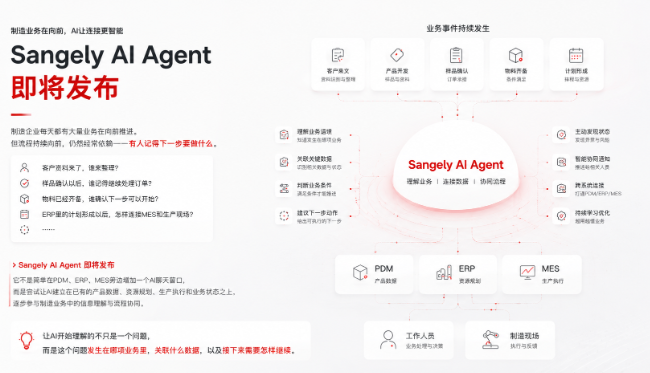
Sangely AI Agent is preparing for release to explore a different way of working.
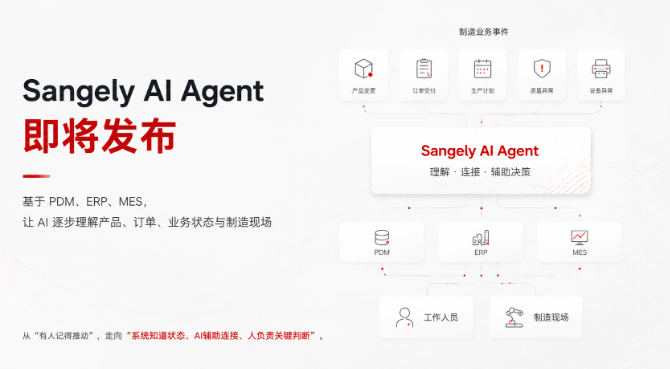
It is not simply an AI chat window placed beside PDM, ERP and MES. It is an effort to build AI on the product data, resource planning, production execution and business status already established in Sangely, so that AI can gradually participate in information understanding and manufacturing-process collaboration.
The objective is for AI to understand not only a question, but also which business activity the question belongs to, what data it relates to and how the process should continue.
1. Manufacturers Need More Than an AI That Gives Better Answers
Most familiar AI interactions follow a relatively simple model:
A person asks a question → AI provides an answer.
Manufacturing work, however, does not end when an answer is produced.
After customer information is recognized, it must enter product development. After the product and sample are approved, the work must continue into orders and materials. Once production conditions are satisfied, the plan must move into MES and the actual shop floor.
Manufacturers deal every day with a chain of connected business states.
For manufacturing companies, the more important question for an AI Agent is therefore not “How many more questions can it answer?” but:
Can AI gradually understand which business activity is being handled and, within the company’s existing data, rules and permissions, help connect the next business stage?
This is the most important directional difference between Sangely AI Agent and a conventional question-and-answer AI.
Manufacturers do not need an AI that is detached from their operating systems. They need an intelligent collaboration entry point built on real manufacturing data.
2. Before the Agent, Sangely Had Already Brought AI into Real Manufacturing Work
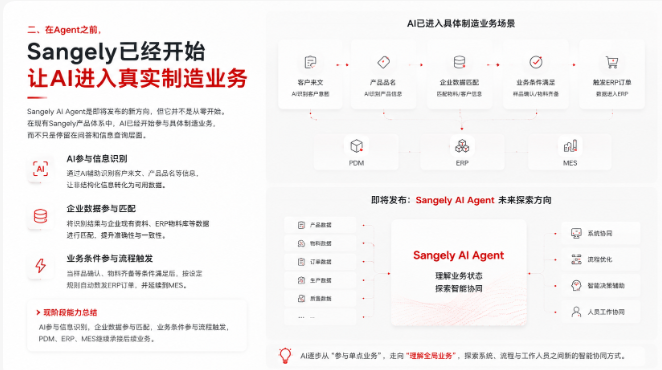
Sangely AI Agent is an upcoming direction, but it does not start from zero. AI already participates in specific manufacturing activities within the current Sangely product system rather than remaining limited to questions and information lookup.
For example, when customer information enters the company, Sangely can use AI-assisted recognition to interpret customer correspondence and bring relevant information into sample development. The system can also recognize customer product names and match them with records in the ERP material master. At a later stage, when predefined conditions such as sample approval and material readiness are satisfied, the system can trigger an ERP order and allow the related data to continue into MES.
This means Sangely has already established several important foundational capabilities: AI participates in information recognition, enterprise data participates in matching, business conditions participate in process triggering, and PDM, ERP and MES carry the work forward.
Compared with simply asking a question and receiving an answer, AI is beginning to connect with real product information, material data and business processes. This matters because valuable manufacturing AI is not another chat entry point; it gradually becomes part of the work that happens every day.
A clear distinction must nevertheless be maintained between these current capabilities and the upcoming Sangely AI Agent.
What exists today is AI assistance, data matching and condition-based triggering at specific business nodes. Sangely AI Agent will build on that manufacturing data and process foundation to explore deeper understanding of business status and new forms of intelligent collaboration among systems, processes and employees.
3. Why Does a Manufacturing Agent First Need PDM, ERP and MES?
When an AI Agent enters a manufacturing company, it does not face abstract questions. It faces specific business objects.
It needs to know which product is being handled, which order is related, how far the business process has progressed and what is happening on the shop floor.
This is an important difference between a manufacturing agent and general office AI.
For Sangely, the PDM, ERP and MES foundations built over time provide three essential forms of manufacturing context.
Sangely.PDM provides product context.
Product information, BOMs, BORs and the development process give the system a basis for understanding which product is being handled.
Sangely ERP provides order and resource context.
Orders, materials, resources and plans allow the system to understand how the company is organizing manufacturing.
Sangely MES provides production-execution context.
Production tasks, operation execution and shop-floor feedback allow the system to understand what happens after a plan enters the workshop.
Connecting an Agent to a large language model does not automatically give it an understanding of these manufacturing relationships.
Without formal product, order, process and production status, AI may understand language but still struggle to understand what is actually happening in a factory.
The foundation for Sangely’s move toward AI Agent is therefore not an isolated new AI module. It is the manufacturing data and business processes that Sangely has already built over time.
4. Why Is Sangely Moving Further Toward AI Agent Now?
As agents become an important direction in AI, more companies are asking whether AI can complete work independently.
Sangely is not moving toward agents merely because AI Agent has become a new technology trend.
Before agents, Sangely had already been working on something else:
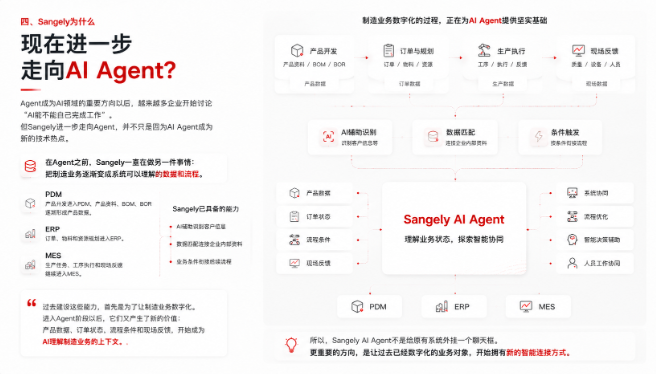
Turning manufacturing activities into data and processes that systems can understand.
Product development enters PDM, where product information, BOMs and BORs become structured product data. Orders, materials and resource planning enter ERP. Production tasks, operation execution and shop-floor feedback continue into MES.
At the same time, Sangely has begun using AI to assist with customer-information recognition, connect enterprise records through data matching and link subsequent processes through predefined business conditions.
These capabilities were initially built to digitalize manufacturing work.
In the Agent stage, they gain additional value:
Product data, order status, process conditions and shop-floor feedback become context through which AI can understand manufacturing operations.
Sangely AI Agent is therefore not a chat box attached to an existing system.
The more important direction is:
Enable business objects that have already been digitalized to connect in new and more intelligent ways.
5. From People Searching Systems to Systems Proactively Connecting with People at Work
Traditional manufacturing software generally requires employees to enter the system proactively.
They open a page, review tasks, search for information, judge the current status and then decide what to do next.
Sangely has already begun exploring a different relationship.
Sangely.PDM previously established a dual-channel messaging mechanism through its in-application assistant and WeCom, allowing system events to reach employees through the software interface or WeCom according to different work scenarios.
Business information in the system is beginning to move away from waiting for an employee to open a page and search for it
and toward business events proactively reaching the relevant employees.
AI Agent is a further exploration of this interaction model.
Sangely AI Agent is exploring how AI can combine manufacturing context to understand which business event has occurred, which product, order or task it relates to, what state the business is in, and which process or employee may need to be connected next.
These are directions the AI Agent is preparing to explore. They do not mean that every business activity will be executed autonomously by AI.
Manufacturing contains substantial professional judgment, exceptional conditions and boundaries of responsibility. An Agent that enters real operations must work within explicit data, rules, permissions and human accountability.
When a business process can continue under predefined conditions, systems and AI can help connect it. When professional judgment is required, the responsible employee still confirms the decision.
6. Are PDM, ERP and MES Still Important with an AI Agent?
Yes.
The more deeply an Agent participates in manufacturing, the more it needs these systems to provide trusted data, business objects and status.
Without PDM, the Agent would struggle to know which product is being handled and which BOM and process information are authoritative.
Without formal ERP business data, it would struggle to understand the relationships among orders, materials, resources and plans.
Without continuous production-execution data from MES, AI might see only an office plan rather than the actual state of the shop floor.
AI Agent therefore does not reduce the value of PDM, ERP and MES.
Instead, it can become a new intelligent collaboration entry point between people and these manufacturing systems.
In the past, employees had to enter different systems and find information themselves.
A direction worth exploring is enabling the Agent, within its authorization, to understand these business objects and states and help reduce repeated queries, information organization and manual process handoffs.
Manufacturing systems carry the real business, AI assists understanding and connection, and people make the critical decisions.
These roles do not replace one another. They form a new collaboration model.
7. What Will Sangely AI Agent Explore?
A manufacturing agent will not move directly to a highly autonomous state. A more practical path is to begin with business activities the enterprise has already digitalized and progressively understand manufacturing data and business status.
Sangely AI Agent will explore how AI can understand not only a sentence entered by an employee, but also the business scenario in which it occurs by combining that sentence with Sangely’s manufacturing data. This includes which product, order or task it concerns, what state the business has reached, which conditions still require confirmation, and which system or employee may need to be connected next.
This differs clearly from conventional question-and-answer AI. General AI focuses on how a question should be answered; a manufacturing agent must also understand what the matter means within the company’s operating processes.
Sangely AI Agent is therefore not intended to work independently of operational systems. It is being built on real manufacturing activities in PDM, ERP and MES. Within explicit data, rules, permissions and responsibility boundaries, AI can help employees understand business status, reduce repeated queries and information organization, and explore more natural collaboration among business stages.
As these capabilities develop, systems may take on more of the routine work currently spent checking status, finding information, repeating confirmations and coordinating notifications. Employees can then spend more time on professional judgment, exception handling and decisions that genuinely require experience.
It is important to emphasize that these are capabilities Sangely AI Agent is preparing to explore and release; they are not all available today. Current Sangely capabilities include AI-assisted recognition, enterprise-data matching and process triggering under specific business conditions. AI Agent will build on these foundations to explore business-status understanding and intelligent collaboration.
The objective of Sangely AI Agent is therefore not to have AI replace people in every task, but to:
Move AI from understanding an isolated question toward understanding the manufacturing activity in which that question occurs.
8. From “Someone Remembers to Push It Forward” to “The System Knows the Status”
Many manufacturing processes have traditionally operated through a very simple mechanism:
Someone remembers what should happen next.
The business team remembers to notify engineering, engineering remembers to confirm the information, relevant employees remember to check materials, and after the conditions are met, someone continues to move the order and production forward.
This approach is highly flexible and has supported manufacturing operations for many years.
But as the number of products, orders, employees and factories grows, the amount that people must remember and coordinate also increases.
Once product data, order status, business rules and production feedback enter the system, manufacturers gain another possibility:
The system knows the business status, AI assists understanding and connection, and people make the critical decisions.
This is the manufacturing collaboration model Sangely AI Agent is preparing to explore further.
Sangely AI Agent Is Coming
From customer requirements to product development, from product data to order and resource planning, and from ERP plans to MES production execution, Sangely has continued to build the data and process foundations needed to operate manufacturing businesses.
The next step is to build AI on these foundations.
The first step is not to add another AI chat entry point beside PDM, ERP and MES.
It is to enable AI to recognize the company’s products, orders, business status and manufacturing operations.
Move manufacturing away from dependence on “someone remembering what happens next”
and gradually toward a model in which the system knows the business status, AI assists understanding and connection, and people make the critical decisions.
Sangely AI Agent is coming.
AI that understands not only the question, but increasingly the manufacturing business behind it.
FAQ
Q1. How Is Sangely AI Agent Different from a Conventional AI Assistant?
A conventional AI assistant generally focuses on questions, information lookup and content generation. Sangely AI Agent will be built on the PDM, ERP and MES data and business status already present in manufacturing companies, enabling AI to participate further in information understanding, business-status recognition and process collaboration.
Q2. Which AI Capabilities Does Sangely Already Have?
Current Sangely AI and workflow capabilities are used in scenarios including customer-correspondence recognition and matching customer product names with the ERP material master. After predefined conditions such as sample approval and material readiness are satisfied, the system can also trigger an ERP order and allow the related data to continue into MES.
These are business foundations already available today and must be distinguished from the upcoming AI Agent capabilities.
Q3. Will Sangely AI Agent Automatically Complete Every Manufacturing Process?
No. Manufacturing involves professional judgment, exception handling, permissions and clear responsibility boundaries. Sangely AI Agent is intended to assist understanding and process connections within enterprise data, rules and permissions, while activities requiring professional judgment remain with the responsible personnel.
Q4. Will Companies Still Need PDM, ERP and MES after Adopting AI Agent?
Yes. PDM, ERP and MES contain the company’s real product, order, resource and production-execution data. The more deeply an Agent participates in manufacturing, the more it needs trusted business objects and status from these systems. AI Agent is better positioned as a new intelligent collaboration entry point between people and manufacturing systems, not as a replacement for those systems.
Q5. Has Sangely AI Agent Been Officially Released?
Sangely AI Agent is currently in a pre-release stage. Capabilities already available include customer-correspondence recognition, product-name matching and ERP-to-MES process connections under specific conditions. Business-status understanding and cross-system intelligent collaboration are directions for further exploration and upcoming release.