
Many manufacturers now possess increasing volumes of production data. Orders are recorded, operations generate data, MES shows production progress, and the shop floor continuously submits work reports.
Yet when management needs to assess production efficiency, a basic question often remains:
What evidence tells us whether the current work is fast or slow?
An employee completes 100 units today, which appears productive—but for this product, operation and manufacturing condition, how many units should normally be completed? A production line produces more today than yesterday, but did efficiency improve, or was today’s product simply easier to make? One operation remains busy all day, but is its workload genuinely high, or has it become a production bottleneck?
If the company has data showing only what actually happened but no reference for what should normally happen, even extensive shop-floor data is difficult to turn directly into an efficiency assessment.
This is the value of standard time.
Standard time is not merely a record of how long an employee worked, nor is it a fixed number of seconds assigned to an operation. It is a reusable time reference established for a specific production activity after the product, process and manufacturing conditions have been defined.
1. Why Can a Factory Have Production Data Yet Still Not Know Whether Efficiency Is High?
The shop floor generates large amounts of result data every day: how many units were completed, how long an operation took, when an order was completed and which line produced more.
This data answers the question:
What actually happened?
Efficiency management requires another layer of information—a standard.
Suppose two employees each complete 100 units. If the product structure, process difficulty and manufacturing conditions differ, quantity alone cannot show which employee was more efficient. Likewise, producing one additional batch today does not automatically mean that a line has become more efficient than it was yesterday.
A major reason traditional manufacturers depend heavily on line leaders, plant managers and experienced technicians is that these people carry a long-developed sense of what the standard should be.
They know approximately how long a style should take, what speed is normally achievable for an operation, which conditions are normal and which deserve attention.
Experience remains extremely important. But as product variety grows and personnel change, different managers may develop different judgments.
The goal is therefore not to eliminate experience, but to turn the parts of that experience that can be defined and verified into shared production standards.

2. What Is Standard Time?
Standard time and actual time are not the same thing.
Actual time records how long one production activity really took—for example, an operation took 20 minutes on this occasion.
Standard time establishes a time reference for that production activity after the product, process and relevant manufacturing conditions have been defined.
The two measures therefore answer different questions:
Actual time: How long did this activity take on this occasion?
Standard time: Under the relevant manufacturing conditions, what time should be used as the reference for this work?
With this relationship in place, production data begins to have comparative meaning.
Managers can look beyond how much was produced today. They can compare actual execution with the standard, identify operations that consistently differ from the reference and determine which areas deserve further analysis.
Standard time therefore adds more than another time field to a system.
It gives the company a measuring scale for judging production status.
3. Why Can Standard Time Not Be Just a Fixed Number of Seconds?
Assigning one fixed time to every operation can easily ignore the complexity of real manufacturing.
The same named operation may have different manufacturing requirements for different products, materials, equipment and processing conditions. This is especially true in frequently changing industries such as bags, handbags, footwear and apparel, where one process name can involve different materials, processing lengths and production conditions.
An effective standard time therefore cannot exist separately from the product and process.
The key is not to make the calculation increasingly complicated, but to answer a practical question:
To which product, process and manufacturing conditions does this time standard belong?
Sangely does not define standard time by simply declaring that an operation always takes a fixed number of seconds. It places the time reference back into the specific manufacturing process and establishes its relationship with the product, process and relevant manufacturing conditions.
A standard established in this way is better suited to support subsequent planning, execution and efficiency analysis.
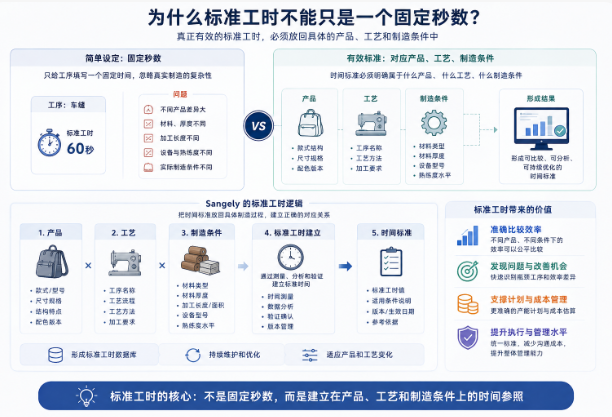
4. How Does Sangely Connect Standard Time with Products, BORs and Manufacturing Conditions?
Before a manufacturer can establish standard time, it must first understand how the product is made.
Within Sangely’s product-data architecture, product information develops into manufacturing foundations such as the BOM and BOR. The BOM describes what the product requires, while the Bill of Resources (BOR) describes the operations and manufacturing process through which the product is made.
Standard time is therefore no longer a separate time sheet detached from the product. It can be understood within a specific process relationship.
The overall logic can be summarized as:
Product Data → BOM / BOR → Manufacturing Conditions → Standard Time → Production Execution
As the product operations, materials, equipment and processing conditions become clearer, the corresponding time reference gains a more specific manufacturing context.
This is one reason Sangely emphasizes the BOR.
A company needs to know not only which operations a product passes through, but also to retain the manufacturing standards related to those operations. Product design and process definitions can then continue into manufacturing data that can be planned, executed and compared.
Standard time is therefore not an isolated function.
Its true value lies in the manufacturing relationship among how the product is made, how the plan is scheduled and how the shop floor executes the work.
5. What Changes in Production Planning and Shop-Floor Management When a Standard Exists?
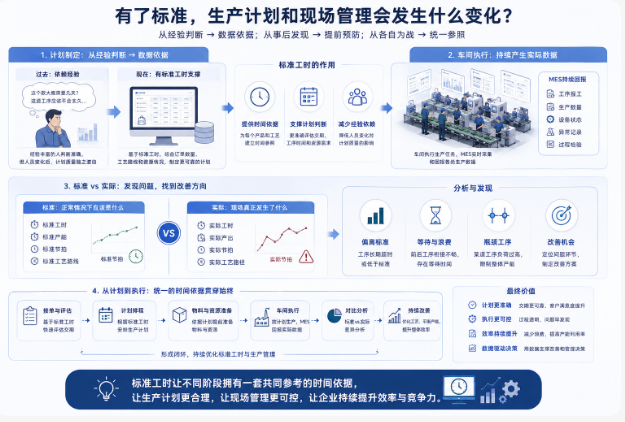
Standard time first provides a time basis.
When planning an order in the past, a planner might rely on experience and estimate that a style should take several days or that a particular operation should not take very long.
An experienced planner can make good judgments. But if production planning depends mainly on one person’s experience, planning quality can change when that person changes.
Once specific products and operations have corresponding time standards, order quantity, process routing and resource allocation gain an additional data reference.
Standard time can therefore support production rhythm, resource allocation and planning decisions.
After work reaches the shop floor, MES continuously generates actual production data.
The company then has two categories of information:
The standard shows what should normally happen, while actual data shows what is really happening on the shop floor.
By comparing the two, managers can more readily identify operations that consistently deviate from the standard, positions where waiting or bottlenecks may exist, and areas that deserve further analysis.
From planning through execution, standard time gives different stages a shared time reference.
6. Standard Time Is Not Intended Simply to Make Employees Work Faster
This is one of the most common misunderstandings about standard time.
If a company treats standard time only as a performance-assessment number and concludes that an employee is slow whenever actual time exceeds the standard, it reduces the value of standard time.
A difference between actual and standard time does not necessarily originate with the employee.
Changes in materials, process design, equipment conditions, production organization, handoffs between preceding and subsequent operations, and shop-floor exceptions can all affect actual execution.
Management should therefore focus not only on the question:
“Why did this employee fail to meet the standard?”
It should first ask:
“Why did actual production differ from the standard?”
Standard time provides the reference, while shop-floor data shows the actual result. Management can then analyze the causes and determine whether the difference comes from operator proficiency, the process, materials, equipment or production organization.
The true purpose of standard time is therefore production management and continuous improvement—not simply a pursuit of ever-higher speed.
The standard is not the endpoint.
It is the starting point for discovering differences.
7. Turning Experienced-Technician Knowledge into the Company’s Own Manufacturing Standards
One of a manufacturer’s most valuable capabilities is the practical experience accumulated over many years.
Experienced technicians know how long an operation should normally take. Engineers know how different materials and processes should be handled. Production supervisors know which operating rhythm is normal.
This experience cannot simply be replaced.
The real question is whether the company can retain the parts of that experience that can be defined, recorded and verified.
Standard time provides one way to do so.
In the past, experienced technicians judged production rhythm from experience. As products, BORs, manufacturing conditions and standard times progressively enter the system, that experience gains a data foundation that can be recorded, compared and continuously adjusted.
New employees no longer have to discover everything from the beginning. When managers change, production judgment does not have to be rebuilt completely. Different products and operations also gain a more consistent analytical foundation.
This is the real meaning of moving manufacturing from experience-based management to data-driven management.
It does not mean eliminating experience.
It means:
Ensuring that valuable experience does not belong to only one person.
Why Do These Standards Become Even More Important in the AI Era?
AI can help companies analyze increasing volumes of manufacturing data. But if the company itself does not know which state is normal, the system sees only a large collection of actual records without a stable basis for comparison.
When product data, process data, standard time and actual shop-floor data become connected, future efficiency analysis and intelligent applications gain a clearer manufacturing context.
AI therefore does not make manufacturing standards less important.
The more a company wants to identify problems within large volumes of production data, the more it first needs to know:
What standard makes the data comparable?
Conclusion: True Data Management Begins with Knowing Where the Standard Is
Manufacturers today do not lack data.
Orders generate data, production generates data, MES continuously records the shop floor, and equipment and employees create new information every day.
Without standards, however, this data can usually tell the company only:
What happened.
Standard time helps the company answer another question:
What should normally have happened?
This is why Sangely does not define standard time as assigning a fixed number of seconds to an operation.
It must return to the specific product, process and manufacturing conditions and establish relationships with the BOM, BOR and subsequent production execution.
When standard and actual data can be compared, production management can move from sensing whether today felt fast or slow to knowing where the difference occurred. Production planning can also add a usable time reference instead of relying mainly on individual experience.
In the past, experienced technicians knew how long normal work should take.
Sangely’s objective is to turn that manufacturing experience into standards the enterprise can continue to use, compare and improve.
Retain the experience, and give production efficiency a measurable basis.
FAQ
Q1. How Is Sangely Standard Time Different from Ordinary Work-Time Recording?
Ordinary work reporting mainly records actual results, such as how long an operation really took. Sangely Standard Time asks which time should serve as the reference for that work under the corresponding product, process and manufacturing conditions.
Sangely therefore does not merely add a time field. It establishes a relationship between the standard and the actual result. The company can see what happened on the shop floor and assess how actual production differs from the reference.
Q2. Does Sangely Standard Time Assign One Fixed Number of Seconds to Every Operation?
No. It does not simply assign one fixed time to an operation.
When the same operation is performed for different products, materials, equipment and processing conditions, its manufacturing conditions may change. Sangely places standard time within the specific product and process and establishes the time reference according to the relevant manufacturing conditions.
A standard is not a number detached from the product. It should correspond to real manufacturing conditions.
Q3. Why Does Sangely Connect the BOR with Standard Time?
Within Sangely’s manufacturing-data architecture, the BOM answers what the product consists of, while the BOR describes how the product should be manufactured.
Once the manufacturing operations and routing of a product have been defined, standard time has a clear process foundation. The company’s understanding of the product can then progress from:
Required Materials → Manufacturing Method → Corresponding Time Standard
and continue into subsequent manufacturing activities.
The BOR is therefore more than a process routing. It can also carry manufacturing data such as standard time, operation rates and standard operating procedures, allowing product and process knowledge to become reusable enterprise standards.
Q4. How Does Sangely Standard Time Support Production Planning and Shop-Floor Management?
Production planning needs more than order quantity. It must consider how much time different operations require, how production rhythm should be arranged and how resources should be allocated.
Sangely connects standard time with product and process data to provide a time basis for production planning and resource allocation. After work enters the shop floor, the standard can be compared with actual MES execution data—what the standard should be versus what actually occurred.
Standard time therefore supports both planning and shop-floor analysis, giving production management a data basis in addition to experience-based judgment.
Q5. Why Is Standard Time Valuable for Manufacturing AI?
AI also needs manufacturing context and a basis for comparison when analyzing shop-floor data. When product data, process data, standard time and actual execution data are connected, they provide a clearer data foundation for future intelligent analysis.