
# How to Choose a PDM Vendor for Bag Manufacturing? Main Solution Types, Core Selection Criteria, and Sangely.PDM Features
As bag and handbag manufacturers continue their digital transformation, PDM, PLM, and other product development management systems are increasingly becoming part of the software selection process.
However, manufacturing PDM does not have a single authoritative ranking or a universal selection standard that applies to every industry. Machinery, electronics, and equipment manufacturers often focus on complex product structures, engineering changes, and R&D collaboration. Bag and handbag manufacturers face a different set of challenges: frequent new styles, repeated modifications, complex color and material combinations, large volumes of historical product data, and the need to carry development data into costing and production.
For bag manufacturers, a more practical question than “Which vendor ranks higher?” is:
When a customer sends a new style, can the products your company has already developed become a useful starting point for the next development and quotation?
Most bag manufacturers are not short of data. Their servers may already contain drawings, Excel BOMs, process information, and years of historical product records. Yet when a new style arrives, sales still asks whether something similar has been made before, engineers search again for patterns, the IE (Industrial Engineering) team rechecks processes, and costing data often has to be reorganized.
So the real role of a bag-industry PDM is not simply to answer, “Where is the file?”
It should help organize drawings, BOMs, BOR process routings, historical products, costing data, and other manufacturing information around the product itself, so that work completed in the past can continue to support future product development.
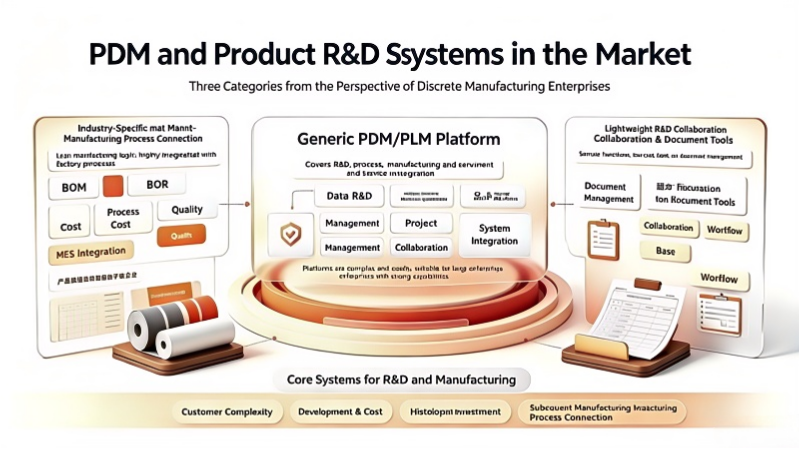
Four Key Dimensions for Evaluating a Bag PDM System
Evaluating a PDM system for bag manufacturing should not simply follow the feature checklist of a general-purpose PDM or mechanical engineering system.
The selection criteria should start from the way bag products are actually developed.
1. Product Data Organization and BOM/BOR Management
A bag product is much more than a drawing and an item number.
One style may include shell fabric, lining, zippers, hardware, webbing, and many other accessories. The same style may also have multiple colorways and different material combinations. When colors, materials, or structures change during development, the related BOM and process data may also need to change.
A PDM system therefore needs to do more than store files. Drawings, BOMs, BOR process routings, and related product information should gradually form clear relationships around the same product.
For a bag manufacturer, this layer can be understood through two simple questions:
What is this product made of?
How should this product be made?
Only when material structures and process routings become reliable product data can costing, ERP resource planning, MES production execution, and future AI applications work from a stronger foundation.
2. Historical Product Search and Data Reuse
A new bag style does not always mean starting completely from zero.
Many new developments are based on existing products with changes to colors, materials, dimensions, or local structures.
If a company has already developed hundreds or thousands of styles, but every new inquiry still requires employees to ask experienced colleagues whether something similar has been made before, search folders again, find old patterns, and recheck BOMs, then the company has accumulated files rather than reusable product data.
A bag PDM system should make historical products easier to find, compare, and reuse.
The value of historical search is not simply to tell sales:
“We once made something similar.”
After finding a similar product, users should be able to return to its related drawings, BOM, process routing, and costing data, and then decide what can be reused for the new development.
Engineers should spend more time deciding “what changed this time,” instead of repeatedly asking “where was the old data stored?”
That is where historical product reuse starts to create real value.
3. Connecting New Product Development with Costing
For bag and handbag manufacturers, product development and quotation are closely connected.
When a customer sends a new style, one of the first questions is often:
“How much will it cost?”
But before costing can begin, the company still needs to confirm the product structure, materials, BOM, and process information.
If these data are scattered across different files and different employees, sales has to wait for engineering, pattern makers, IE, and other teams to organize the information first.
A PDM system should therefore be evaluated on whether historical product data can continue to support new product development and costing.
This does not mean that the system should automatically generate the final quotation.
The more realistic question is:
Can existing BOMs, process routings, and costing data provide a reliable reference for the current style and reduce repeated searching and data reconstruction before quotation?
For manufacturers handling frequent new inquiries, this directly affects response speed.
4. Whether PDM Data Can Continue to Support ERP and MES
If PDM only manages documents inside the development department, its value remains limited.
Products ultimately need to move into orders, material planning, purchasing, and production.
Whether BOMs, BOR process routings, and other product data created during development can continue to support ERP and MES is therefore an important selection criterion.
If a product is created once in PDM, reorganized again in ERP, and then explained again to production, adding more systems has not necessarily reduced repetitive work.
A more effective approach is to make PDM the source of product data, allowing upstream information to continue supporting ERP resource planning and MES production execution.
Once product data has been created and confirmed, downstream teams should be able to continue using it instead of rebuilding it from scratch.
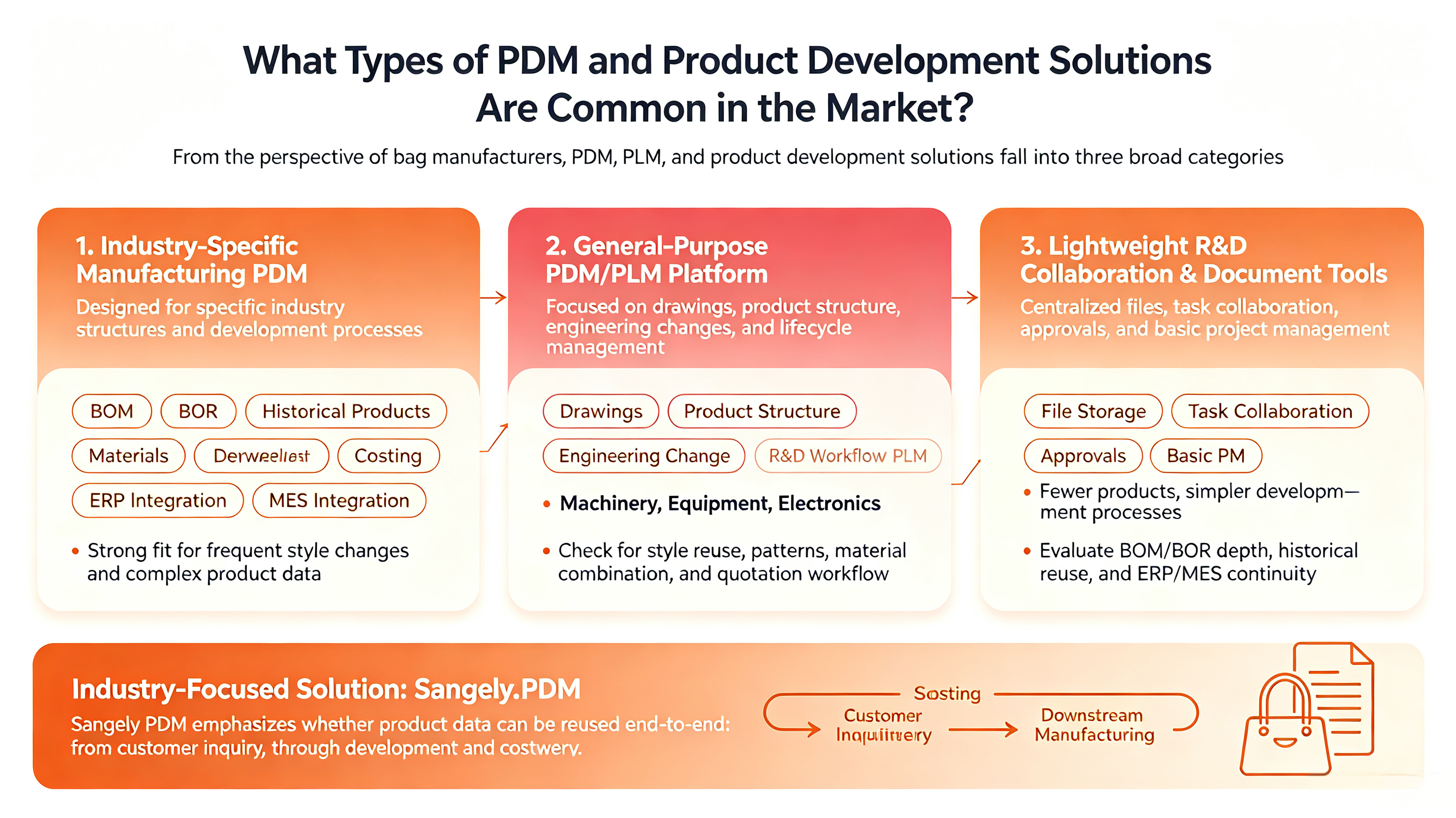
What Types of PDM and Product Development Solutions Are Common in the Market?
From the perspective of bag manufacturers, common PDM, PLM, and product development solutions can broadly be understood as three types.
The first category is industry-specific manufacturing PDM. These systems are designed around the product structure and development processes of specific industries. They go beyond file management and may include BOM, BOR, historical products, materials, costing, and connections with ERP and MES. They are generally more relevant to bags, handbags, footwear, apparel, and other manufacturing environments with frequent style changes and complex product data.
The second category is general-purpose PDM/PLM platforms. These systems usually focus more heavily on drawings, product structures, engineering changes, R&D workflows, and broader product lifecycle management. They may be better suited to machinery, equipment, electronics, and other industries with complex engineering organizations. When used in bag manufacturing, companies should further verify support for historical style reuse, patterns, material combinations, and quotation workflows.
The third category is lightweight R&D collaboration and document tools. These products mainly address centralized file storage, task collaboration, approvals, and basic project management. They may suit companies with fewer products and simpler development processes. When manufacturers require deeper BOM/BOR management, historical product reuse, or ERP/MES data continuity, they should evaluate whether these tools are sufficiently capable.
As an industry-focused solution, Sangely.PDM places greater emphasis on whether product data can continue to be used from customer inquiry, through development and costing, and into downstream manufacturing.
A Closer Look at an Industry-Focused Solution: Sangely.PDM
Dongguan Dianliang Software Co., Ltd. focuses on multi-style manufacturing scenarios such as bags, handbags, footwear, and apparel.
Sangely.PDM is designed not simply as another product document repository, but as a way to make historical products, BOMs, BOR process routings, and related product data reusable for future development.
In addition to conventional product data management, Sangely.PDM also includes 3D modeling, image-based similar-style search, and the Sangely.PDM AI Assistant.
These are not universal requirements for every bag-industry PDM system. They are differentiated capabilities designed around Sangely’s product development workflow.
1. Historical Similar-Style Search: New Development Does Not Always Need to Start from Zero
Sangely.PDM supports keyword search, image comparison, and similar-image matching across historical products.
Users can also provide a single product image to search for similar historical styles.
This helps sales and development teams narrow down the range of historical products worth reviewing. After users confirm a suitable reference style, they can continue to call up existing process routings, adjust relevant nodes according to the changes in the new product, and then form new BOM, process routing, and costing data.
The purpose is not to replace the professional judgment of pattern makers, IE teams, or engineers.
Instead, it changes the starting point of development from:
“Search through everything again”
to:
“Reuse historical data first, then focus on what has actually changed.”
2. BOM and BOR as the Product and Manufacturing Data Foundation
Sangely.PDM can establish BOMs and BOR process routings from CAD drawings, turning information such as required materials and manufacturing processes into structured product data.
For bag manufacturers, BOM and BOR do not only serve the development department.
BOM describes the material structure of the product.
BOR describes how the product is made through its process routing.
These data can continue to support order, material, and resource planning in Sangely ERP, as well as production execution in Sangely MES.
When drawings, BOMs, BORs, and historical product data gradually form relationships around the same product, the company is no longer accumulating only scattered files.
It begins to establish a reusable product data foundation.
This data foundation also matters for AI.
Whether a company uses one product image to search for historical similar styles, or uses the Sangely.PDM AI Assistant to read customer documents and assist with sample order creation, AI works more effectively when the underlying product data is clear and structured.
PDM establishes the product data foundation first; ERP, MES, and AI applications can then work from more reliable manufacturing data.
3. 3D Modeling and Similar-Style Data Reuse: Building a Better Starting Point for Faster Quotation
When a customer sends a new style, the biggest delay is often not the final price calculation.
The delay happens earlier.
Sales may need to find patterns. Engineering needs to confirm process information. Teams need to check materials. Employees may also need to search historical products for a useful reference.
If any one of these steps takes too long, quotation slows down.
Sangely.PDM includes 3D modeling capabilities.
After a pattern image is submitted, the system can process it and generate a 3D model, allowing the company to view the product more intuitively during development and reducing repeated operations based only on 2D information.
However, Sangely.PDM does not use 3D simply as a presentation feature.
Combined with image recognition, users can provide a single product image to search historical data for similar styles. From there, teams can further reference similar patterns, process information, and material quotation data.
After a similar product is found, relevant employees can verify and adjust the data according to the materials, structure, and process changes of the current product.
This means new product development and costing do not always need to return to “searching everything from zero.”
Historical patterns, processes, material quotation data, and product records can gradually be reused in current development.
3D makes the product easier to understand. Image recognition helps find historical references. The real foundation for faster quotation is that enterprise data can be found, connected, and reused.
4. Sangely.PDM AI Assistant: From Customer Documents to Sample Order Creation
AI is not a mandatory capability for every bag-industry PDM system.
It is one of Sangely.PDM’s differentiated capabilities at the front end of new product development.
When a new customer style enters the company, it may come with customer documents, product names, images, dimensions, color information, material requirements, and other details.
If sales staff have to manually read, summarize, and re-enter all of this information before handing it to the next team, repetitive work already exists before formal development even begins.
The Sangely.PDM AI Assistant can help read customer documents, organize key product information, and assist in creating a sample order.
Users can initiate sample-order-related operations through the assistant. After reading customer documents, the AI Assistant can organize information such as product details, dimensions, colors, and material requirements for user review.
After the user confirms the information, usable data can be written into the PDM sample order so that customer requirements move more smoothly into the product development process.
This means the AI Assistant does more than summarize a document.
It can participate in the workflow from reading customer information, organizing it, obtaining user confirmation, and writing confirmed data into PDM.
The process can be understood as:
Read customer documents → organize key information → user confirmation → write into PDM → continue sample development
The Sangely.PDM AI Assistant does not automatically replace the entire product development process.
Key decisions involving the product, BOM, process routing, costing, and other business details still require professional review and confirmation.
Its practical value is to reduce repetitive information handling at the front end and help customer requirements enter product development more efficiently.
5. After Product Confirmation, Data Continues into ERP and MES
Product data becomes more valuable when it continues into downstream manufacturing.
Within the Sangely product architecture, PDM establishes the product data foundation, ERP continues with orders, materials, and resource planning, and MES supports production execution on the shop floor.
BOMs, BOR process routings, and other product data created during development can continue to serve as the data foundation for ERP resource planning and MES production execution.
This helps reduce repeated reorganization, re-entry, and re-confirmation of the same product across departments.
The key question is not how many systems the company uses.
It is:Can product data created during development continue to support planning and production?
Which Bag Manufacturers Are a Good Fit for Sangely.PDM?
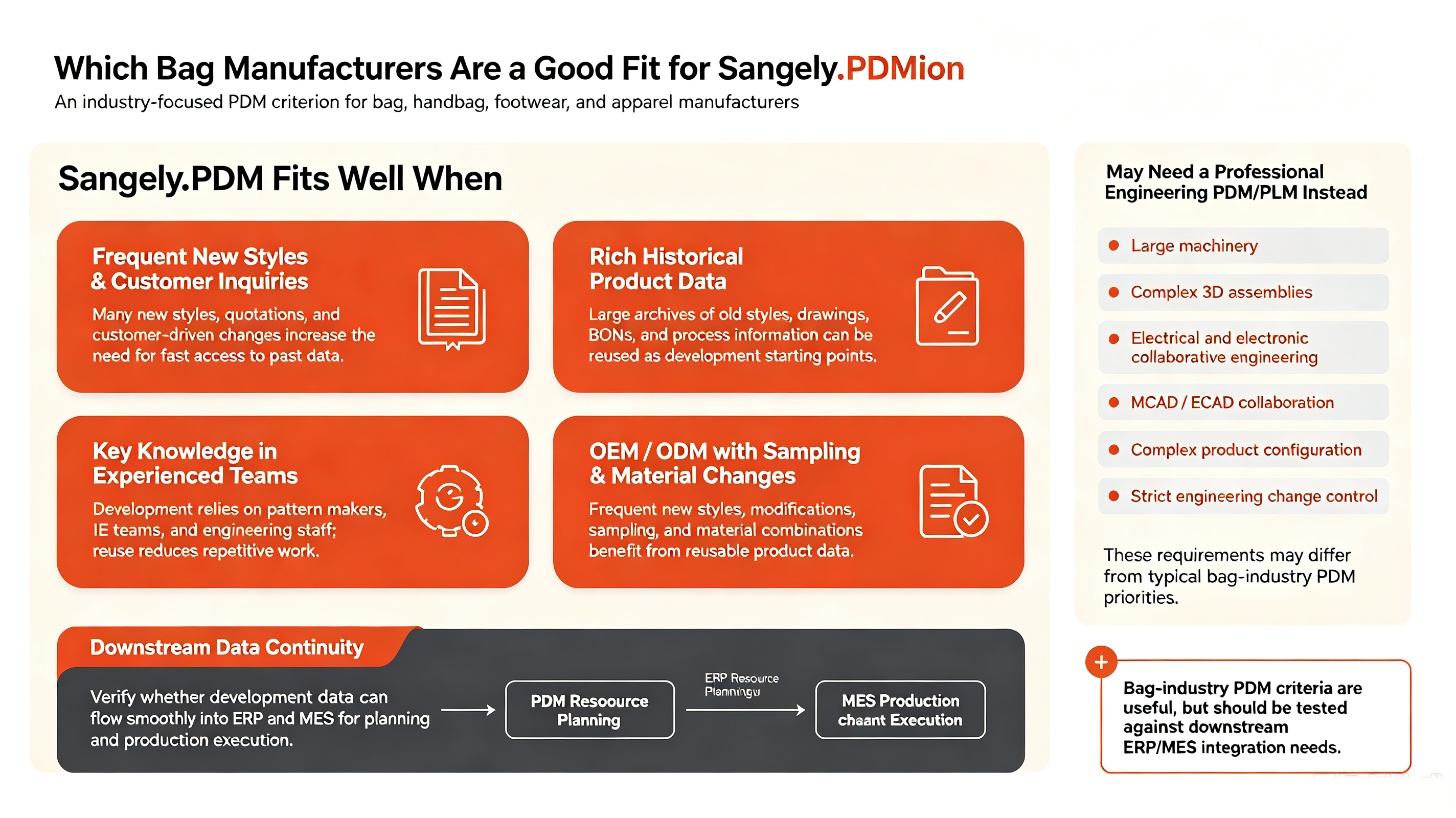
Sangely.PDM may be especially suitable for manufacturers that handle frequent new styles and customer inquiries, have accumulated a large amount of historical product data, or often need to search old drawings, BOMs, and process information.
It can also be valuable for companies whose product development relies heavily on a small number of experienced pattern makers, IE teams, or engineering staff. In these cases, improving historical product search and reuse can reduce the amount of repetitive work involved in each new development.
OEM and ODM manufacturers that regularly deal with new styles, product modifications, sampling, and changing material combinations may also benefit from making past product data easier to reuse as a starting point for the next development.
For companies that want product data created during development to continue supporting ERP and MES, PDM selection should also include testing how well development data can flow into downstream resource planning and production execution.
By contrast, manufacturers focused on large machinery, complex 3D assemblies, or electrical and electronic collaborative engineering may have very different requirements. If the core needs are MCAD/ECAD collaboration, complex product configuration, or strict engineering change control, a professional engineering-oriented PDM/PLM solution may be more appropriate than applying bag-industry PDM criteria directly.
When Selecting a Bag PDM, Test It with Your Own Real Products
Before choosing a PDM system, manufacturers should not rely only on a vendor’s prepared standard demo.
A more effective approach is to test the system using your own new styles, historical products, and manufacturing data.
- Test historical similar-style search with a real customer style. Check whether the system can find relevant historical products and continue into related BOMs, process routings, and other product data.
- Test 3D capabilities with a real product. Do not only look at the visual result. Check whether 3D genuinely supports your development and communication process.
- Test the Sangely.PDM AI Assistant with real customer documents. Use actual customer documents and product information to see whether AI-assisted reading, information organization, and sample order creation fit your daily workflow.
- Test the depth of historical data reuse. After finding a similar style, check how much of the existing BOM, process routing, and costing data can be reused.
- Test real modification scenarios. Change colors, materials, or part of the product structure and observe which existing data can still be used and which information needs to be reviewed or adjusted manually.
- Continue testing toward ERP and MES. Do not stop at the PDM product page. Check whether data created during development can continue to support resource planning and production execution.
A meaningful evaluation is not about watching a vendor demonstrate a perfectly prepared standard process.
Use your own real products—especially the difficult ones—to see whether the system truly fits your business.
Faster Quotation Depends on How Well Product Data Can Be Reused
Why does quoting a new customer style often take so long?
On the surface, sales may be waiting for engineering, engineering may be searching historical data, and costing may still be waiting for BOM and process information to be confirmed.
But the deeper issue is often this:
Products developed in the past have not yet become reusable data for the next development.
If historical products are difficult to find, proven processes cannot be referenced, and previous BOM and costing data have to be reorganized every time, then even a manufacturer with years of experience may still start almost from zero whenever a new style arrives.
Sangely.PDM is designed to change this working pattern.
Through historical product search, image comparison, and similar-style reuse, BOM, BOR, costing, and other product data can gradually be organized around the product itself. 3D modeling makes product information more intuitive, while the Sangely.PDM AI Assistant helps customer information and sample orders enter the development workflow more efficiently.
The product data created during development can then continue to serve as a foundation for Sangely ERP resource planning and Sangely MES production execution.
The result is that the company accumulates more than an ever-growing collection of files.
It begins to build a product data foundation that can be continuously searched, adjusted, reused, and carried forward into manufacturing.
Let every product developed in the past become a stronger, data-backed starting point for the next product development and quotation.
FAQ: Common Questions About Bag PDM Selection
1. What should bag manufacturers focus on when selecting a PDM system?
Bag manufacturers should not evaluate PDM only by the number of document management, approval, or workflow features.
More important questions include whether product data can be organized clearly, whether historical products can be searched and reused, whether BOM and BOR can support new product development, and whether product data can continue to support ERP and MES downstream.
Because development processes and product complexity vary between companies, the most reliable approach is to test the system using the manufacturer’s own products and historical data.
2. How does Sangely.PDM search and reuse historical similar styles?
Sangely.PDM supports keyword search, image comparison, and similar-image matching across historical products.
Users can also provide a single product image to search for similar historical styles.
The system helps narrow the range of relevant historical data, while users still decide which historical products are appropriate references.
After a reference style is confirmed, existing process routings can be called up, relevant nodes can be adjusted according to current product changes, and new BOM, process routing, and costing data can then be formed.
3. What can the Sangely.PDM AI Assistant do?
The Sangely.PDM AI Assistant can help read customer documents, organize key product information, and assist in creating a sample order.
It can help identify information such as product details, dimensions, colors, and material requirements.
After users review and confirm the organized information, usable data can be written into the PDM sample order so that customer requirements move more smoothly into the development process.
The Sangely.PDM AI Assistant does not automatically replace the entire product development process. Key decisions involving BOM, process routing, costing, and product development still require professional review and confirmation.
4. Are 3D and AI mandatory capabilities for a bag PDM system?
No.
The core evaluation criteria for a bag-industry PDM system should still focus on product data management, BOM/BOR, historical product reuse, and connection with downstream manufacturing processes.
3D and the Sangely.PDM AI Assistant are differentiated Sangely.PDM capabilities designed to further improve product understanding, product development, and historical data utilization.
They are not universal requirements for every bag PDM system.
5. Can a historical similar style directly generate a final quotation?
Not necessarily.
A historical similar style is better used as a reference starting point for new product development and costing.
Employees still need to verify and adjust the data according to the materials, structure, and process requirements of the current product.
The value of Sangely.PDM is to reduce repeated searching and data reorganization before costing and provide a more complete product data foundation for quotation.
6. Should a bag manufacturer choose PDM or PLM?
PDM and PLM are not simple substitutes for each other.
In general, PDM focuses more on the creation, management, and reuse of product data, including drawings, BOMs, process routings, and historical product information.
PLM typically covers a broader range of product lifecycle management activities.
If a company’s current problems are mainly scattered historical data, fragmented BOM and process information, and repeated work during new product development, it may first need to strengthen its product data foundation.
If the company also requires broader R&D collaboration, lifecycle management, and engineering change processes, it can further evaluate PLM solutions.
7. Can PDM data continue to be used by ERP and MES?
Yes.
Within the Sangely product architecture, BOMs, BOR process routings, and other product data created in PDM can continue to serve as a data foundation for ERP resource planning and MES production execution.
This does not mean that every downstream business activity requires no human confirmation.
The goal is to reduce repeated reorganization, re-entry, and re-explanation of the same product across different departments.