
Many manufacturing companies already have production plans and workshop managers.
However, when real access is made, production remains highly dependent on experience.
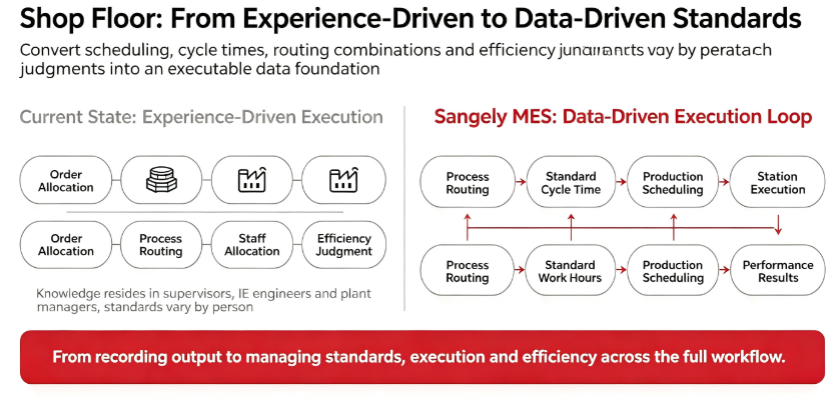
The question of which line an order should be assigned, how the process should be organized, how many people should be required for each post, how long a process should normally be carried out, and how the team leader would judge that it is not efficient today is often in the minds of IE, the team leader and the factory manager.
If standard time vary from one person to another, with experience-based maintenance of the process routings, and the production scheduling depends mainly on manual adjustments, and the efficiency of production is measured after completion, it is difficult for enterprises, even if they have systems, to really translate manufacturing experience into a stable data base.
Sangely MES is concerned with this part of the manufacturing execution problem.
It is not just a record of “how much has been done today”, but rather a desire to link the process routings, standard time, production scheduling, personnel, workstation execution and performance results gradually, moving the manufacturing site from relying on individual experience to clearer standards and data.
I. What Is MES?
MES, the manufacturing execution management system.
In the case of manufacturing companies, MES is actually faced with what happens when the production programme enters the workshop.
The process through which the product should go, the normal time required for a process, how different tasks should be assigned to production lines and personnel, and how efficiency, quality and performance data should be generated after the site is completed are part of the manufacturing execution management.
So MES is not just a "ERP program" post.
What it really needs to address is:
How manufacturing standards enter the field, how production tasks are organized, how personnel are carried out and how the results are recast.
If these relationships do not enter the system, the enterprise will still have to rely on IE, the team leader and the plant manager for ongoing interpretation and adjustment.
ii. Why is MES an issue for the boss?
MES appears to have taken place mainly in workshops, but ultimately it is up to the enterprise to see if it can really see the production capacity.
If standard time are set differently by IE, there is no uniform basis for comparison of efficiency data that the boss sees; if a single line is lined up and the process is entirely dependent on the experience of a team leader, then the original management capacity will be difficult to replicate; and if there are separate tables for quality, working hours and team performance, managers tend to see only sporadic results.
So it's not how many machines there are in the workshop that the boss really needs attention.
More important is whether enterprises have a relatively stable set of manufacturing standards and whether they can continue to be used for detour, production implementation and efficiency analysis.
The real management value of MES is to allow the production site to gradually move from “a person knows what to do” to “a business with sustainable manufacturing standards and implementation data”.
III. Why does Sangely MES place standard time in such an important position?
For manufacturing companies to judge production efficiency, a relatively credible time standard is needed first.
If working hours are primarily based on human experience and standards may differ from IE, from plant to plant, or even from time to time, it is difficult to base follow-up scheduling, performance and efficiency analysis on a uniform basis.
Sangely MES links standard time to working methods, processing conditions and process routings and does not simply interpret it as “a fixed number of seconds to be filled by a person”.
The system establishes a calculation logic for standard time on the basis of action studies, AB-value databases and standard formulas, so that the same method can have a relatively consistent time basis under the corresponding conditions. This approach is summarized in the information as the bottom logic of the “three rates” and is further used for process routings, standard hours and subsequent manufacturing.
It's really important, not just to calculate the hours.
Instead, it allows the business to start having a “manufacturing time rule” that can be used on a sustainable basis.
Without this standard, the on-site data can only tell the enterprise “how long this time it took”; when the standard is in place, the enterprise will have the opportunity to continue to judge whether “this result is normal”.
Why does the process routing need to be managed with standard time?
Standard working hours cannot be separated from the process.
What is done in a process, what is used, what is the length of the process, what equipment is used, these manufacturing conditions affect the time standard.
Sangely MES places the process routing and standard time in the same manufacturing relationship. When the product process is defined, the corresponding process trajectories, processes and time standards can continue to develop data relationships.
The information also shows the application of the DXF Pyramid, the process routing to the length and trajectory of the car and continues to be used in standard setting, computer car templates and associated equipment instructions.
This indicates that the value of the process routing is not simply that the worker is told “to do A before B”.
It also assumes the role of a vehicle of manufacturing standards.
The clearer the process routing, the more stable the basis is for standard time, detachments and on-site implementation.
Why can SOP not be just a job guide in a folder?
Many businesses have SOP.
The real question is whether workers can see directly when they need it and whether SOP is still consistent with current processes.
Sangely MES can generate SOP around established processes and standards and allow SOP to further enter the workshop. For some of the operational elements that need to be highlighted, video could also be used to provide staff with direct access to relevant operational information at the workplace.
Thus, SOP is no longer just a document kept by the engineering department.
It begins to really enter production implementation.
The value of this approach for newer training, critical process descriptions and field quality maintenance lies in the fact that process standards can be closer to where work actually takes place.
Only when the standard is actually available will it have the opportunity to become a daily standard at the production site.
Why do you have to continue to do automatic production scheduling when standard time are established?
With technical routes and standard time, enterprises begin to have an important basis for commuting.
Because what is really going to be done is not simply to divide the process between different people, but to consider the time of the process, the number of people involved, the equipment, the process combination and the overall balance of the production line.
Sangely MES further develops the automatic detour capacity on the basis of standard time and supports IE ' s pre-planned combination of parts of the process, allowing the system to consider the corresponding constraints during the detour. The information also shows the number of inputs, the number of equipment and the results of the platoon after the process combination.
This means that the platoon is no longer just “filling people in a form”.
It began to be based on process and time data.
This is important for manufacturing companies, because a truly enforceable production line arrangement needs to be answered not only “who does what”, but also to consider whether the overall production line is balanced.
VII. Why is line balance an important issue for MES in managing production efficiency?
Inefficiency of a production line does not necessarily mean that everyone is slow.
More often, the excessive length of certain processes, the waiting of certain jobs and the different paces of the back-to-back processes eventually create bottlenecks along the entire line.
As standard time, process routings and detachment data gradually enter the system, enterprises can further observe the rhythm relationships between different processes.
Sangely MES may also continue to provide reference for IE and on-site managers in line organization after automatic scheduling.
So MES really needs to be optimized, not just the speed of an individual.
It is more concerned with how the entire production line works.
Single point efficiency is not the same as full line efficiency; what MES really needs to see is the relationship between people, processes and production lines.
viii. Why do MES also need a workshop and an "electronic squad leader"?
If all standards and plans exist only in the back-office system, there is still a need for the team leader to repeat them.
Sangely MES continues to take SOP, the mission and the related production information to their actual working position through the workshop. The same direction is reflected in the “electronic team leader” in the information: to allow some of the information that would have required constant communication and supervision by the personnel to gradually enter the production line through the system.
Thus, the machine is not just a reporter ' s equipment.
It's more like MES entering the site's executive entrance.
Staff members are able to work in specific positions around current tasks, operational requirements and relevant standards, and when production is completed, implementation information can be re-entered into the system.
So the MES actually formed a two-way relationship:
The system takes tasks and standards to the site, where the real results of the implementation are returned to the system.
ix. Why does MES have to connect personnel attendance and personal points?
The execution of manufacture is ultimately carried out by human beings.
If MES only knows the order and the process, but does not know who is actually on duty and how many hours of work, the efficiency and performance analysis still lacks an important background.
Sangely MES continued to link data on personnel attendance, individual piece-rate tracking, working hours, team performance and payroll to the manufacturing site.
The personnel component not only covers basic information such as departments, shifts, shifts and overtime, but also allows for further integration of individual piece-rate tracking and order execution so that the results can continue to be analysed according to orders, personnel and working hours.
This means that personnel data are no longer used only for the month-end calculation of salaries.
It has also begun to enter manufacturing efficiency management.
For the owner and the manager, the more valuable question is not just how many people are here today, but:
How much time did these people spend on what orders resulted in what kind of production.
X. Why do individuals have to consider leniency and compensation?
It is easy to ignore differences in the real manufacturing process if the piece or count is simply calculated on the basis of production per unit price.
Changes in colour, changes in process conditions and different operational circumstances may create additional time and workload.
Sangely MES allows for further consideration of such factors as leniency and process compensation in individual points to establish a more rational relationship between personnel performance and real manufacturing conditions.
This is important.
Because performance management can easily be reduced to a mere pursuit of quantity if it is detached from manufacturing reality.
Real digital performance requires an understanding of how many employees have done and under what manufacturing conditions.
Eleven, why can't MES be a personal analysis, but also a team performance?
The manufacturing site is not a group of independent people.
The product needs to be completed through a multi-track process and a combination of different people, so it is highly efficient on an individual basis and does not necessarily represent the performance of the entire production line.
Sangely MES further builds team performance in addition to individual points.
The system allows management to extend from the individual to the team around the performance of the data analysis groups, such as orders, styles, working hours, check-ups, efficiency and quality. In this way, enterprises can further observe performance between different groups and production lines rather than relying solely on the subjective judgement of the team leader.
Real manufacturing efficiency is not just personal quickness, but the ability of the entire team to generate stable output around orders.
XII. Why must quality also enter MES?
Production implementation cannot be limited to production and efficiency.
If a production line is fast, but quality problems are increasing, high yields are not equal to efficiency.
Sangely MES data analysis includes quality indicators such as check rates, good quality rates, and can be analysed by different dimensions such as date, group, order, style and floor.
This means that production efficiency and quality are not two completely independent sets of data.
The real value of on-site management requires both working hours, production results and quality performance.
Therefore, it is not only:
"How much have you done?"
It also includes:
"How much resources have been spent, how fast have you done, how good is the final quality?"
Why does the pay settlement have to do with manufacturing enforcement?
The pay structure of manufacturing companies is often complex.
Timing, billing, performance, overtime and different shifts may affect final pay.
If these data are in the time and attendance system, the production system and Excel respectively, manual aggregation and reconciliation will be required again at the end of each month.
Sangely MES may take attendance and piece data and settle them in conjunction with the established pay structure of the enterprise. Management elements such as shifts, shifts, overtime control, salary adjustments and performance pay are also shown.
This has enabled production data to be used not only for viewing workshops.
It can also continue to access personnel and cost management.
But what is really important here is not “systems to determine pay for enterprises”, but rather to allow the attendance, counting and production data that have already taken place to continue to be the basis of salary accounting.
XIV. Sangely MES is really managing point, line, face.
This MES resource contains a very valuable concept:
Pointers, liners, mills.
It actually explains very well the management logic of Sangely MES.
The dots are individuals. Systematic attention is paid to staff attendance, individual piece-rate tracking, working hours and work-specific performance.
Lines are class groups and production lines. The system continues to focus on line balance, team performance, efficiency and quality.
The "face" is the whole factory. Managers are further informed about the production status of the plant through data from multiple teams and orders.
So MES can't solve just one newspaper move.
A truly complete manufacturing execution management requires a gradual linkage of data at the individual, production line and factory levels.
How do Sangely MES connect ERP and PDM?
Sangely MES does not create manufacturing data from scratch.
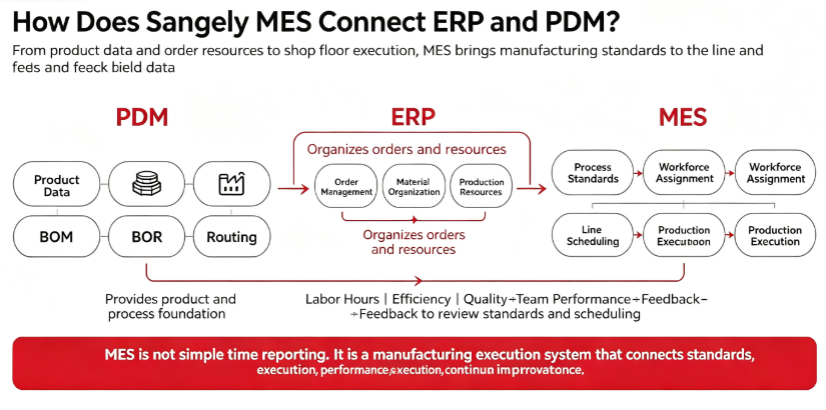
In the Sangely system as a whole, PDM provides the basis for products and processes such as BOM and BOR; ERP further organizes orders, materials and production resources; and MES continues to bring process standards, personnel, production line arrangements and production execution to the manufacturing site.
Thus, it can be understood that:
PDM establishes a product and process base, ERP organizes orders and resources, and MES truly puts manufacturing standards on the line of production.
MES also produces continuous on-site data on working hours, efficiency, quality and team performance.
These data, in turn, can help enterprises to constantly check the reasonableness of their standards, detour and production organization.
This is also the key to the difference between MES and simple paper software.
XVI. What should enterprises start building MES, first?
The construction of MES should not start with the “how many machines should be installed first”.
It is more important to first confirm whether there are relatively clear processes and manufacturing standards in enterprises.
If there is no uniform definition of what a process should do, the standard time depend entirely on different personnel experience, and the production line arrangements are adjusted mainly by the team leader on an ad hoc basis, then more site terminals will simply move the original mess into the system.
A more practical approach would be to gradually establish the process routings, standard time and main production processes for key products, and to continue to link the data on detachment, implementation, attendance, counting and performance.
The real importance of MES is not how much data is collected on the first day.
They are:
These data are based on relatively clear manufacturing standards.
Conclusion: what MES really manages is how manufacturing standards enter the scene.
The MES that is really needed by the manufacturing company is not just a replacement for a paper paper paperman to an electronic paperman, it is not just an extra few screens for the workshop.
A truly valuable MES requires that enterprises have relatively clear manufacturing standards before they continue to enter production lines.
Sangely MES continues to connect SOP, automatic production scheduling, line balance, workstation execution, personnel attendance, individual piece-rate tracking and team performance, starting from the process routing and standard time, to allow manufacturing companies to gradually establish data relationships from standards to implementation and from analysis of results. This means that not only do enterprises know how much they produce today, but they can further understand how many people have been spent, how many working hours have been spent, whether the production line is balanced, how good quality is and how efficient the different teams have finally been.
From this point of view, the real need for MES is to address how the manufacturing standards of enterprises can be transformed into operational field missions, and how real field results can be transformed into data that businesses can analyse and improve.
What Sangely MES really wants to do is not to give the workshop more system operations, but to move process, personnel, production line and production results into the same manufacturing execution logic.
Allow standards to enter the site and turn it into data.
FAQ|XTERRM2X common problems
Q1: What Is MES?
MES is the Manufacturing Execution Management System. For manufacturing companies, it not only records production results, but also links process standards, production tasks, personnel, production lines and on-site implementation, so that the manufacturing process can produce data on a continuous basis.
Q2: Why does Sangely MES place standard time at an important level?
As there is no relatively uniform time standard, there is a high reliance on personal experience for detachment, efficiency and performance analysis. Sangely MES establishes standard time through engineering methods, relevant manufacturing conditions and standard computing logic to provide a time basis for subsequent platooning and on-site efficiency analysis.
Q3: Can Sangely MES be used as an automatic detour?
Yes. Sangely MES may provide a free schedule based on standard time and process routings, and support IE ' s pre-planned partial process combination to enable the system to take further account of the corresponding production constraints when waiting.
Q4: Why does Sangely MES manage staff and team performance?
Because the results of the construction are implemented by people and teams. Sangely MES allows enterprises to observe the overall performance of teams and production lines from a single person by combining data on attendance, working hours, individual piece-rate tracking, efficiency, quality and team performance.
Q5: What is the difference between Sangely MES and the General Notification System?
The general information workers pay more attention to the number of records after completion of production. Sangely MES further links standard time, process routings, SOP, detachment, workstation execution, personnel and team performance, allowing the system to continue from results to the whole production implementation process.