
Many manufacturing companies already have ERP.
The order is in the system, the purchase is recorded and the inventory is also searchable. But when the boss really asks about production, companies often need to reconfirm: When the order is ready, the materials are ready, how much is needed, when the different segments start, whether the production capacity is sufficient, and how much is spent when the order is completed.
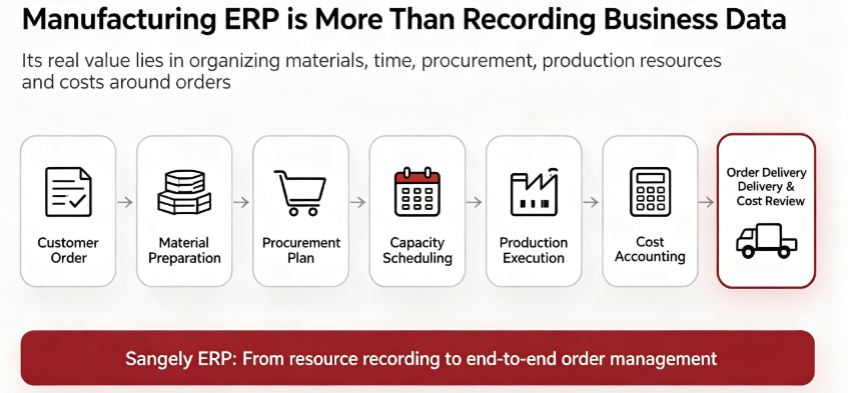
This means that the ERP, which is really needed by manufacturing companies, does not stop at “recording business into the system”.
It also needs to further address:
Once the order is entered, the enterprise organizes the material, time, procurement, production resources and costs.
This is also the most important entry point for understanding ERP in manufacturing.
Sangely ERP is concerned not only about what resources the enterprise now has, but about whether they can continue to be valued, procured, scheduled, produced and cost managed around the purchase orders.
I. What Is ERP?
ERP, enterprise resource planning.
For manufacturing companies, it does not really manage orders, purchase orders or inventories, but rather the resource relationship between these operations.
The issues of what material is required, how much material is required, when to procure, when to start different segments, how to organize production resources and how much cost is incurred when an order is completed are all part of ERP.
Therefore, what ERP in manufacturing really needs to answer is not just “what happened in the business”, but:
How these resources should then run around the order.
Sangely ERP revolves around manufacturing operations such as materials, costing, BOM, procurement, warehousing, production scheduling, cost and finance, enabling orders to gradually enter a more complete resource planning process.
ii. Why is ERP an issue for the boss?
ERP appears to be used daily by business, procurement, warehouse, PMC and finance personnel, but ultimately it affects the ability of the enterprise to operate at the order tempo of its resources.
If the material base is not uniform, BOM, procurement and inventory are prone to duplication or confusion; if production schedules and materials are prepared to be separated, the plan may still be ready for the site because of lack of materials; if there is no uniform time reference, PMC still needs to rely heavily on individual experience to determine how long it takes; and if the cost of completing the order cannot be clearly analysed, it is difficult for the owner to judge how much the different orders, styles and colours actually cost.
So what the boss really needs to look at is not how many menus there are in ERP, but whether the system can allow the order, material, time, procurement, production and cost to evolve into a set of data links that can be kept running.
The clearer the business resource relationship, the less the order will need to be re-confirmed by a large number of people, from receipt to production to accounting.
iii. Why does Sangely ERP start with the material base?
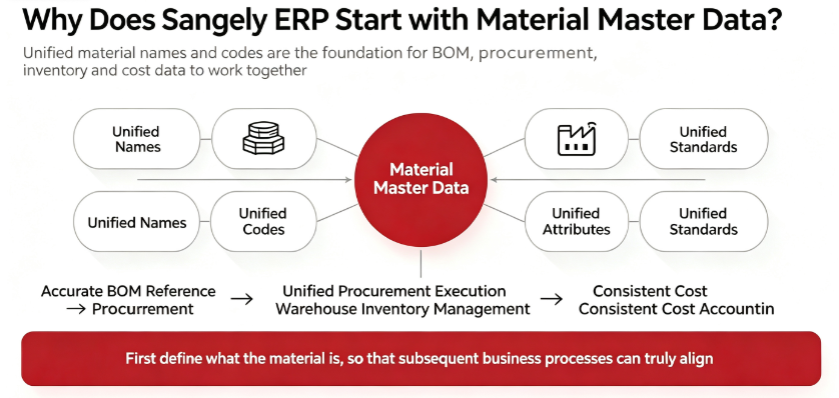
Many of the follow-up problems of manufacturing companies begin with the material base.
In the same material, BOM, procurement, inventory and cost data are affected if different people use different names and different sectors use different codes.
Sangely ERP may create the corresponding material name and material code according to the composition properties of the material, allowing the enterprise to establish more uniform material norms from the base information.
This does not appear to be as intuitive as scheduling and automation, but it determines whether many of the latter operations can really be matched.
Only if “what is this material” is made clear, BOM can be quoted accurately, procurement can be carried out in accordance with uniform material, the warehouse can continue to manage the inventory and the subsequent cost accounting has a relatively consistent data base.
Thus, the Sangely ERP does not wait for an order to begin to manage the resources, but rather to gradually clarify the material data on which the manufacturing company is based.
iv. Why cannot manufacturing companies use only one fixed number?
For manufacturing companies such as bags and handbags, the amount of material used runs through product development, costing, purchase and formal production.
However, the accuracy of the attention at different stages is not identical.
The costing phase requires rapid and usable reference, the procurement phase needs to be closer to the actual demand for the material and, when it enters into formal production, to the actual manufacturing conditions.
Sangely ERP uses Q as a logic for calculating materials for use at different stages of manufacture, so that enterprises can have a basis for their use from development, costing and purchase to formal production. ERP also provides the logic of the material at different stages of Q0-Q9 and applications such as Q2 costing, Q5 purchase material and Q7/Q8 production.
This means that material calculations go through all operations with the same static number more than once.
More importantly, it allows for the refinement of data at different stages around the same product and order.
v. Why can the costing in ERP not simply “to add up the cost of the materials”?
When a customer asks for a price, it is not just the amount of fabric that an enterprise really needs to judge.
The cost of a product may also involve different components such as direct wages, indirect wages, out-of-court processing, development costs, packaging and transport.
Sangely ERP allows the product to continue the process of costing of the material and associated costs, so that the offer is based as much as possible on the resulting manufacturing data rather than re-reliant on manual collection of discrete information.
If each offer requires re-searching of materials, engineering, validation of processes by the operational staff and re-collection of costs, the more products and changes, the more vulnerable the offer is to human experience and information.
When the material, BOM and the associated cost information are gradually brought into the system, the costing will have the opportunity to move from “research” to “continuation of calculations on the basis of available manufacturing data”.
VI. How can the procurement continue after BOM is formed?
BOM is not the end point after product development has been completed.
For ERP, it is also an important basis for procurement and material planning.
Sangely ERP allows the aggregation of material requirements around BOM and orders to form a material and volume basis for procurement. The enterprise could also set up rules for loss and loss between different material types and quantities, so that standard quantities could further develop recommended purchases that are more responsive to actual procurement needs.
Thus, what the procurement needs to answer is not just “what material is in BOM”, but what is required for the current order, what is the standard amount of use, and what should be prepared after the actual wear and tear.
This allows further entry of product data into resource readiness.
BOM informed the business of what was needed for its products and ERP continued to translate these needs into a basis for procurement and material preparation.
Why would BOM affect ERP?
Manufacturing enterprises, such as packs and handbags, often face the same colour, material changes and multi-wheel product development.
If ERP could only see a fixed BOM, after actually entering the order, procurement and production would still have to rely on personnel to re-evaluate what material should be used in different colours and different development states.
Sangely ERP supports the recording of BOM in different rotations, and may also make the corresponding color BOM for different products.
This means that when the product enters the operational and manufacturing stages, it is not only known that “this amount has an BOM”, but it is also able to further distinguish between different development states and the material relationships of different colours.
This distinction is important for procurement, inventory and cost, as it is not an abstract product, but a specific order, a specific colour, and the material and volume relationship to which it relates.
8. Why is standard time also an important basis for ERP production programmes?
Manufacturing enterprises need to plan not only to know the number of orders and the availability of materials, but also to know how much time it takes for different products and processes to normally take.
In the absence of a relatively uniform time frame, the production schedule remains easily dependent on the experience of PMC, plant managers and field managers.
Standard working hours are provided on such a time basis.
The Sangely standard time are not simply a fixed number of seconds for a process, but are time-referenced in conjunction with the product, the BOR process routing and the associated manufacturing conditions. This time standard could continue to provide a data base for the production plan, process organization and resource planning in ERP.
In this way, ERP not only knows “how much to do” when organizing orders and resources, but also has further reference to “the approximate amount of time required under the corresponding manufacturing conditions”.
So the relationship between standard time and ERP is not isolated.
Standard working hours bring the time standard in the product process into the resource planning, so that ERP is scheduled not only for orders and materials but also gradually has a time basis for manufacture.
MES will continue to produce actual implementation data when it enters the production site. A comparison between standard and actual working hours can also provide a basis for follow-up efficiency analysis and production improvement.
IX. Why must the production schedule be accompanied by materials and time?
The schedule of production does not mean that the order has already been made.
At manufacturing sites, there is a situation in which the plan has been established but the critical materials are not yet in place; or the number of orders is clear, but there is no uniform time basis, and the different sections still rely mainly on experience.
Thus, a truly implementable production programme requires two questions:
Availability of materials and justification of production time.
Sangely ERP's large-scale scheduling catch-up capability places production time and material preparation in the same management perspective. Not only do enterprises need to know when the order should start, but they need to be kept informed of the extent to which the material is currently prepared and can be put at the production pace.
Standard working hours further inform the production schedule, so that the schedule is not just a date but can be built on products, processes and manufacturing times.
Therefore, orders, materials, standard time and production schedules are not a few separate data.
Together they decide:
Can an order go into production as planned?
Why should stockpile management not be limited to “how many more”?
Manufacturing enterprises are not safer with more stocks.
Excess preparation of materials in advance can create an inventory and storage pressure; insufficient preparation can lead to production waiting.
So what ERP really needs to help the business solve is not just how much material the warehouse now has, but what is the relationship between these stocks and the current order demand.
Sangely ERP allows enterprises to understand material preparation around actual manufacturing needs by means of an order, BOM, procurement requirements and production scheduling. At the same time, the system can continue to generate data such as material balances and average prices, providing the basis for subsequent inventory and cost management.
This makes the inventory no longer a static quantity but a resource relationship between order, procurement and production.
XI. Why continue to analyse costs after the order has been completed?
The final concern of the manufacturer is not just whether the order has been completed.
It is also important to know how much material was actually used in this order, how much labour and related costs were incurred and what costs were ultimately incurred.
Sangely ERP allows for a cost analysis based on different dimensions, such as month, order, style and colour, and further accounts for material costs, labour costs and related cost-sharing.
As a result, cost management is no longer limited to a total amount.
Enterprises can further understand the cost differences between different orders, different styles and colours and continue to use these results as a reference for subsequent offers and business judgements.
This cost relationship is particularly important for manufacturing companies that have multiple, multi-colored and frequently changed orders, as the same amount is not necessarily the same as the resulting cost under different order and colour conditions.
How does Sangely ERP link financial management?
In the end, manufacturing operations also require entry into business accounting.
Data on orders, purchases, costs and liabilities, if re-organised at the end of production, still have data faults in the enterprise.
Sangely ERP covers the financial management landscape, such as billing, cost and ledger, and supports the continued accounting processing of related payables. At the same time, data can be linked to the existing financial systems of the enterprise, allowing business data generated at the manufacturing end to continue to service the subsequent financial accounting.
Therefore, the manufacturing data in ERP do not end when the production is completed, but rather need to continue to enter the final business results of the enterprise.
Why does Sangely ERP need to connect to the device?
Traditional ERP is mainly operated in offices, where staff enter data, maintain data in the system and follow-up is carried out by personnel on the basis of system information.
However, as the manufacturing digitization continues deep into the field, many of the real data are not generated manually by personnel, but rather from equipment, sensors and field operations.
Sangely ERP can further connect to the manufacturing equipment. For example, in the context of counterpart operations, sensors, ATMs, etc. can be connected to ERP and 2D codes, complete automatic pounds and allow on-site data to continue into the system.
This means that ERP begins to extend further from traditional back-office management software to real manufacturing sites.
The equipment connects to a place of real value, not just “mechanical networking”, but allows data generated by on-site equipment to continue to enter order, material and resource management.
The system not only manages data entered by enterprises, but also begins to connect data that are occurring at the manufacturing site.
Why do Sangely ERP continue to connect PDM and MES?
Sangely ERP does not exist in isolation.
In the overall Sangely manufacturing system, PDM first produces product data such as products, BOM and process; ERP further organizes enterprise resources such as materials, procurement, inventory, standard hours, schedule and cost around purchase orders; and, when production conditions are met, plans continue to enter MES, with MES carrying production performance and on-site feedback.
Thus, the three are engaged in different stages of work.
Sangely.PDM focuses more on the source of the product data, Sangely ERP focuses more on how the resources operate around the order, and Sangely MES continues to focus on the implementation at the production site.
Standard working hours provide positive benefits between these stages, both from products and processes, and continue to serve the ERP programme, which can be compared with the actual implementation data for MES.
What is really important here is not that a few systems be simply sequenced into a process, but that the data already developed at the previous stage continue to be the basis for the latter.
15. What should be addressed first when enterprises start building ERP?
The construction of ERP does not have to start with “maximum functionality”.
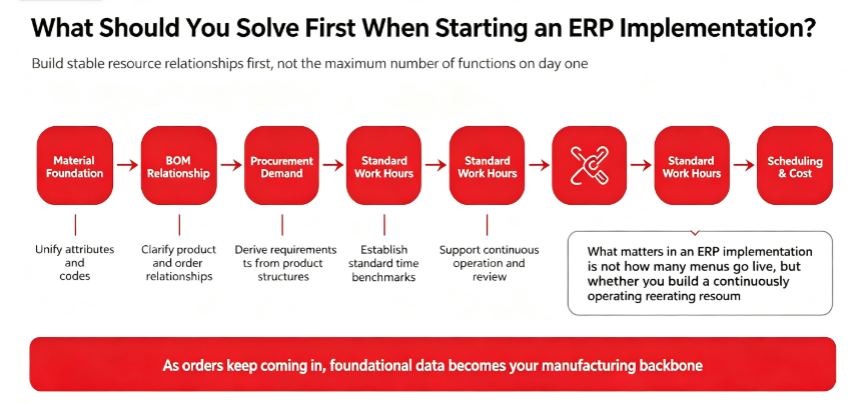
If the material base is not clear, BOM is confusing, procurement needs are still based on manual calculations, standard time are not established and scheduling is largely based on experience, then even if there are many additional functions in the system, it is difficult to link the latter operations.
A more practical approach would be to gradually clarify the most fundamental resource relationship.
For example, by harmonizing the attributes and coding of commonly used materials, and clarifying the relationship between BOM and the order, procurement requirements can be based on products and orders, and standard time, production scheduling, inventory and cost management are gradually being established.
The real importance of ERP is not how many menus go online on the first day, but whether the enterprise can gradually establish a set of ongoing resource relationships.
As orders enter, the relationship becomes the real basis for the enterprise's manufacturing.
Conclusion: let the resources really run around the orders
The ERP, which is really needed by manufacturing companies, does not simply allow orders, purchases and inventories to enter the computer from paper, but rather allows these resources to continue around real manufacturing.
The enterprise needs to know what material is required for an order, how much is to be prepared, when to procure, when to enter production, how much time is normally required for different processes and how much costs are ultimately incurred after the order is completed.
Sangely ERP begins with the material base and continues to connect to volume calculations, costing, BOM, procurement requirements, standard time, inventory, production scheduling, material tracking, cost and finance, making the resource relationship behind the purchase order increasingly clear.
At the same time, ERP can continue to connect MES to manufacturing equipment, allowing the enterprise system to move beyond its office to a real production process.
From this perspective, what is really needed in the manufacturing sector, ERP, is to allow material, time, procurement, inventory and production resources to continue to be organized around the same order and to continue to return to cost and business management after production is implemented.
What Sangely ERP really wants to do is not to give the enterprise more documents, but to let the resources enter the right manufacturing chain at the right time.
FAQ|XTERRM1X Common problems
Q1: What Is ERP?
ERP is ERP. For a manufacturing company, not only does it manage orders, purchases and inventories, but it also needs to continue to organize materials, time, production resources and costs to enable it to develop more complete manufacturing resource relationships around orders.
Q2: Why does Sangely ERP emphasize material standardization?
As BOM, procurement, inventory and cost need to be based on clear material. Sangely ERP can create the corresponding material names and codes based on material composition properties, allowing follow-up operations to use uniform material data to the extent possible.
Q3: Why is the standard time related to ERP?
Standard working hours establish time references for different products and processes and can continue to provide a time basis for production plans, process scheduling and resource planning in ERP. It is not an isolated fixed number of seconds, but rather an important manufacturing data linking product processes to production plans.
Q4: Why does ERP have to be followed up after the production program?
Since the timing of production does not mean that conditions are in place to start work. Sangely ERP places production arrangements and material preparation in the same management perspective through large-scale scheduling pursuits, and keeps an eye on whether the materials are ready for production.
Q5: Can Sangely ERP do a cost analysis?
Yes. Sangely ERP can analyse costs around dimensions such as month, order, style and colour, and further account for material, labour and related cost-sharing to help enterprises understand the cost composition of different orders and products.