
When many manufacturing companies develop new products, the real difficulty is not an inability to make samples.
The problem arises more in the development process itself.
Client information has come in and the business has identified the need, but it is not clear what the project is going to take; the issue of whether the release is complete or not is to be asked after the release has been made; whether the sample has been sent out and continues to be confirmed after it has been completed; and whether the material is ready or not, but may depend on separate records from different persons.
As a result, a new product development process can easily be dispersed in the memory of mail, WeChat, Excel, paper documents and different people.
The product can, of course, be produced at the end, but it is difficult for managers to know at any time where they are now, where the bottlenecks are, and who should handle the next step.
This is also the most important entry point for understanding PLM.
The PLM is really in need of management, not just the information that the product eventually produces, but whether the information at all stages can be sustained from the entry of a product from the customer's needs to the development of a sample, the development of information, the advancement of a process and its subsequent continued use.
Sangely PLM is concerned with development synergies in the life cycle of this product.
I. What Is PLM?
PLM, Life Cycle Management of Products.
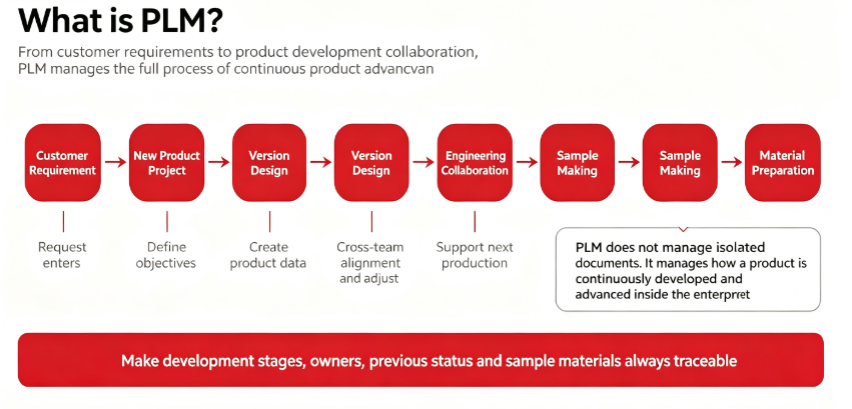
If PDM focuses more on product data itself, such as product profiles, BOM, and process routings, then the PLM focus goes further, requiring management of product entry from demand to development into the whole process of working with different people.
For manufacturing companies, the development of a new product usually involves operations, pattern makers, engineering, fabrics, sample making and related material management.
These persons do not work at the same time, but continue to connect around the same product.
So what PLM really needs to answer is: what stage of development the customer needs are now in, who is processing, whether the previous link has been completed, whether the materials are ready for the samples, and whether the state of the product's development can be continuously recorded.
The PLM management is not an isolated product information, but rather how the product is continuously developed and advanced within the enterprise.
ii. Why is PLM an issue for the boss?
PLM appears to be the main service business, engineering and layout, but ultimately it affects the speed of response and transparency in the development of new products in the enterprise.
If the customer information comes in, the development status can only be asked on a person-by-person basis, and the owner sees only “many samples being made”, but it is difficult to know which money is being printed, which is being prepared, which is being replaced, which has been completed and which is being stuck at a certain point.
The cost of communication increases rapidly when product development relies on a small number of familiar people to take control of progress and when orders increase, people change or multiple samples advance simultaneously.
So what the boss really needs to look at is not how many process nodes there are in PLM, but whether the new product can be seen when it enters the business, whether the process can continue, and whether the material and the human state can be related to the same product.
The more transparent the development process is, the less the business needs to judge where a new product is now by asking people everywhere.
How can a sample development mission really take place when customer information is entered?
Many manufacturing companies develop their products, starting with customer source documents.
Clients may express their product requirements by means of information such as PDF, AI, and operational personnel need to understand the content before transferring the requirements to subsequent engineering and sample development positions.
Sangely PLM supports customer source documents and further development of sample orders, which can continue to be identified and modified by personnel before entering internal processes. The relationship between the translation of customer source documents from PDF, sample orders and the management of departmental processes was demonstrated.
In this way, the client information is not simply in the business personnel ' s mailboxes or chat records, but is beginning to enter the formal sample development process within the enterprise.
This step is important for manufacturing companies, as a truly manageable development process requires, first and foremost, a clear business start.
IV. Why is the development of samples most in need of `process visible'?
The most likely problem in the development of new products is not that people are not doing it, but that different people know only their own part.
The business knows the needs of its clients, the preparer knows that he is making a copy and the preparer knows which material is not yet available, but what managers need to see is the whole process.
Sangely PLM can establish process management around sample orders, continuously record development progress through different sectors and processes, and further present these in the development progress board.
For example, the stages of operations, layouts, copy preparation, trimming and sample completion and dispatch can be developed through corresponding feedback.
In this way, product development is no longer merely a “work-for-work” ambiguity, but rather a further understanding of where it is going.
The real change from PLM is to move product development from “person-recording progress” to “system-informed progress”.
Why must the sample material also enter PLM?
Sample development requires not only profiles and personnel, but also real materials.
The sample could not continue until the key material was available, if the editor was ready to prepare the version. Conversely, if the material is ready for completion but not reflected in the system, there is a risk that the business and engineering will continue to repeat the queries.
Therefore, the development of samples is truly transparent, not just to manage process nodes, but also to continue to manage material status.
A digital version of the Sangely PLM house system includes sample material access and warehouse management scenes. The silos allow material acceptance, dispatch and related queries around sample orders, allowing further access to the material status of the sample development process.
Thus, development progress and material preparation are no longer two completely separate sets of information.
For operational and engineering personnel, it is also possible to judge more clearly whether a sample is “doing” or “doing” the same.
Why don't the digital pattern room just move the paper process to a computer?
Traditional building management relies heavily on skilled personnel.
Who is doing what, where is the sample card and what is not yet complete, and in many cases is in the hands of the landlord and the old employee.
Sangely PLM uses the digital version of the room as an important scenario for product development management, allowing the work to evolve into searchable data through sample processes, development progress, material status and personnel feedback.
This means that the digital pattern room does not simply change the original paper sample sheet to a spreadsheet.
What is more important is that what happens in product development can be kept on track.
When the business, copymaster, fabric and sample completion state is gradually moving into the same system, the layout management is no longer entirely dependent on an individual to remember everything.
Why should development progress be combined with staff efficiency?
Management of product development, not just the completion of a sample.
The company will also be concerned about the number of development tasks carried out by different persons, the long-standing backlog of links and the actual working status of the different positions.
Sangely PLM supports the efficiency board for digital versioners. Through the development of task and return data in the process, it is possible to further develop an efficiency analysis of the occupants and provide a data basis for subsequent performance judgement. The value here is not simply for ranking employees.
More importantly, it is important to allow for the availability of analytical data for the first-ever hard-to-quantifiable version of the building.
It is when an enterprise sees both the progress of the sample and the input of personnel that it is easier for managers to judge whether the problem arises from a process, material, tasking or a long backlog.
viii. Why is PLM and PDM not the same system?
PLM and PDM are close, but the focus is not exactly the same.
PDM is more concerned with product data per se, such as product profiles, BOM, BOR process routings, historical similar products, and re-use of product data.
PLM is more concerned with how to move forward over the entire development life cycle, including sample orders, sector processes, development progress, sample material and related personnel, as the product moves from customer demand.
It is simply understood that:
PDM is more concerned with “what is the product data” and PLM is more concerned with “how the product development process advances”.
By combining the two, enterprises are able to manage both the data that eventually emerges from the product and how they evolve in the development process.
This is why PLM cannot simply be understood as “another PDM”.
Nine, PLM why do you need to connect ERP and MES?
Once the product is developed, it will not stop at PLM.
Once the sample is confirmed, the product will continue to enter the order, material and enterprise resource planning system; when it actually enters production, MES will be required for on-site execution.
The real value of PLM is therefore premised on the operational status and product information that have been developed in the product development process and can continue to be the basis for subsequent manufacturing operations.
In the overall Sangely product system, different systems can be understood at different levels: PLM is responsible for product development processes and life cycle synergy, PDM further sedimentation product data, ERP organizational orders and business resources, and MES continues to enter manufacturing sites.
What is really important here is not the mechanical sorting of several systems into a fixed process, but rather the re-interpretation of what has already been done in the first place, without having to go to the next system.
Why is PLM particularly suited to new and frequently developed manufacturing companies?
If an enterprise develops only a small number of fixed products a year, many sample work can also rely on manual coordination.
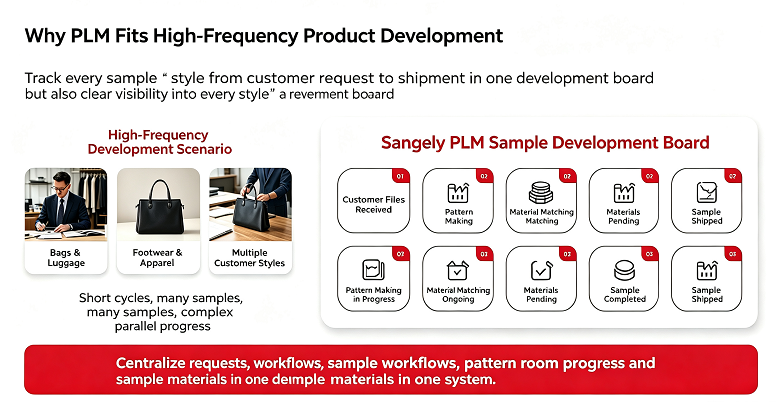
However, for the trades of bags, handbags, footwear, etc., clients come in frequently, with a short development cycle, and at the same time there may be a large number of parallel advancements.
At this point, the real difficulty is more than just “can't we look for a face?”
It is whether the enterprise can continue to know the state of each paragraph when a large number of samples are being carried out simultaneously.
The higher the administrative costs of the more products, the more client information is received, the more they are produced, the more they are prepared, the more they are prepared, the more they are prepared, the more they are prepared, the more they are prepared, the more they are prepared, the more they are completed and the more they are sent out.
Sangely PLM places customer source documents, sample processes, digital pattern-room progress and sample material in the same development management system, which is more suitable for rapid product changes and frequent sample development.
XI. What should enterprises start building PLM, first?
Enterprise construction PLM does not necessarily require the design of a very complex product life cycle process at the outset.
A more practical way would be to clarify the current development process, which is the easiest to lose control.
For example, when customer information enters, who builds the sample list, what core departments will the sample go through, which stages are now most dependent on manual inquiries, which material status often leads to development waiting, and which progress information managers most wish to see.
These core sample development nodes will be placed in the system, with each product having a clear state of development, and gradually extended to material, efficiency and subsequent product data management.
PLM is really important, not as many nodes as possible.
They are:
Once every new product enters the business, it is possible to know where it is and where it is going next.
Conclusion: Stop product development from relying on “growing for progress”
The PLM that is really needed by manufacturing companies is not just about creating more sample orders or adding a board for development.
What it really needs to be addressed is whether the business, layout, materials and the different development jobs can continue to work together around the same product as the client's needs enter.
Sangely PLM has developed a relationship between previously dispersed information in the development of new products through data on customer source documents, sample orders, development processes, digital pattern room progress, sample material and staff efficiency. As a result, managers no longer rely only on telephone calls, WeChat messages and verbal inquiries to determine the status of the sample, and the business can have a clearer idea of the current stage of the customer product.
From this perspective, two things really need to be addressed: on the one hand, making the product development process visible; and, on the other hand, keeping the client's needs, development tasks, sample materials and people connected around the same product.
What Sangely PLM really wants to do is to move the development of new products from “someone remembers where they are now” to “the system knows what stage the product is at”.
This is the value of a product life-cycle management that actually enters a manufacturing company's development site.
FAQ|XTERRM3X Common Problems
Q1: What Is PLM?
PLM is product life cycle management. For manufacturing companies, it not only manages final product information, but also further manages customer needs, sample development, process progress, materials and synergies between different jobs.
Q2: What are the main development operations managed by Sangely PLM?
Sangely PLM covers developments such as customer source documents, sample orders, development processes, digital pattern room progress, sample material and related personnel efficiency, allowing new products to move from demand to a state of continuous traceability.
Q3: What is the difference between Sangely PLM and PDM?
PDM focuses more on product data such as slotting, BOM, and process routing, and PLM focuses more on how the development of samples and the different business links continue to advance as the product enters from customer demand. The two address the different aspects of product data and product development.
Q4: Can Sangely PLM see the development progress of the sample?
Yes. Sangely PLM can document the state of development of different sectors and processes around the sample process and see the progress of the development of different models through a progress board.
Q5: Why do enterprises that are more frequently developed need PLM?
Since it is difficult to keep track of the status of each of the funds when a large number of samples are being pushed at the same time, the memory of the operational, engineering and living room staff alone is difficult to keep track of. PLM allows different samples to have clear processes and progress records, and reduces the frequency and dispersion of queries and information.