
1. Point solutions and complete manufacturing systems address different levels of problems
To make one chair, a hammer and several boards may be enough. The objective is clear, and one person can complete it with relatively simple tools.
The difficulty changes completely when the objective becomes a full customized interior.
Each room has different dimensions and uses, requiring more precise measurement and cutting. Carpenters, electricians, installers and other trades must coordinate around the same spatial relationships. Cabinet dimensions must account for socket positions, and equipment installation must account for wiring and space. If any information is misaligned, downstream conflicts and rework can follow.
The real challenge is not whether each trade can perform its own task, but whether different specialties can still coordinate around a shared data foundation as complexity rises.
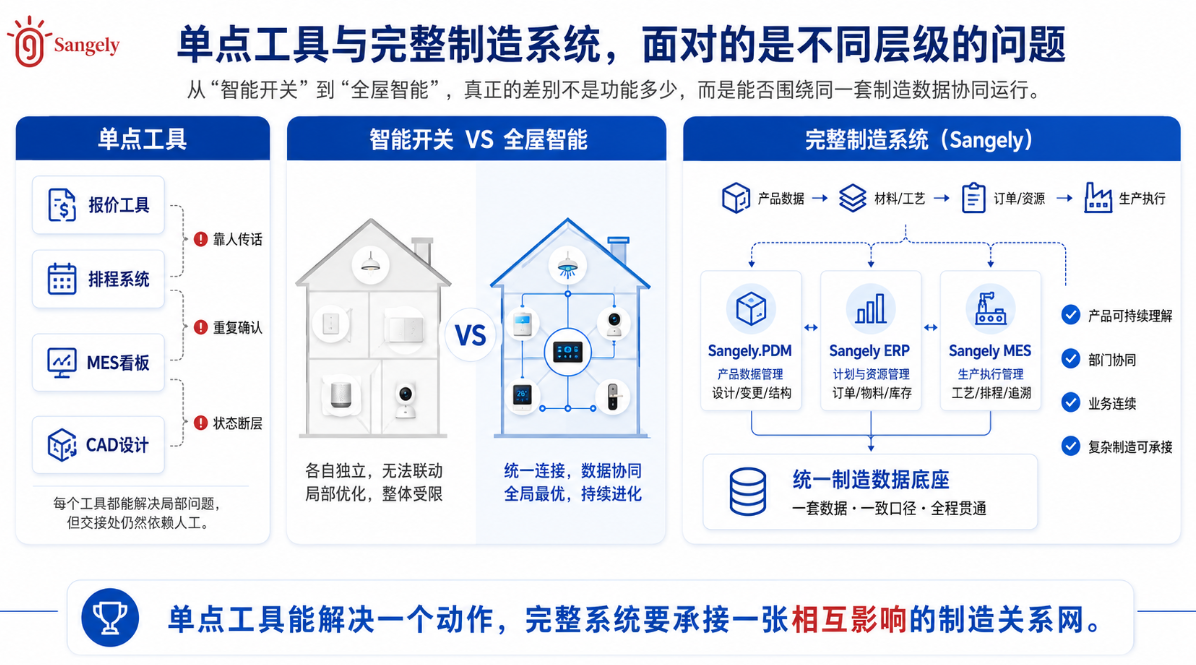
Manufacturing is the same. Nesting, quotation, planning and production can each be addressed by a tool in isolation. Once products, materials, processes, orders, resources and production are connected, however, the system no longer faces separate actions; it faces a network of interdependent manufacturing relationships.
This is why deeper manufacturing digitalization cannot be evaluated only by the strength of one function.
2. Supporting complex manufacturing begins by defining key data relationships clearly
In frequently changing industries such as bags, footwear and apparel, a product is more than one item number.
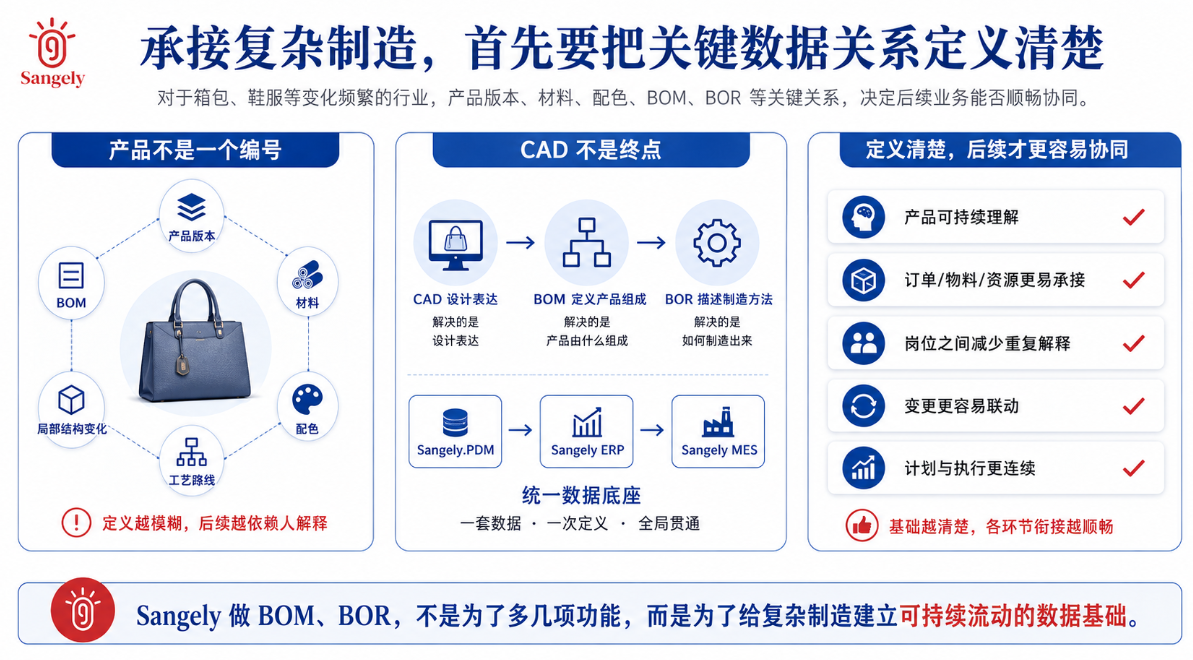
The same style may have different versions, colorways and primary-material combinations, and customer requirements may trigger material substitutions or structural changes. A small visible change may affect the BOM, material preparation, process routing, resource planning and manufacturing execution.
If the system records only a product number, it understands very little about manufacturing.
Data granularity here does not mean breaking data into endlessly smaller fields. It means defining the relationships that truly affect downstream manufacturing in enough detail for the business to continue operating.
For bag, footwear and apparel manufacturing, these relationships may include product versions, materials, colorways, BOMs and process routings. The clearer they are, the easier it is for resource planning and manufacturing execution to share the same data foundation.
Sangely’s product-data architecture follows this logic. Current capabilities support forming BOM material structures and BOR process routings from CAD drawings, then using this data in downstream PDM, ERP and MES operations.
3. Why does Sangely not treat CAD as the endpoint of product data?
CAD represents product design, but manufacturing does not stop after the product can be visualized.
Once manufacturing begins, the company must answer two additional questions: What is the product made of? How should it be manufactured?
Sangely therefore does not treat CAD drawings as the endpoint. It continues by establishing BOM and BOR data.
In simple terms, CAD expresses the design, BOM defines product composition, and BOR describes the manufacturing method.
This is more than adding several tables. It increases the system’s understanding of manufacturing relationships. Once material composition, BOM and process-routing data are established, the product is ready to continue into resource planning and manufacturing execution.
This is why BOM and BOR matter in Sangely. They are not isolated documents, but an essential data foundation for moving a product from design into manufacturing. Sangely.PDM centers on product data and uses CAD, BOM and BOR to extend product development toward manufacturing.
4. The value of PDM, ERP and MES is not merely having all three, but enabling them to understand the same product
A company that owns PDM, ERP and MES does not automatically have one manufacturing system.
The real question is whether a product clearly defined upstream can still be understood in downstream business stages.
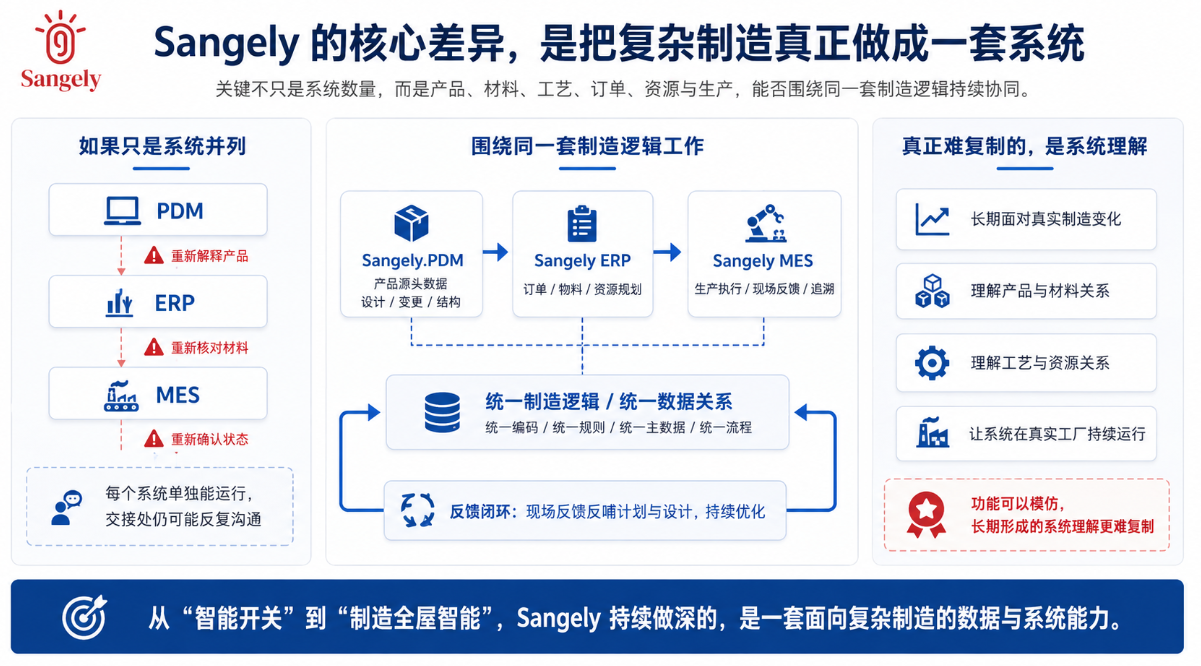
Within Sangely, Sangely.PDM establishes the product-data foundation during development; Sangely ERP manages orders, materials and resource planning; Sangely MES enters manufacturing execution and shop-floor feedback.
The three systems perform different work, but they must be built on continuous data relationships.
If underlying product data is unclear, each system may run independently while employees still have to reinterpret the product, reconfirm materials and reorganize business status at every handoff.
Data granularity therefore affects more than the back-end structure. It determines whether roles must repeatedly explain information, whether a product must be reorganized at every business stage, and whether PDM, ERP and MES can form a continuous business relationship.
5. What is difficult to replicate is the system understanding built through long-term exposure to complex manufacturing
Drawing a system architecture is easy. The difficulty is whether it continues to work in a real manufacturing environment.
Real factories do not follow one standard process forever. Customers change requirements, materials change, colorways are adjusted and product versions multiply, while engineering, purchasing, planning and production work in different contexts.
A manufacturing system should therefore accumulate more than functions. It should accumulate understanding of the relationships among products, materials, processes, resources and production.
Founded in 2005, Sangely Software has long focused on manufacturing scenarios in bags, footwear, headwear and apparel. The founding team has an even longer background in manufacturing practice, providing an important basis for products that continue to start from shop-floor realities. Today the Sangely suite has a three-layer PDM, ERP and MES architecture connecting design definition and enterprise resource planning with manufacturing execution.
The reasons for establishing BOM, extending further to BOR, and continuing product data into ERP and MES are not to make the software architecture appear more complex. They are system principles formed through long-term exposure to product changes, material changes and cross-role coordination.
What is truly difficult to replicate is not one function, but the system understanding formed by working with complex manufacturing over time.
6. Sangely’s core difference is turning complex manufacturing into one system
What Sangely emphasizes is neither “more functions than others” nor simply placing PDM, ERP and MES side by side.
A point solution can solve one defined problem very well. Sangely must answer a broader question: when products, materials, processes, orders, resources and production enter one complex manufacturing system, can the data remain connected, can the systems coordinate, and can the enterprise continue to operate smoothly?
This is why Sangely emphasizes BOM, BOR and clearer data relationships—not to add several more functions.
Together, they support Sangely’s ability to understand and carry a complex manufacturing system.
The difference resembles moving from isolated “smart switches” to whole-home intelligence that understands products, materials, processes, resources and production. Sangely continues to deepen precisely this data and system capability for complex manufacturing.
Sangely is not intended to solve only one point in manufacturing. It enables products, resources and production to continue coordinating within the same data system.
That is what we mean by whole-system intelligence for manufacturing.
FAQ
1. Why does Sangely emphasize BOM and BOR?
CAD primarily expresses design, while manufacturing must also define what the product consists of and which process routing it follows. BOM and BOR enable product data to continue into resource planning and manufacturing execution and provide a foundation for data continuity among PDM, ERP and MES.
2. What roles do Sangely PDM, ERP and MES perform?
Sangely.PDM forms and manages product data during development. Sangely ERP manages orders, materials and enterprise resource planning. Sangely MES continues into manufacturing execution and shop-floor feedback. Each is responsible for a different stage, and their data relationships create a chain from product definition to execution.
3. Does “data granularity” mean the company must enter more data?
No. Data granularity means clearly defining the relationships that actually affect downstream manufacturing, such as product versions, materials, colorways, BOMs and process routings. It does not mean endlessly splitting fields merely to increase data volume.
4. What is the main difference between Sangely and point manufacturing software?
Point software usually solves one clearly defined problem. Sangely focuses on the overall data relationships among product development, resource planning and manufacturing execution. Its core difference is not simply more functions, but cross-stage coordination in complex manufacturing scenarios.