
More and more manufacturers have completed ERP and MES implementations.
Orders, purchasing, inventory and resources are increasingly managed in ERP, while production tasks, process execution and shop-floor data begin to be managed through MES. Judged by the number of systems, the company appears to have a digital foundation.
Yet on the shop floor, familiar scenes remain: the office has created a production plan, but a supervisor must explain again what should be made today; tasks exist in the system, but paper work orders, phone calls or chat groups still carry them to the floor; after work is completed, management must wait for manual statistics and supplemental entry before it sees actual progress.
Having ERP and MES therefore does not mean that management systems have truly entered production.
To move further toward smart manufacturing, a company must solve more than whether a plan exists in the system. It must deliver plans to specific roles, return execution status promptly, and create more continuous coordination among people, tasks, materials and equipment.
This is why Sangely continues to extend toward digital workstations and shop-floor execution.

1. ERP and MES address system-level management, but production happens at specific workstations
ERP focuses on enterprise-level orders, materials, resources and planning. MES then manages production tasks, process progress and shop-floor feedback.
Products, however, are not manufactured by an ERP page or an MES back office. They are made at specific workstations.
Cutting, material preparation, sewing, final inspection, patrol inspection and team-leader roles each have their own tasks, information and judgments. If a system task still has to be printed, forwarded and explained verbally by a supervisor, digitalization returns to manual work in the “last mile.”
After ERP and MES, the company must therefore solve a practical question:
How do tasks in the system actually reach the worker’s place of work?
That is the purpose of a digital workstation.
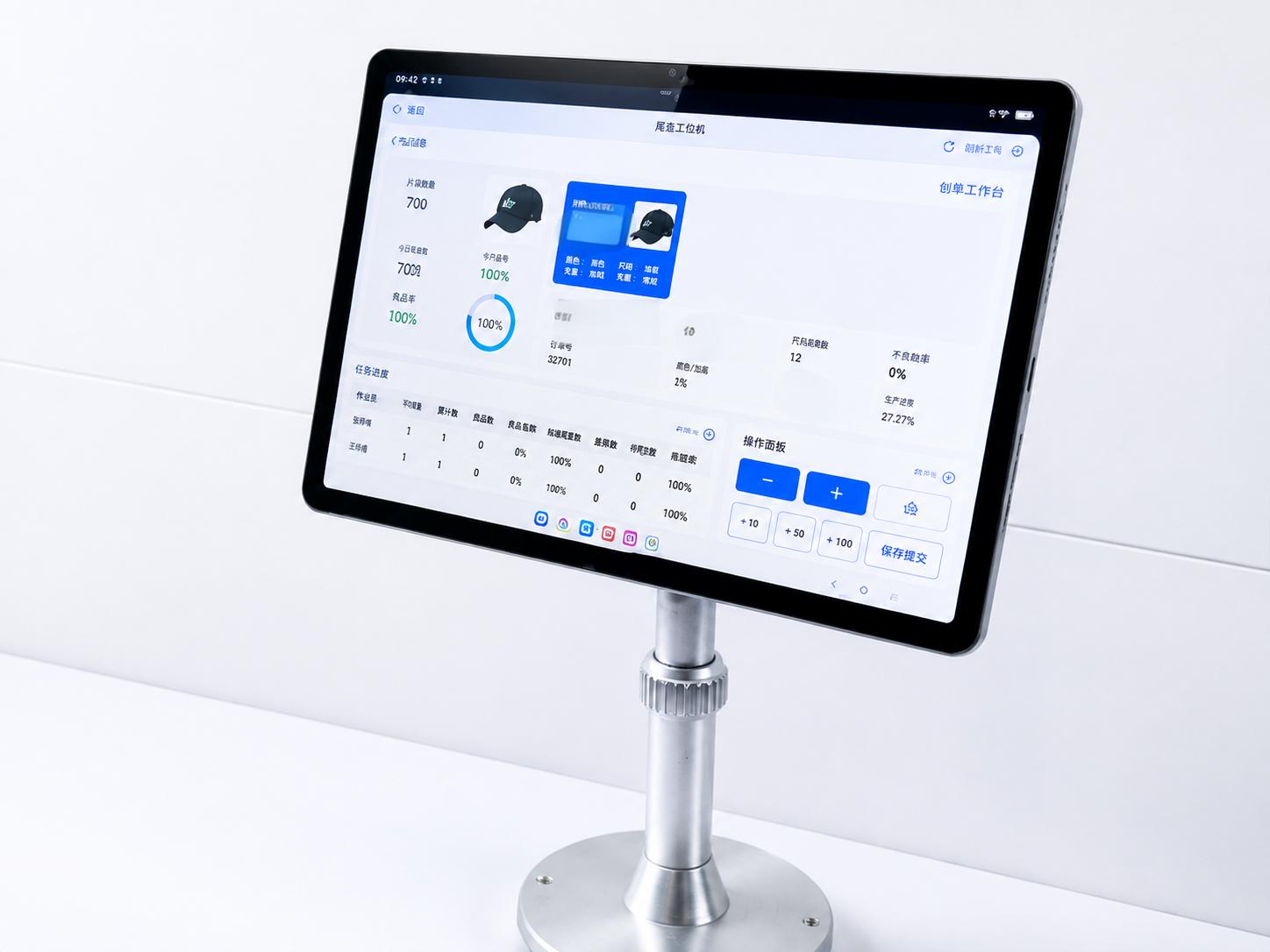
2. Sangely workstation terminals bring system tasks into specific operating scenarios
Sangely MES uses workstation terminals for different roles to connect production tasks with actual shop-floor work.
A workstation terminal is not merely a display in the workshop. Its more important role is to connect system tasks and operations with the physical workstation.
After a production task enters MES, it can be associated with upstream operations such as cutting, edge painting and embroidery. Team leaders, final inspectors and patrol inspectors can also use role-specific work entries to view and process the information relevant to their responsibilities.
The shop floor then receives more than one general production order: each role receives the information required for its own work.
This step is critical for a manufacturer.
Only when the system enters the workstation can production data continue to form during execution rather than being collected and entered in a batch after the work is finished.
3. QR codes and mobile terminals move feedback beyond after-the-fact statistics
Another shop-floor digitalization challenge is simple: once a task has been issued, how does the company know it has been completed?
Traditional workshops often use paper registration, supervisor summaries and manual re-entry. The problem is not a total absence of data, but a significant delay.
By the time managers see the result, the shop floor may already have changed again.
Sangely MES can use QR codes, workstation terminals and WeChat mini-program access in shop-floor task assignment and production reporting. Relevant employees provide status feedback during execution so production information enters the system as the task progresses.
The value is not simply one less form to complete.
More importantly, the enterprise moves from “collecting production statistics afterward” to “continuously receiving shop-floor information during execution.”
Production supervisors can combine the data forming in the system with on-site management, instead of relying entirely on walking the floor, asking each person and manually consolidating answers.
4. Why is a workstation terminal more important than simply adding another MES page?
After implementing MES, many companies assume that adding more system functions will naturally digitize the shop floor.
The reality is more complicated.
Office and workshop personnel operate in very different contexts. Managers need an overall view of orders, plans and resources. Shop-floor workers care more about what they must do now, how far the work has progressed and what is required next.
If everyone uses the same complex interface, the system may have many functions without being willingly adopted on the floor.
Sangely’s workstation logic emphasizes role-specific work entries. The information and operating focus presented to each role can be organized around the actual job.
This reflects a more important principle for manufacturing systems:
Digitalization cannot only require the shop floor to adapt to the system; the system must also understand how the shop floor works.
When the operating entry matches the real workstation, the system can become part of production rather than an additional data-entry burden.
5. Beyond the workstation, the shop floor must also connect materials and logistics
The production floor consists of more than people and tasks.
Work in process, raw materials and other production supplies must continue to move among locations.
Even when tasks reach the workstation, production rhythm can still be interrupted if material supply depends entirely on manual searching and on-site coordination.
Sangely’s shop-floor architecture therefore also considers coordination between workstations and manufacturing logistics.
In relevant scenarios, team-leader and supermarket workstations can coordinate with AGVs and other logistics equipment so work-in-process delivery relates to production tasks.
The important point is not that “there is an unmanned vehicle in the factory.”
It is whether automated equipment participates in actual business: when transport is needed, which shop-floor demand it serves, and where the material must be delivered.
When logistics equipment connects with tasks, workstations and material requirements, it becomes an execution node in the manufacturing system rather than an isolated machine.
6. Smart warehousing and the production floor face the same underlying problem
Many companies treat production digitalization and warehouse digitalization as two completely separate projects.
In a real factory, however, production and warehousing are always connected.
Production requirements determine how the warehouse prepares materials, while material location and delivery timing determine whether production can start as planned.
As smart manufacturing extends further into the shop floor, warehousing and logistics must participate as well.
Sangely WMS coordinates warehouse operations and material movement with ERP resource information and logistics capabilities such as AGV and CTU, bringing material management closer to the manufacturing site.
This does not mean that WMS and MES form one fixed serial chain. They have separate responsibilities for warehouse logistics and manufacturing execution while serving the same process.
The real question for the company is:
Can materials keep pace when production needs them?
7. A truly smart factory is not necessarily “unmanned”; it depends less on people relaying messages
When discussing smart manufacturing, companies often interpret the goal as “fewer people” or “no people.”
Automation is an important direction, but factory maturity cannot be measured only by how many people remain on site.
A more important question is whether information that once had to be manually relayed, confirmed and counted can now continue through the system.
Previously, a supervisor explained the plan again to the floor, team leaders repeatedly expedited tasks, the warehouse confirmed materials by phone, and management waited until the end of the shift to see consolidated data.
As ERP, MES, workstation terminals, QR codes, mobile access and logistics devices become connected, systems take on more fundamental information delivery and execution-recording work.
The value of people does not disappear.
Instead, employees can devote more attention to exception handling, quality judgment, on-site coordination and production improvement.
Smart manufacturing therefore changes the division of responsibility among people, systems and equipment.
8. Why does Sangely emphasize coordination among PDM, ERP, MES and the shop floor?
Viewed individually, ERP manages resources, MES manages production, workstation terminals process shop-floor tasks, and AGVs carry materials.
A manufacturer does not face these as independent problems.
Product data affects production preparation, production plans must reach the floor, execution must generate feedback, and warehousing and logistics must continuously support manufacturing.
Sangely’s overall approach begins with PDM product data, continues through ERP order, material and resource planning, enters manufacturing execution through MES, and uses digital workstations to bring the system to real roles.
WMS, AGV and CTU capabilities support the manufacturing site from the warehousing and logistics dimension.
They are not simply a list of functions stacked together.
They must form relationships that coordinate around the manufacturing process.
Conclusion: A factory becomes truly smart when systems begin to enter the shop floor
Why do many companies still feel that their factories are “not smart enough” after implementing ERP and MES?
Because going live with systems is only the first step.
Manufacturing happens in the workshop, not in the software back office.
If production plans still require manual relaying, completion status still depends on after-the-fact statistics, and material delivery still relies on repeated expediting, the company has more systems but not a more continuous manufacturing process.
Through MES, workstation terminals, QR codes, mobile access and AGV-related capabilities, Sangely brings management systems into specific workstations. WMS and logistics automation also create more coordination between warehousing and the production floor.
The objective is neither more software nor simply more advanced equipment.
It is that after an order enters the company, product data, resource planning, shop-floor tasks, material movement and production feedback can continue around the same manufacturing process.
The key to smart manufacturing is not only “having systems,” but making those systems participate in the factory’s daily work.
FAQ | Common questions about ERP, MES and the digital shop floor
Q1: If a company already has ERP and MES, why are workstation terminals needed?
ERP and MES manage resource planning and manufacturing execution, but actual work occurs at specific workstations. Workstation terminals bring system tasks to the shop floor and receive status feedback after role-level execution, bringing the system closer to the real manufacturing process.
Q2: Which roles can use Sangely workstation terminals?
Sangely’s shop-floor workstation architecture can support cutting, material preparation, sewing, team leaders, final inspection, patrol inspection and other scenarios. Specific workstation configurations can be planned according to the company’s actual production process.
Q3: How does Sangely MES obtain shop-floor data?
Sangely MES can use QR codes, workstation terminals and WeChat mini-program access for shop-floor dispatching and production reporting so that relevant data continues to form during task execution.
Q4: Can Sangely MES coordinate with AGVs?
Yes. In relevant production-logistics scenarios, workstations can coordinate with AGVs and other logistics capabilities so that work-in-process movement relates to shop-floor tasks and production demand.
Q5: Does smart manufacturing ultimately require a completely unmanned factory?
Smart manufacturing includes automation as well as more appropriate coordination among people, systems and equipment. Systems and devices can gradually take on repetitive work suited to automation, while exception handling, quality judgment and production improvement continue to require professional human expertise.