
More manufacturers are beginning to use AI. Writing emails, summarizing documents, generating content and searching knowledge are rapidly becoming common applications. Yet as AI tools become easier to access, a new question is emerging:
If every company can use AI, where will the real difference come from?
For manufacturers, the answer may not be which company has connected to the most advanced large language model.
The real difference may be who owns the data that enables AI to understand manufacturing operations.
A general-purpose AI model can understand language. A manufacturer, however, needs AI to understand questions such as: Have we made this product before? Which internal material corresponds to the product name supplied by the customer? Which Bill of Materials (BOM) belongs to this product record? What process routing was used previously? Has the current sample been approved? Which business process should begin next? Every one of these questions depends on the manufacturer's own manufacturing data.
1. Without Enterprise Data, AI Easily Remains a Peripheral Tool
The conventional AI interaction model is simple: a user enters a question and AI returns an answer. Manufacturing operations are not a question-and-answer process.
Once a customer requirement enters the company, it may involve sales, engineering, procurement, planning and production. The real value of manufacturing AI therefore extends beyond understanding a sentence.
It must also understand:
How that sentence relates to the company's current business operations.
This requires AI to connect with product records, material master data, BOMs, process routings and business status.
What manufacturers truly need to build is therefore not an isolated AI entry point, but a manufacturing data foundation that AI can use.
2. Product Data Is a Critical Foundation for Manufacturing AI
An engineer can assess a new product quickly because that engineer has accumulated experience.
The engineer knows which similar products were made before, which materials can be referenced and which processes were used for particular structures. If that experience exists only in people's minds, AI cannot use it directly either.
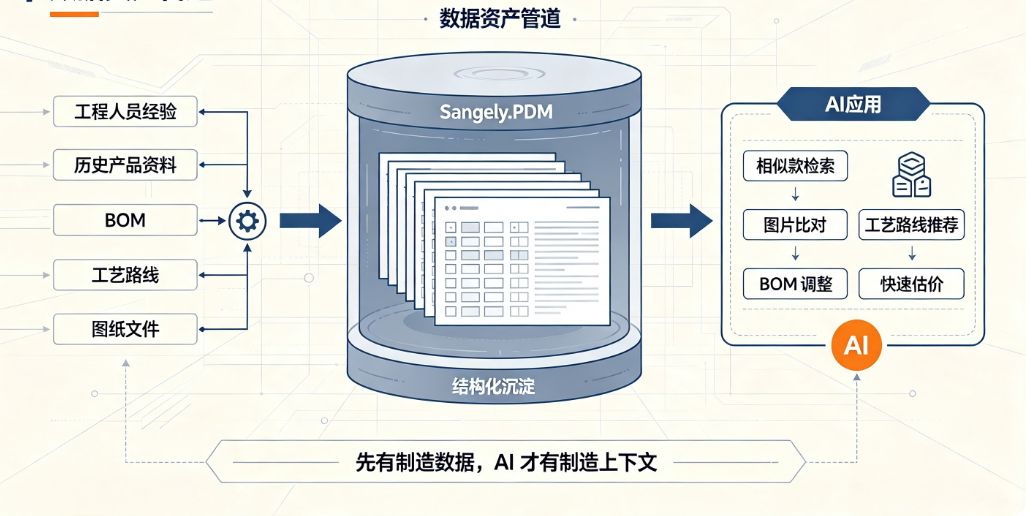
Only when product records, BOMs and process routings are progressively brought into a system can historical manufacturing experience become data that machines can also search, associate and reuse.
*Sangely.PDM currently supports similar-style searches through keywords or image comparison. After a user confirms the match, the system can retrieve the corresponding process routing and use existing data as a basis for adjusting the BOM, process routing and cost estimate.*
This illustrates an important direction:
Manufacturing data must come first; only then can AI have manufacturing context.
3. AI Does Not Have to Begin with Decision-Making; It Can First Reduce Information Conversion
Manufacturers handle large amounts of repetitive information every day. When customer documents arrive, sales personnel review them first and then enter the information again in a sample order. Customers use their own product names, so employees must also search for the corresponding materials inside the company.
These tasks may not be complex, but they consume substantial time.
*Sangely.PDM has already applied AI to these scenarios. AI can recognize incoming customer documents and connect the extracted information with a sample order. It can also identify product names supplied by customers and match them with material master data in ERP.*
AI does not replace sales or business personnel in this process.
Instead, it reduces the repeated work involved in reading documents, locating records and re-entering information. These practical scenarios represent a more realistic path for manufacturing AI to be introduced step by step.
4. The Next Step: Connecting AI with Business Conditions
Manufacturing operations are complex because business processes usually have prerequisites.
Before an order can enter production, for example, the sample may need approval and the required materials must be ready. Shop-floor execution should begin only after the production conditions have been met.
Under a traditional operating model, people move this process forward manually. Sales notifies procurement, procurement notifies planning, and planning then notifies production.
*Sangely supports a conditional-trigger scenario: when material readiness and sample approval have both been confirmed, the system can trigger an ERP order according to configured conditions and pass the relevant data to the Manufacturing Execution System (MES).*
The business logic can then become:
Customer Requirements → Enterprise Data → Business Status → Conditional Logic → ERP → MES
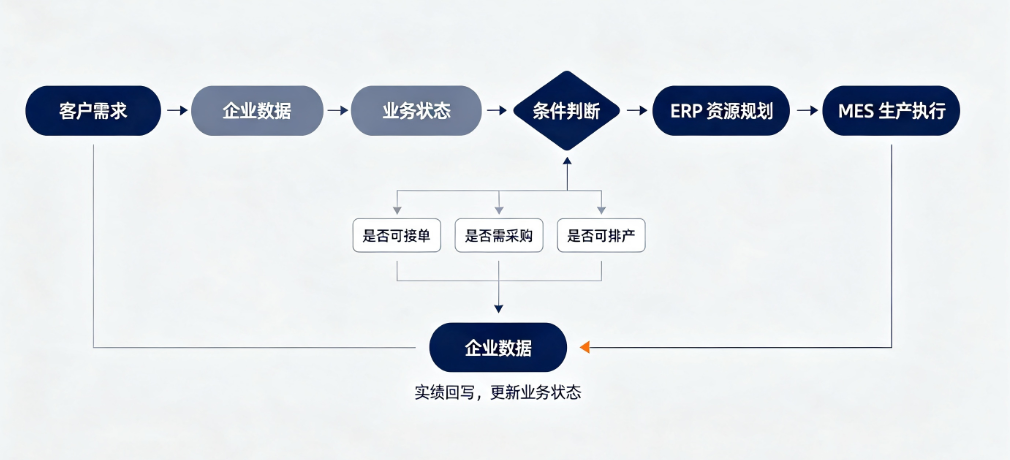
This is an important distinction between manufacturing AI and a general-purpose AI tool. AI begins to move from answering questions toward participating in a defined process.
5. Why Can Manufacturing AI Not Operate Separately from PDM, ERP and MES?
Because real manufacturing operations already exist within these systems.
*Product Data Management (PDM) holds product-development data. Enterprise Resource Planning (ERP) holds orders, materials and resource-planning data. MES manages shop-floor execution.*
If AI operates separately from these business systems, it knows only the temporary information that a user provides during an interaction.
When AI is connected with the manufacturing data architecture, it has the opportunity to understand:
What the company has made before, what it is making now, and what should be connected next.
Sangely's product architecture is built around:
PDM → ERP → MES
On this foundation, AI can participate in information recognition, historical-data reuse and process connections under clearly defined business conditions.
Sangely therefore does not define manufacturing AI as another chat tool placed beside operational software.
Instead, the objective is:
To let AI progressively enter the manufacturing business chain that already exists.
6. What Will Define a Manufacturer's Real AI Competitiveness?
AI models will continue to improve, and AI tools will become increasingly widespread. Simply using AI is unlikely to remain a unique long-term capability for any manufacturer.
What is difficult to replicate is the product information accumulated over many years, historical BOMs, process data, material systems and business rules;
And the relationships that have already been established among those data assets.
This is the context that AI truly needs when it enters a manufacturing company.
As manufacturers enter the AI era, the investment that matters is not limited to AI tools.
It also includes:
Turning product experience into data, turning business processes into systems, and connecting manufacturing data across functions.
Once these foundations are progressively established, AI is no longer only a general-purpose tool outside the enterprise.
It can begin to become part of the company's manufacturing capability.
Conclusion
The real dividing line in manufacturing AI is not whether a company has connected to AI.
It is whether AI has manufacturing data that it can understand.
Without product, BOM, process and business data, AI mainly helps individuals process information.
Once a company has progressively established product data, resource data and production data, AI has the opportunity to move from:
Information recognition, to data association, and then to process collaboration.
*Within Sangely's PDM, ERP and MES data architecture, AI can participate in recognizing incoming customer documents, matching product names, retrieving historical products and connecting process steps under explicit business conditions.*
What manufacturers should build for the future is not only AI capability.
They should build a data foundation that enables AI to understand real manufacturing operations.
FAQ
Q1: Why do manufacturers need PDM when adopting AI?
PDM retains product data such as CAD files, BOMs, process routings and historical product records. The more complete this product data becomes, the more effectively AI can support search, matching and assistance within real product-development processes.
Q2: Is Sangely AI a chatbot?
Sangely AI is not designed solely for conversation. It supports scenarios such as recognizing incoming customer documents, matching customer product names with ERP material master data, retrieving historical products and connecting process steps under clearly defined conditions.
Q3: Can AI manage the entire manufacturing process automatically?
No. Within Sangely.PDM, AI assists with recognition, matching and data reuse, and it can support process triggers under specific business rules. This should not be interpreted as every manufacturing process operating without human involvement.