
For manufacturers of bags and handbags, managing more products involves more than managing more orders.
As orders increase, styles, colorways, material combinations and customer changes also increase. A new color, a different primary material or a local material change may appear to be one product revision, but it can continue to affect the BOM, material consumption, quotation, purchasing preparation and production documents.
The real complexity of bag manufacturing is therefore not “how to calculate one material requirement,” but:
When a product keeps changing, can the data and calculation results already created continue to serve as the foundation for downstream work?
Sangely intelligent-nesting computing focuses on this need for continuous calculation from product development through resource planning and manufacturing execution.
1. Calculation complexity in bag manufacturing comes from continuous product change
Highly standardized products can be manufactured repeatedly under stable conditions, but bag manufacturing contains extensive variation.
The same style may have different colorways, different orders may use different materials, and primary materials may form different combinations. Customers may also continue to adjust structure, materials and product solutions during development.
A simple customer change can therefore create a new set of manufacturing conditions inside the factory.
When one material changes, the company must determine whether the BOM needs revision, whether material consumption changes, whether new consumption affects quotation and cost judgment, and which actual conditions should be used for recalculation during purchasing and production. The challenge is not merely calculation speed.
It is how the calculation logic continues to change with the product.
2. Moving from experience-based calculation to enterprise data and computing capability
Bag factories have always faced complex material and colorway problems.
When product volume was limited and order structures relatively stable, experience could carry much of the work.
Experienced engineers and nesting specialists often knew which materials a product type used, how similar combinations had been handled, and how different patterns should be arranged.
This experience is highly valuable.
As the company grows, however, relying only on individual memory reaches its limits.
Products increase, colorway relationships become more complex, material combinations multiply, and development and production stages require different data.
An experienced person may know many products, but cannot remain the permanent database for every historical product, version and calculation relationship.
The necessary upgrade is therefore not simply helping one person “calculate faster.”
It is gradually establishing:
A product-data and calculation foundation that the enterprise can continue to use.
3. Why can repeated calculation remain after CAD, ERP and MES are in place?
Many manufacturers already have CAD and ERP, and some have also deployed MES.
Having systems does not make data continuous. CAD addresses design. ERP manages orders, materials and enterprise resource planning. MES manages manufacturing execution. Without a shared product-data foundation, product changes can still create new manual conversions between these stages.
For example:
Design modifies CAD; engineering reorganizes the BOM; ERP users reconfirm materials and consumption;
And before production, the company calculates again according to actual manufacturing conditions.
Two concepts must be distinguished here.
Recalculation at different stages is not inherently a problem.
Product development, quotation, purchasing preparation and actual production can face different conditions.
For mass production, actual incoming materials, order quantities and production conditions may legitimately require recalculation.
The real question is:
At every new stage, must the company understand the product again from the beginning, reorganize the basic data and rebuild the calculation conditions?
If the answer is yes, more than calculation time is being wasted.
The company also repeats data preparation and manual confirmation.
4. Sangely begins solving the calculation problem from the product-data foundation
Continuous calculation first requires continuous data. Sangely therefore does not understand intelligent nesting as an isolated nesting tool. Product data begins at the design source.
The overall logic can be understood as:
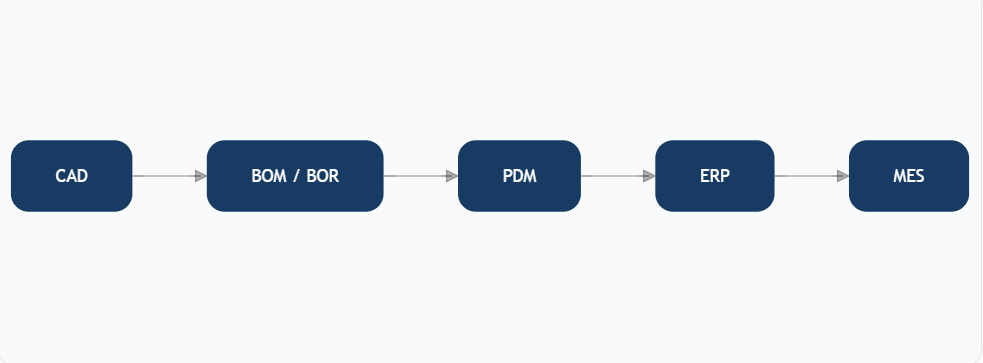
CAD Drawings → Product Data → BOM Material Structure → BOR Process Routing
BOM describes the materials required by the product.
BOR describes the process routing through which the product should be manufactured.
Together they give manufacturing meaning to product information that previously remained at the design stage.
On this foundation, material calculation, resource planning and manufacturing execution have clearer data sources.
In other words:
For computing capability to remain continuous, product data must first remain continuous.
5. Manufacturers need more than one material calculation at one stage
Intelligent nesting is easily understood as an independent calculation tool.
Patterns and conditions are entered, a nesting solution is calculated, and material-use results are produced.
That capability is important.
Across the complete manufacturing process, however, one calculation does not solve every problem.
A product passes through different business stages.
During product development, product structure, BOM and process data must be established.
In ERP, planning continues around orders, materials and enterprise resources.
During actual production, calculation and execution must reflect real shop-floor manufacturing conditions.
A computing system suited to manufacturing should therefore behave as follows:
Sangely extends intelligent-nesting computing from PDM and ERP into MES to create a calculation foundation spanning different manufacturing stages.
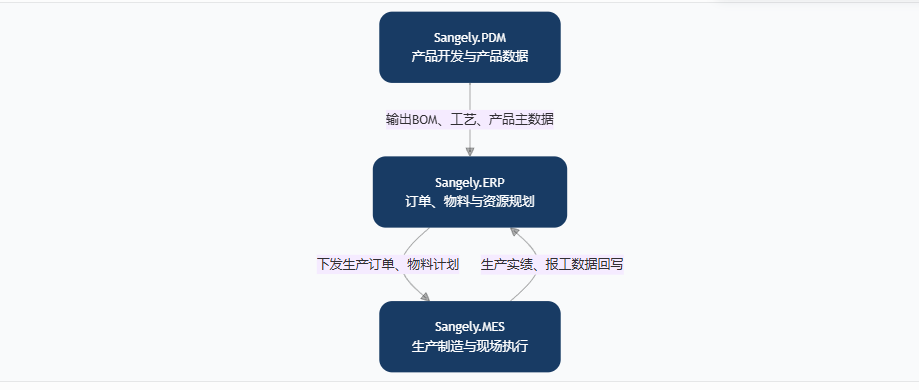
“Spanning” does not mean that every stage uses exactly the same calculation result.
It means:
Product data continues downstream, and each stage calculates according to its own business conditions.
6. What must be reduced is “starting again from zero every time”
Material waste is easy for manufacturers to observe.
Changes in how much of a roll is consumed or in utilization shown by a nesting result are relatively visible.
There is also a less visible cost in manufacturing:
Repeatedly interpreting the product.
Engineering organizes it once.
Purchasing confirms it again.
Another business stage establishes the calculation conditions again.
Before production, the data is checked one more time.
These activities are not wrong; the roles do have different responsibilities.
The problem is:
If every role cannot use the basic data already formed upstream, substantial time continues to be consumed by repeated organization and explanation.
This complexity grows with the number of products, colorway relationships and material combinations.
Continuous computing is not intended to eliminate the professional judgment required at each stage.
It is intended to:
Let professional judgment build on an existing data foundation rather than begin from a blank page every time.
7. How does Sangely intelligent-nesting computing span PDM, ERP and MES?
Sangely positions intelligent-nesting computing as more than a stand-alone nesting application.
Its more important role is to let computing capability continue to operate around product data at different manufacturing stages.
PDM Stage: Establish product and manufacturing master data
CAD drawings enter product development and are extended into BOM, BOR and other product data, providing a foundation for downstream material and manufacturing calculations.
ERP Stage: Enter orders, materials and resource planning
When the product enters commercial and mass-production stages, product data connects with orders, materials and resource planning, and is calculated according to current business conditions.
MES Stage: Continue supporting manufacturing execution
During actual manufacturing, product and material data established upstream continues into production, where corresponding calculations and execution reflect real production conditions.
This creates the following result:
Intelligent-nesting computing no longer remains isolated in one department; it becomes one of the data-computing capabilities connecting multiple stages.
8. Why do colorways and multiple primary-material combinations require continuous calculation?
Much of the complexity of bag manufacturing comes from combinations: different colorways, combinations of primary material 1 and primary material 2, local material substitutions, and changes among order solutions.
If data remains only in one nesting result, a change in product conditions can force downstream work to restart.
Sangely intelligent-nesting computing instead aims to establish:
Product-condition change → product-data change → downstream stages continue calculating from the new data.
This differs from “calculating one nesting result.” One solves a calculation at a single point.
The other solves how computing capability continues throughout the manufacturing process.
9. From a one-time calculation to the manufacturer’s own computing foundation
Valuable computing capability should not remain with one role, tool or business stage.
It should gradually become the enterprise’s own data asset.
How products were made, which materials were used, which BOMs were formed, which process routings were adopted, and which calculation conditions were used at each stage should remain available.
When this information is retained and reused downstream, the company can handle more orders and changes with less dependence on individual memory.
This is the core logic behind combining Sangely intelligent-nesting computing with PDM, ERP and MES:
Not merely calculating faster, but giving calculation a continuous data foundation.
Conclusion: The key is not whether the company can calculate, but whether it can continue calculating
For bag manufacturers, more orders are not inherently the problem.
The challenge is that more orders bring more products, colorways, material combinations and customer changes.
If every change requires engineering, purchasing, planning and production to rebuild data from zero, management complexity continually rises.
Future manufacturers therefore need more than one material calculation.
They need a computing system that continues to work with product data.
Sangely starts from CAD drawings, establishes manufacturing data through BOM and BOR, and extends intelligent-nesting computing from PDM and ERP into MES.
Each stage can still recalculate according to its own business and production conditions, without rebuilding the product and consumption foundation from zero every time.
This is the problem Sangely intelligent-nesting computing is intended to solve:
Not merely producing one nesting layout, but allowing computing capability to move downstream with manufacturing data.
From product development, to resource planning, to manufacturing execution.
Each set of data already formed can continue to become the foundation for the next manufacturing stage.
FAQ
Q1: Is Sangely intelligent nesting only a nesting tool?
No. Sangely intelligent-nesting computing can extend from PDM and ERP into MES to support calculations and data at product-development, resource-planning and manufacturing-execution stages. Its focus is not one nesting result, but computing capability that continues downstream with manufacturing data.
Q2: Are calculation results in PDM, ERP and MES exactly the same?
No. Different stages may face different product, quotation, purchasing, incoming-material and production conditions, so stage-specific recalculation is appropriate. Continuous calculation means that product data established upstream becomes the foundation for downstream calculations instead of being rebuilt from zero.
Q3: Why are BOM and BOR important to intelligent-nesting computing?
BOM describes the materials a product needs, while BOR describes its process routing. Together they form an essential data foundation from design into manufacturing so material calculation, resource planning and execution can use clearer product data.
Q4: Which manufacturing scenarios suit Sangely intelligent nesting?
Current product capabilities primarily address manufacturers of bags, handbags, footwear and headwear that use CAD drawings and face complex colorways, multiple-material combinations and material-consumption calculations.
Q5: Why do more product changes require a continuous data chain?
Color, material and structural changes can affect BOMs, consumption and production preparation. If each stage rebuilds its basic data, more product complexity creates more repeated organization and manual confirmation. A continuous data chain lets existing data continue serving downstream stages.