
1. A manufacturer must plan more than one order
An order in ERP appears to contain a product, quantity and due date. Manufacturing must answer much more: Which processes and operations are required? Which materials are needed and when must they be ready? How should existing resources be arranged? When should each operation start and finish?
Production planning is therefore not simply assigning one date to an order. It organizes orders, materials, processes, resources and time.
When orders are few and products stable, experienced PMC planners or supervisors can coordinate these relationships from judgment. As orders grow, products change faster and lead times shorten, managers must process more information. If planning logic remains in the heads of a few people, ERP may store extensive order and material data without fully using it for production planning.
The next challenge is to make existing data participate in the production plan.
2. Sangely ERP master scheduling places orders and manufacturing resources in one plan
In Sangely ERP, master scheduling performs an important production-resource planning and coordination role.
The system starts from order demand and plans with material status, production resources and product process flows. With existing routings, resources and planning data, it can form estimated start and completion times for each operation.
The planning logic can be understood as:
Order Demand → Material Status, Production Resources and Process Flow → Sangely ERP Master Scheduling → Estimated Operation Start/Finish Times → Downstream Production Arrangements
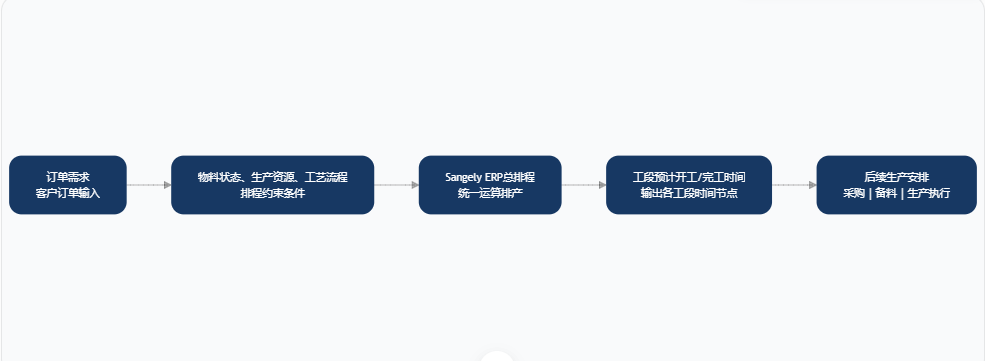
ERP then answers not only “how many orders does the company have,” but also “at what production rhythm should those orders proceed?”
This matters to purchasing, production control and production management. Each role begins to work around relatively clear production-time relationships instead of seeing only its own document.
3. Why must production planning consider materials and processes together?
Whether a manufacturing plan can be executed depends on whether its manufacturing conditions are valid.
If an order is scheduled to start tomorrow but critical materials are not available, the date has little execution value. If the process routing is unclear, the system also lacks a basis for coordinating operations.
Orders are therefore not the only upstream input to production planning.
A more complete relationship begins at the product stage. Sangely.PDM manages development data, including CAD drawings and the resulting BOM and BOR foundation. Sangely ERP then plans orders, materials and resources on that product-data foundation. Sangely MES manages downstream manufacturing execution.
In other words:
PDM manages product data, ERP manages resource planning, and MES manages manufacturing execution.
When products, materials, processes and resources share a data foundation, a production plan becomes more than a manually entered date and can reflect the manufacturing conditions behind the order.
4. Once a plan is formed, the key is whether it can continue into the workshop
A common digitalization break occurs after “the plan has already been created.”
ERP contains the production arrangement, but before work reaches the floor it may be exported to Excel, reorganized into production sheets, communicated manually, and then rearranged by supervisors. The company ends up with two plans: one in ERP and another in actual workshop execution.
Coordination between Sangely ERP and MES allows the plan to continue into execution.
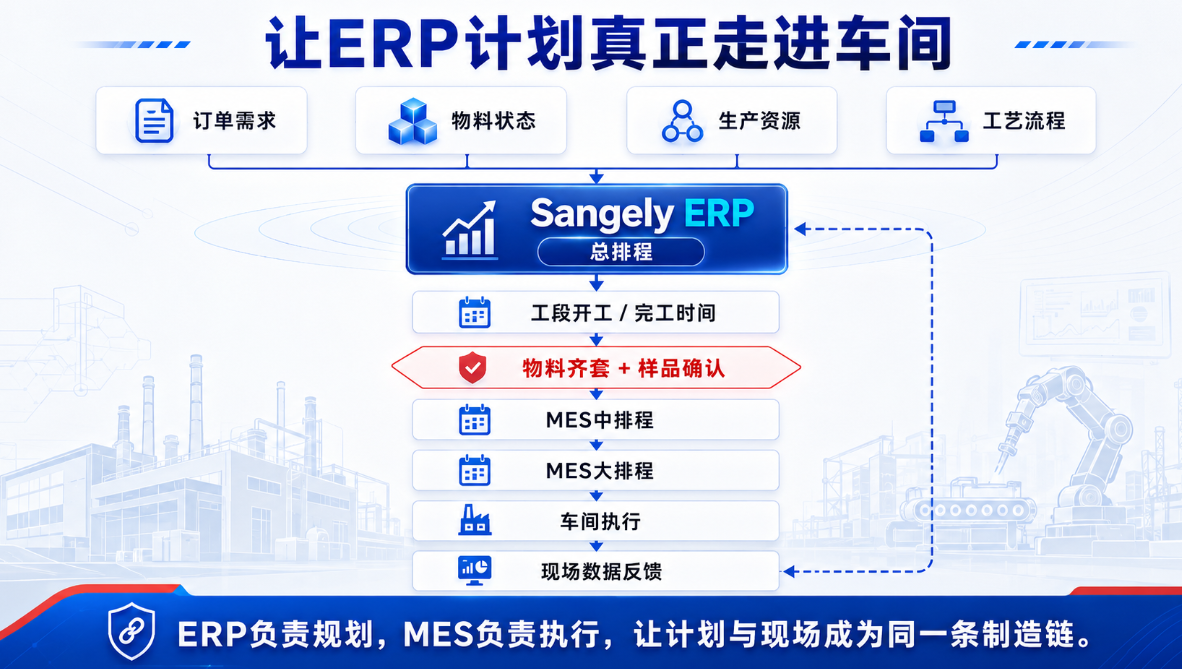
After defined conditions such as material availability and sample approval are satisfied, the production plan can be pushed to MES according to the company’s configured process. MES then manages intermediate scheduling, detailed scheduling and shop-floor execution.
The relationship becomes:
ERP Master Scheduling → MES Intermediate Scheduling → MES Detailed Scheduling → Shop-Floor Execution
This does not mean that “the workshop never adjusts after ERP creates the plan.” Real production conditions continue to change, and professional human judgment remains necessary.
The important change is that after the plan moves from ERP to MES, the enterprise does not have to rebuild a completely independent information chain between the system and the shop floor.
5. ERP and MES must connect planning with execution
ERP and MES have different responsibilities.
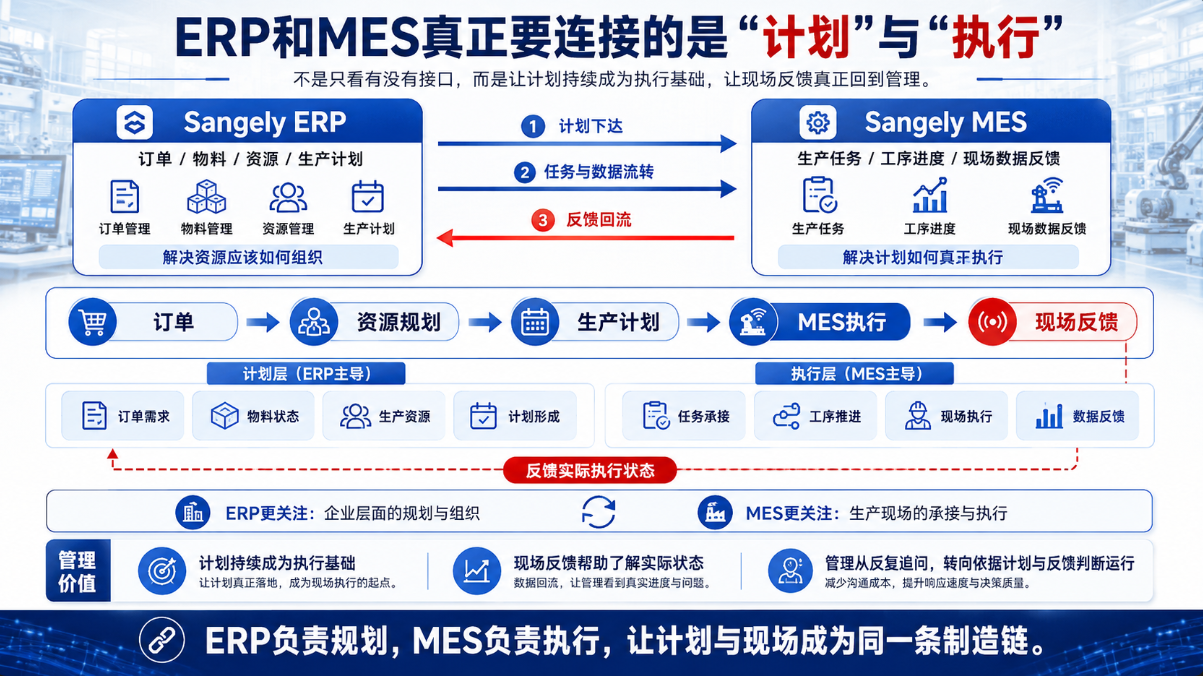
Sangely ERP focuses on enterprise orders, materials, resources and production plans—how resources should be organized. Sangely MES is closer to the shop floor and manages production tasks, process progress and shop-floor feedback—how the plan is actually executed.
Effective coordination cannot be judged only by whether “the two systems have an interface.”
The more important questions are:
Can the plan formed in ERP become the basis for MES execution? Can shop-floor data generated in MES show the enterprise the actual execution state?
This gradually creates:
Order → Resource Planning → Production Plan → MES Execution → Shop-Floor Feedback
as a manufacturing business chain.
With continuity between planning and execution, managers do not have to rely only on repeatedly asking where an order is. They can evaluate operations through plan status and shop-floor feedback.
6. Why does production scheduling also affect purchasing and material preparation?
Production scheduling is not only a production-department matter.
If the company knows which materials are missing but not when they are needed, purchasing and preparation cannot align reliably with production rhythm.
Preparing too early occupies storage and capital; preparing too late can leave the workshop waiting when it is ready to start.
Once master scheduling creates time points for operations, it gives purchasing, material preparation and production a shared time reference. Purchasing sees not only required quantity but also when demand occurs in the production rhythm.
A working production plan therefore connects upstream supply preparation and downstream manufacturing execution.
7. Digital production planning does not eliminate experience; it places experience on data
Manufacturing experience accumulated over time is extremely important.
Strong plant managers and PMC planners know which orders are urgent, which materials are likely to be delayed and which operations become bottlenecks. A system should not simply replace these judgments.
If all planning logic remains in a few people’s heads, however, it cannot become a repeatable organizational capability.
Digital planning first creates a clearer foundation from orders, materials, processes and resources, after which managers judge and adjust according to real production conditions.
Moving from “experience-driven” to “plan-driven” does not remove experience. It frees experience from repetitive information preparation so it can focus on exceptions, resource coordination and production improvement.
8. From one factory to multiple factories, planning needs a unified architecture
Planning becomes more complex when a manufacturer operates multiple factories.
The group must manage product data, orders and resources, while each factory executes according to its own conditions. If every factory builds independent product data and planning logic, group coordination increasingly depends on manual consolidation.
Sangely supports an architecture with group PDM, group ERP and MES for multiple factories, including cross-network and cross-domain operating modes.
The group can plan products and business resources, while each factory receives actual manufacturing execution through MES.
This does not mean the system automatically decides which factory produces every order. It establishes clearer data relationships between group planning and multi-factory execution.
9. Sangely ERP shortens the distance between the plan and the shop floor
The value of manufacturing ERP cannot be judged only by its menus, documents and reports.
A better test is whether an order can form a production plan, whether that plan reflects materials, processes and resources, whether it can continue into MES, and whether shop-floor execution status can return to enterprise management.
Sangely ERP master scheduling sits between business demand and the manufacturing site.
Upstream, it receives orders, materials, resources and process data. Downstream, it connects MES scheduling and shop-floor execution.
The intended result is not a more complicated planning table, but a more continuous manufacturing chain:
Order → Resources → Plan → Execution → Feedback
Conclusion
ERP first brought basic information such as orders, purchasing, inventory and materials into manufacturing systems.
As manufacturing complexity increases, companies must ask whether that existing data can truly participate in production.
Through master scheduling, Sangely ERP plans order demand, material status, production resources and process flows together. After defined conditions such as material availability and sample approval are satisfied, the plan continues into MES.
ERP manages planning; MES manages execution.
What they need is not merely an interface, but a data relationship that continues from resource planning into the shop floor.
When the plan no longer remains in the office and continues into the workshop, ERP moves from “recording what happened” toward helping organize what production should do next.
FAQ
Q1: Why does production planning still rely heavily on people after ERP is implemented?
Having order, purchasing and inventory data in ERP does not automatically create a production plan. If orders, materials, resources and process flows are not planned together, or the plan does not continue into MES execution, the shop floor still requires extensive manual coordination.
Q2: What does Sangely ERP master scheduling do?
Starting from order demand, Sangely ERP master scheduling plans material status, production resources and process flows. With the necessary master data, it creates estimated start and completion times for operations and provides a basis for downstream arrangements.
Q3: What are the separate responsibilities of Sangely ERP and MES?
ERP manages enterprise resource planning, order coordination and production planning. MES manages shop-floor tasks, process progress and production feedback. Together they create continuity from planning to manufacturing execution.
Q4: When can an ERP plan continue into MES?
After defined conditions such as material availability and sample approval are satisfied, the system can push the relevant plan into MES intermediate scheduling, detailed scheduling and downstream shop-floor execution according to the company’s configured process.
Q5: Can master scheduling completely replace PMC and plant-management experience?
No. Real production continually faces changes in orders, materials and shop-floor conditions. Master scheduling provides a more complete data and planning foundation, while professional human judgment remains essential.
Q6: Does Sangely support group-level multi-factory coordination?
Sangely supports group PDM, group ERP and MES for multiple factories, as well as cross-network and cross-domain coordination. Implementation must still be planned around the company’s actual organization, factory structure and processes.