
When a manufacturer operates only one factory, many management problems are less complex than they may appear.
The engineering manager knows where the product information is stored. Production planning and material control personnel know which order is urgent. Experienced technicians remember how a style was made before. When an exception occurs, the plant manager can often visit the shop floor and identify the likely cause.
At this organizational scale, direct communication can temporarily bridge data gaps between departments. A phone call or a message is often enough to move the work forward.
The situation changes when the company opens a second or third factory.
The problem for many companies is not the absence of systems. It is that a data architecture designed for one factory can no longer support the new organizational relationships created by expansion.
Headquarters receives the customer order. A group engineering team defines the product. Factory A produces one part of the order, while Factory B undertakes another manufacturing task. Management must now consider more than whether the order was issued: Are all factories using the same product-data version? Are their BOMs consistent? Do resource plans conflict? Can production progress be reported promptly? Will a change at one plant affect delivery of the entire order?
This is why the digital architecture must be redesigned when a manufacturer moves from single-factory operations to group manufacturing.
1. The First Multi-Factory Question Is Not How to Allocate Orders, but Which Product Data Is Authoritative
When a company expands from one factory to multiple production sites, it is natural to focus first on order allocation, capacity coordination and production planning.
For product-based manufacturers, however, the first real step in multi-factory collaboration is to establish a shared product definition.
An order eventually becomes a production task, and every production task must first answer a basic question: Are all sites making the same product?
In a single factory, product information may be scattered across CAD, spreadsheets, folders and employees' computers, yet engineers can still confirm details through direct communication. In a multi-factory organization, if each site maintains its own product records, BOMs and process data, the same product can easily develop into multiple versions.
The engineering department at headquarters may change a material. Factory A adopts the new version while Factory B continues using the old information. One factory may adjust a process to suit its local conditions but fail to update the group product record. As product volume grows, these differences become increasingly difficult to resolve manually.
The first principle of group manufacturing should therefore be:
Unify the product definition first, and then coordinate execution across factories.
The value of PDM in this context extends beyond storing drawings. It enables group-level product information to become a shared data foundation.
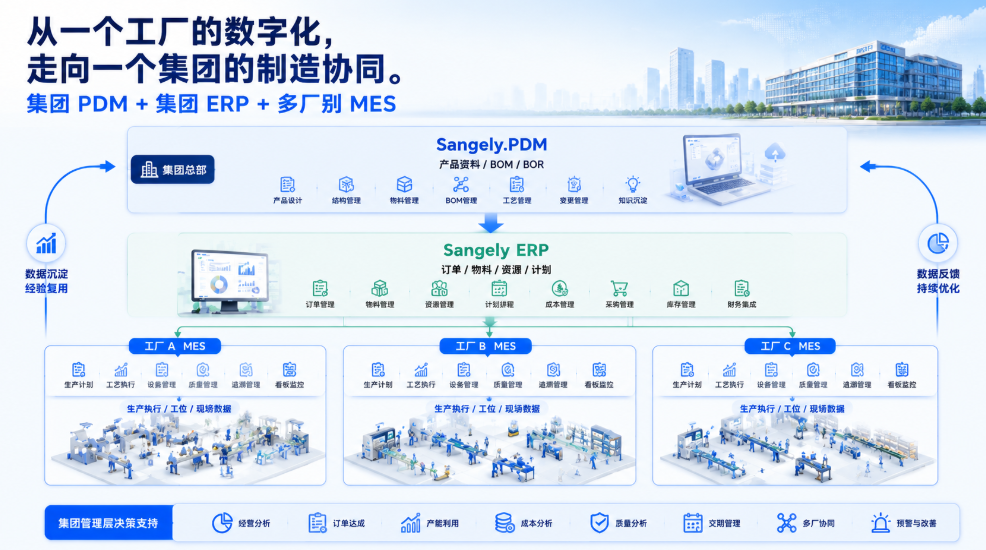
*In Sangely.PDM, product development can proceed from CAD files to manufacturing data such as the Bill of Materials (BOM) and Bill of Resources (BOR). The product definition no longer remains only in design files; it can continue into downstream resource planning and manufacturing execution.*
*This is especially important in group manufacturing. Only when foundational product data is reasonably consistent can orders, materials, plans and shop-floor execution across different factories be based on the same product definition.*
A shared product definition does not mean that every factory must use exactly the same production method. Equipment, personnel and local production conditions may differ. Those differences should be managed on top of shared foundational product data, rather than allowing each factory to create an independent set of product information.
2. After Expansion, ERP Must Do More Than Manage Orders for One Factory
At the single-factory stage, ERP usually focuses on orders, procurement, materials and enterprise resource management.
Once the company begins operating as a group with multiple factories, the business relationships handled by ERP become more complex.
One order may involve several production sites. Material preparation may require cross-department coordination. Each factory has different production resources, while group management needs a higher-level view of the relationships among orders, resources and production plans.
ERP therefore plays an important role in enterprise orders, materials and resource planning within a group manufacturing architecture.
One distinction is important: group ERP is best understood here as a description of the group manufacturing architecture, while Sangely ERP is the product system that performs resource planning.
Group-level manufacturing collaboration begins with shared product data and then combines order demand, material status, production resources and process requirements for planning. Once the plan is formed, it must continue into the relevant factories.
The key difference from a single-factory model is that the question changes from how one plant should produce to how the group should plan and how different factories should execute.
If ERP continues to operate only within the boundary of one factory, new data silos can form among sites. Headquarters has one plan, each factory has its own arrangement, and group operating plans must be reconciled manually with actual shop-floor execution.
Multi-factory digitalization is therefore not the act of copying one ERP system into every plant. It requires a new relationship between group-level data and resource planning and the different production sites.
3. Once Plans Reach a Factory, MES Must Carry Them into Actual Manufacturing Execution
The group can establish shared product data and create resource and production plans, but manufacturing ultimately takes place in individual factories.
This defines another important boundary in group manufacturing: the group coordinates and plans, while factories execute and provide feedback.
Headquarters needs to know what the product is, how the order is planned and how resources are coordinated. Each factory must turn those plans into daily production tasks and continuously report the status of shop-floor execution.
MES provides the manufacturing-execution layer in this architecture.
Each factory accepts tasks according to its own production conditions. Progress and shop-floor data generated during production are then fed back, enabling group management to see not only where work was planned, but also how far actual execution has progressed.
A multi-factory architecture therefore does not require one larger monolithic system. It requires a layered collaborative relationship.
*The group level is responsible for product definition and resource planning, while each factory is responsible for actual manufacturing execution. Plans can move downward into execution, and shop-floor results can return as feedback.*
If group management has only plans and no factory execution data, it can see only the intended plan. If each factory has an isolated MES that is not connected to group product and operating data, headquarters must still consolidate the overall status manually.
Multi-factory manufacturing must connect these two levels.
4. The Hardest Part of Multi-Factory Digitalization Is the Change in Organizational Boundaries
When companies first implement digital systems, the default organizational boundary is usually one factory.
Product data belongs to that factory, ERP serves that factory, and MES is deployed inside that factory. Business processes, user permissions and network environments are all organized around the same entity.
Group manufacturing breaks this boundary.
Product development may be centralized at headquarters, orders may be accepted at the group level, and production may be distributed across several factories. Sites may operate in different regions and maintain their own networks and shop-floor environments.
The digital architecture must therefore answer a new question:
Which data should be standardized at the group level, which operations should be executed independently by factories, and how should a stable data relationship connect the two?
This is why multi-factory digitalization cannot be understood merely as adding more user accounts or factory records.
When the organizational structure changes, the system architecture must change with it.
*Sangely's group multi-factory architecture supports cross-network and cross-domain operating modes. It establishes collaboration among group PDM, Sangely ERP and factory-specific MES environments, connecting group product data and operating plans with manufacturing execution at different factories.*
*The objective is not to turn every factory into an identical organization. It is to establish a clear relationship between the group's shared data foundation and the actual production conditions of each factory.*
5. A Multi-Factory Architecture Must Balance Group Standardization with Independent Factory Execution
Group manufacturing can move toward two extremes.
At one extreme, headquarters standardizes everything and expects every factory to work in exactly the same way. This appears centralized, but it can overlook differences in equipment, personnel and actual production conditions.
At the other extreme, every factory operates independently. Each site maintains its own product records, plans its own work and manages its own shop floor. Headquarters can understand overall operations only through reports and manual consolidation.
A more practical group manufacturing architecture must find a balance between these two models.
Foundational product data and group-level operating plans should be standardized wherever practical, while factories retain the flexibility to execute production according to their local conditions.
This relationship can be summarized as:
The group standardizes product data and operating plans. Factories undertake actual manufacturing execution and return the execution results.
Headquarters can then move away from repeatedly calling each factory to ask what has happened and progressively establish a data architecture that shows the relationships among products, orders, plans and shop-floor execution at group level.
For management, the value is not simply access to more reports. Group operations begin to rely on a shared foundation of business data.
6. Why Does PDM Become Even More Important in Group Manufacturing?
When companies discuss group-level digital development, group ERP is often the first idea that comes to mind.
This is understandable. As the organization expands, it must strengthen order, resource, supply-chain and operating management.
For manufacturers of bags, footwear, apparel and other products with frequent changes and complex material combinations, however, even strong resource planning may rely on inconsistent information if product data has not been standardized.
Group manufacturing cannot begin only with the question of how to manage more factories. It must return to the product source and ask:
Are different sites looking at the same product definition?
Do BOM changes have clearly controlled versions?
After product information changes, is downstream resource planning still based on accurate data?
*This is why PDM sits at the front of Sangely's group architecture.*
*Group PDM, Sangely ERP and factory-specific MES correspond to three different stages of manufacturing operations: product definition, resource planning and manufacturing execution.*
*Once these systems are connected, group multi-factory digitalization is no longer the act of placing several factories inside one system. It enables different organizations to collaborate around the same manufacturing data.*
7. What Should Manufacturers Reconsider When Moving from One Factory to Group Manufacturing?
Manufacturers entering a multi-site, multi-organization stage can no longer follow the simple model of implementing an independent system for each factory.
They must answer several foundational questions again: Is there one authoritative source for group product data? Do different factories work from reasonably consistent product definitions? How are group-level orders, materials and resources planned? How do plans continue into different factories, and how does actual execution at each factory return to the group level?
The answers determine whether the company merely owns several digital factories or is establishing a group manufacturing digital architecture.
*Sangely's group multi-factory architecture is built around collaboration among group PDM, Sangely ERP and factory-specific MES environments, and it supports cross-network and cross-domain operating modes.*
*Its core logic is not to let one system replace every management responsibility. Instead, it clarifies the responsibility of each stage: PDM establishes the group product-data foundation; ERP plays an important role in orders, materials and resource planning; and MES manages manufacturing execution and shop-floor feedback at each factory.*
*When these three levels progressively form a continuous relationship, the digital architecture can keep pace with the organizational changes involved in moving from one factory to group manufacturing.*
*Final Thoughts
When a manufacturer expands from one factory to multiple production sites, the increase is not only in the number of factories. The relationships among products, orders, resources, organizations and shop floors also multiply.*
Problems once solved through direct communication grow rapidly at group scale. Product-version consistency, cross-organizational planning and the execution status of each factory can no longer depend on the experience of a few individuals.
For manufacturers of bags, footwear, apparel and other frequently changing products, the greatest group-management challenge is not merely managing more factories. It is enabling different factories to work together around shared product data and operating plans.
Multi-factory digitalization therefore requires a redesigned data relationship that begins with product definition, continues through resource planning and reaches manufacturing execution at each factory.
The group standardizes and plans; factories execute and provide feedback. Product data is the starting point, ERP performs planning, and MES carries the plan into the shop floor.
This is the new architecture manufacturers need when moving from single-factory digitalization to group manufacturing digitalization.
FAQ
Q1: Why must a manufacturer redesign its system architecture after it already has ERP and begins operating multiple factories?
A single-factory ERP usually operates around the orders, materials and resources of one plant. Once the company has multiple production sites, product data, resource planning and manufacturing execution cross organizational boundaries. The original data relationships may no longer support group collaboration. The company must reconsider how group data is standardized, how factories execute, and how execution results are returned.
Q2: Why should multi-factory digitalization begin with PDM?
For product-based manufacturers, procurement, planning and production all depend on the product definition. If factories use different versions of BOMs, process routings or product records, downstream planning and execution can easily diverge. Multi-factory collaboration should therefore establish a reasonably consistent product-data foundation first and then allow each factory to execute according to its actual conditions.
Q3: What roles do PDM, ERP and MES perform in group manufacturing?
PDM primarily creates and manages data during product development. ERP plays an important role in orders, materials and enterprise resource planning. MES operates closer to each factory's shop floor, managing production tasks, execution progress and feedback. Connected through data, the three systems form a manufacturing chain from product definition to resource planning and manufacturing execution.
Q4: Does Sangely support multi-factory collaboration across regions?
Sangely's group multi-factory architecture supports cross-network and cross-domain operating modes and establishes collaboration among group PDM, ERP and factory-specific MES environments. The implementation must still be planned around the company's actual organization, network environment and manufacturing operations.
Q5: Does multi-factory management require every factory to use exactly the same production method?
No. Group management should establish a shared foundation for product and operating data, but this does not require identical execution at every factory. Each factory can produce according to its equipment, workforce and production conditions. The key is for execution to rely on reasonably consistent data and remain connected with group planning.