
When a manufacturer develops a new product, drawing it is rarely the only time-consuming work.
After customer requirements enter the company, sales and engineering must understand the information, search historical products, judge whether similar structures exist, organize materials, establish the BOM, confirm process routings and estimate cost.
For bag and handbag manufacturers with many frequently changing products, this work repeats every day. Drawings, BOMs and process data continue to accumulate, yet a new requirement may still send engineers back to “finding the documents.”
Have we made a similar style? Which historical product is closest? Can its process routing be reused? Is this only a local change, or must the entire product structure be rebuilt?
The important question is not whether historical data exists, but:
Can accumulated product data truly participate in the next product-development cycle?
Sangely.PDM intelligent product development addresses this question by connecting customer requirements with existing product data, moving new-product development from “rebuild every time” toward “continue from historical data.”
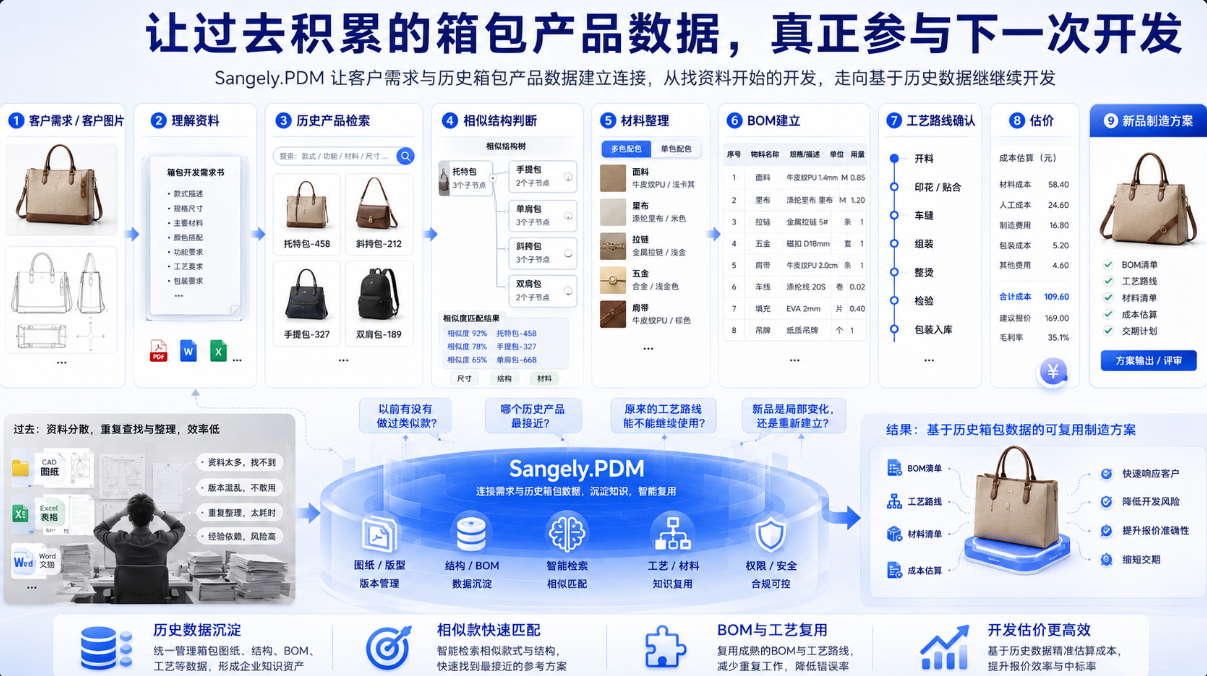
1. When customer information enters the company, it must become reusable product data
Customers often provide an image, a drawing file or a set of product requirements.
The factory must do more than save the file. This information should become data that downstream development, material analysis and manufacturing preparation can use.
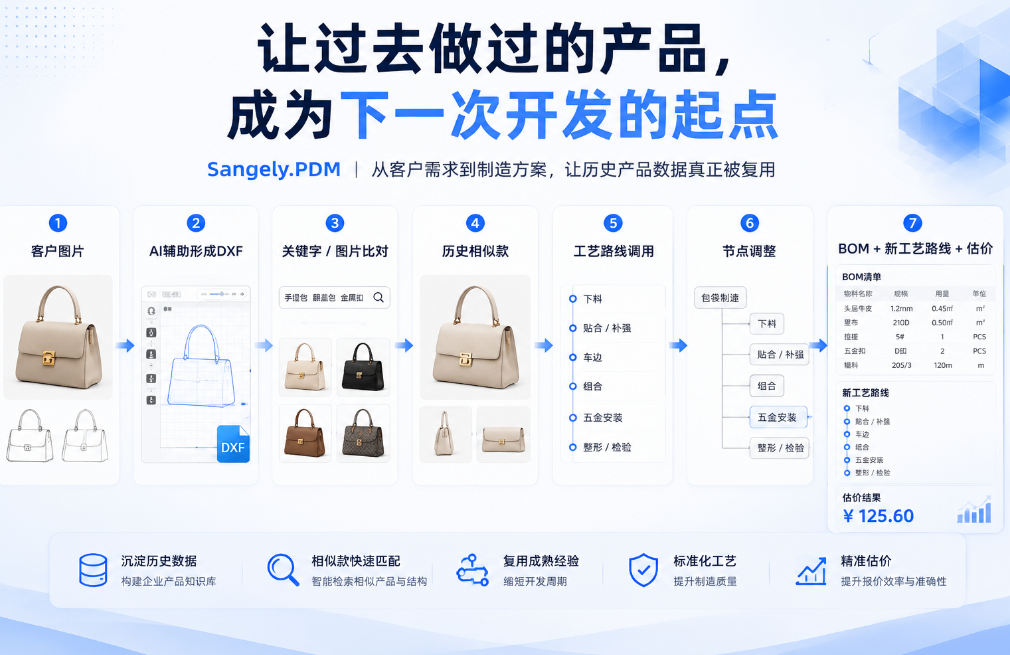
Starting from a customer image, Sangely.PDM can use AI assistance to form a DXF vector document so external input can enter the product-data process.
This step is more than “converting an image into another file format.”
It begins to bring external customer information into the company’s product-data system and establishes a foundation for product structure, BOM, process routing and the manufacturing solution.
Customer-image-to-DXF is not the only development entry. The company’s accumulated historical drawings and product data can also provide an important starting point.
2. The value of history lies in whether historical products can be found again
The longer a manufacturer operates, the more products it has made.
Many customer requests do not begin completely from zero. A new style may resemble a previous structure, changing only certain materials, colorways or local design, or it may reuse a proven manufacturing method.
When an experienced engineer sees a new style, a common first thought is:
“Have we made something similar before?”
As product volume grows, individual memory can no longer perform all retrieval.
If experience depends on file names, folders and one employee remembering a past project, accumulated products do not necessarily become a usable data asset.
Sangely.PDM supports keyword search across relevant drawings and image comparison to help find historical similar styles.
Completed products then become more than files on a server; they can return to new-product development.
If the company has made something once, it should not have to start entirely from zero the next time.
3. After a similar style is found, the value comes from reuse followed by adjustment
Finding a similar product does not mean copying it directly.
Differences remain between a new and historical product, including materials, structure or several manufacturing nodes.
After the user confirms a similar style, Sangely.PDM can retrieve the related historical process routing and allow relevant nodes to be adjusted according to the new product.
The business logic can be summarized as:
Historical Data Search → Similar-Style Confirmation → Retrieve Existing Process Routing → Adjust Changed Nodes → Form a New Product Solution
“User confirmation” is essential.
The system helps find past data and provides a reuse foundation; engineers still judge and adjust it according to the new product.
Historical experience thus moves from something used only as a reference to a structured foundation for new development.
4. A BOM does not have to start from a blank page every time
Product development must answer a practical question:
Which materials does this product require?
When a new product changed, engineers traditionally reorganized material relationships and rebuilt the BOM. As products, customer versions and material combinations increase, this repeated work also grows.
After a similar product is confirmed and its changed nodes adjusted, Sangely.PDM can form a new BOM.
This does not mean copying the old BOM unchanged onto the new product.
The more accurate logic is:
Start from an existing product structure, then adjust it around the new product’s changes.
New-product development can then use previously completed product data and reduce repeated searching, organization and rebuilding of foundation data.
For manufacturers with rapidly changing products, reuse creates more value than saving several data entries.
It allows product experience to accumulate instead of returning to a folder after every development project.
5. Process routings should also become reusable enterprise experience
A BOM answers “what is the product made of?” Manufacturing requires another answer:
How should this product be made?
That is the value of the process routing.
A mature manufacturer’s difficult-to-replace capability is not only knowing which materials to use, but knowing how those materials and components become the finished product.
This experience often remains with engineers and experienced workers. When they know the product, problems are resolved quickly; when people change, the same manufacturing knowledge must be relearned.
Sangely.PDM includes process routings in the product-development data system. After a user confirms a historical similar style, the existing routing can be retrieved and relevant nodes modified according to the new product to form a new routing.
A historical product then retains more than a drawing and a BOM.
It also retains:
How the product was manufactured.
When these relationships can be searched, retrieved and adjusted, individual experience begins to become reusable enterprise data capability.
6. Product data enters real business when BOM and process routing continue into costing
A company does not develop a new product merely to create a polished data file.
The business needs to answer the customer more quickly: How is the product made, which materials and processes are required, and how can an estimate be formed from existing data?
After similar-style confirmation, process-routing retrieval and node adjustment, Sangely.PDM can form new BOM, process-routing and costing data.
Not every requirement must follow one identical technical path.
Customer requirements can enter development through different routes:
Entry A: Customer Image → AI-Assisted DXF Product Data
They can also enter through:
Entry B: Keyword Search / Image Comparison → Find Historical Similar Styles
After the user confirms the corresponding product, the process continues with:
Retrieve Existing Process Routing → Adjust Changed Nodes → New BOM / New Process Routing / Costing
This creates a more direct data relationship between product development and business response.
A customer requirement no longer means only “start drawing a new product.” It gradually becomes a product solution that can continue into downstream manufacturing.
7. Intelligent product development uses history better; it does not replace engineers
Discussions of AI in manufacturing often jump to “when will AI design products completely automatically?”
Engineering judgment in complex manufacturing is not that simple.
The more useful question for Sangely.PDM intelligent development is how AI and existing enterprise data each perform an appropriate role.
One current AI application starts from customer images and assists in forming DXF vector documents. The system can also use keyword search and image comparison to find accumulated historical similar styles.
After the user confirms the similar style, existing process routings are retrieved, changed nodes are adjusted, and BOM, routing and costing are formed.
The core is therefore not “AI replaces the engineer.”
It is:
The system helps engineers find, understand and reuse the company’s accumulated product experience more quickly.
AI assists with suitable input recognition, the system organizes historical product data, and people continue to confirm and adjust what requires professional judgment.
This is a practical model for intelligent product development in manufacturing.
8. Sangely.PDM establishes a product-experience reuse chain
Viewed separately, customer-image-to-DXF, keyword search, image comparison, BOM, process routing and costing may look like different functions.
Placed in the complete development process, they form the product-experience reuse chain Sangely.PDM is intended to establish:
Customer Requirement → Historical Data Search → Similar-Style Confirmation → Process Data Reuse → Node Adjustment → New BOM / New Process Routing → Costing
The important result is not a larger number of functions, but:
Products made in the past continue to serve the next development project.
Manufacturers should accumulate more than an increasing number of drawings.
More valuable are products that can be found again, BOMs that can be reused, process routings that can be retrieved and adjusted, and historical experience that can return to new development.
Conclusion: Make a past product the starting point for the next development
Improving development speed does not simply mean asking engineers to “work faster.”
If every new product requires searching, judging, rebuilding the BOM and rebuilding the routing, more historical data can actually create a greater search burden.
A better approach is to bring accumulated product experience back into today’s development.
Starting from customer requirements, Sangely.PDM uses AI assistance to process customer images into DXF product data and uses keyword search or image comparison to help find historical similar products.
After user confirmation, existing process routings and product data can be adjusted to form new BOM, routing and costing information.
The manufacturer can move from:
“We made it before, but today we still have to search and rebuild it.”
to:
“We made it before, so today we can continue development from that foundation.”
This is the value created when product data truly accumulates.
Every completed product should give the next development project more reusable experience.
FAQ
Q1: Can Sangely.PDM directly convert a customer image into DXF?
Sangely.PDM supports using AI assistance to form a DXF vector document from a customer image. Results depend on the source image and actual product scenario and should be confirmed within the business process.
Q2: How does Sangely.PDM find historical similar styles?
The system supports keyword search across historical drawings and image comparison to find similar products, after which the user confirms the appropriate historical style.
Q3: What can be done after a similar style is confirmed?
Existing process routings can be retrieved, relevant nodes adjusted according to new-product changes, and new BOM, process-routing and costing data formed.
Q4: Can Sangely.PDM generate process routings completely automatically?
Sangely.PDM supports retrieving, forming and adjusting process routings, but complex development still requires confirmation against the actual product. It should not be understood as eliminating human judgment in every scenario.
Q5: Which manufacturers are best suited to this development model?
It is particularly suitable for bag and handbag manufacturers with many product models, frequent customer customization, extensive product history, and recurring BOM, process-routing and costing work.