
Many manufacturers already operate more than one digital system.
The design department uses CAD. Management works in ERP. The shop floor runs MES. The warehouse may have its own management system. Viewed department by department, the company may already appear highly digitalized.
Yet when the full business process is considered, a contradiction emerges: the number of systems keeps increasing, but the amount of person-to-person confirmation does not fall significantly.
After customer information arrives, the business team still organizes it again. After CAD work is completed, someone rebuilds the BOM manually. When the product changes, purchasing reconfirms the requirements. ERP creates a production plan, but the shop floor rearranges it. MES contains production data, yet managers still consolidate it manually.
The real problem is not a lack of data. It is that the data has not become one continuous business chain.
1. Data Being Recorded Does Not Mean Data Is Working
Manufacturers generate large volumes of data every day: product data, order data, material data, inventory data, production data, quality data and more.
If that data is used only for lookup and archiving, it remains primarily “recorded data.” Data creates operational value only when it can continue to influence the next business activity.
For example, a product BOM should be able to drive purchasing requirements. Process routing should provide a basis for production planning. An ERP plan should continue into MES, and shop-floor execution results should feed back into the management system.
Only when data begins to drive the next business step does it move from “information” to an operating capability of the enterprise.
2. Why Do Multiple Systems Easily Create New Data Silos?
CAD, ERP and MES address different problems. CAD supports design. ERP manages enterprise resources. MES manages manufacturing execution.
The problem is that when data has no continuity across systems, each system may need to rebuild the same information.
The company then ends up with one version in CAD, another in an engineering spreadsheet, and yet another set of data in ERP.
The shop floor may print another production document. The greatest risk is not simply the repeated entry.
It is that different departments can gradually establish different versions of the facts. A dependable manufacturing data system needs a clearer hierarchy:
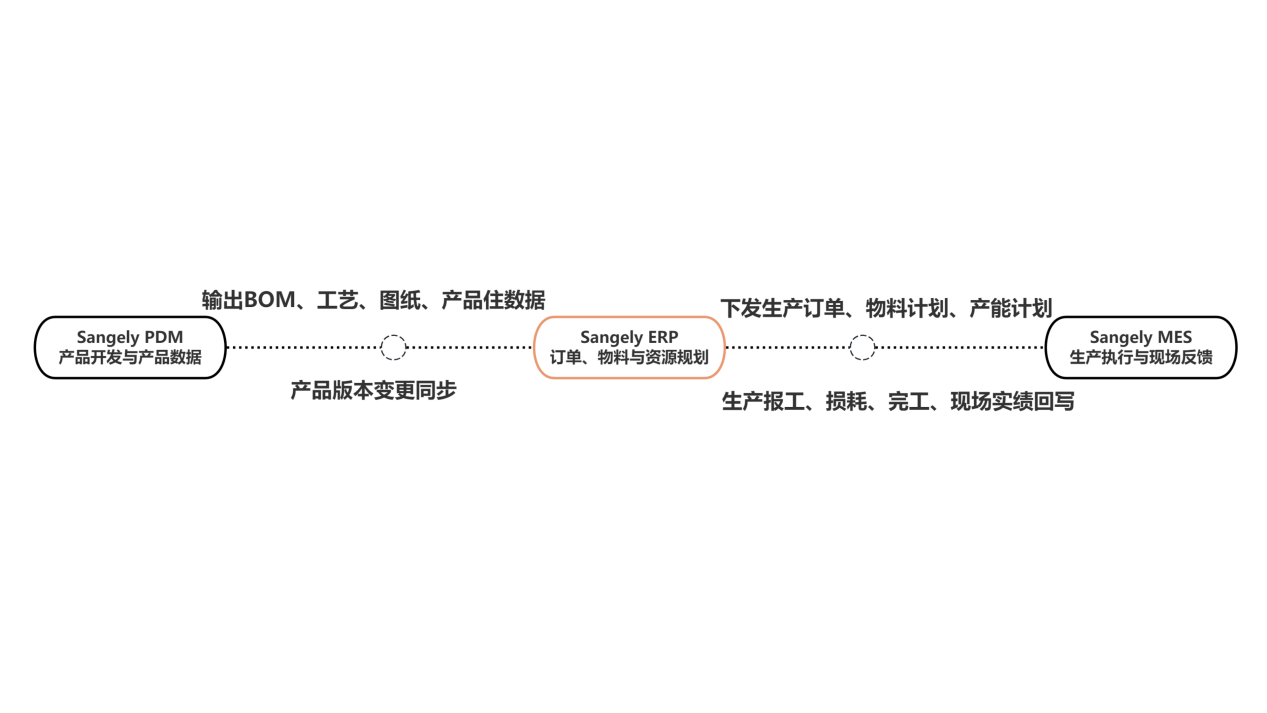
PDM establishes product data → ERP plans resources around products and orders → MES carries manufacturing execution.
Sangely's current product system follows this logic through a three-layer PDM, ERP and MES architecture.
3. Why Is PDM the Starting Point of the Data Chain?
Production does not begin only when work reaches the shop floor. Many production problems are already embedded in the product-definition stage.
Is the BOM complete? Are materials clearly defined? Has the process routing been established? Are product changes synchronized?
If these questions are not resolved during product development, ERP and MES can do little more than reconfirm them repeatedly.
Sangely.PDM therefore extends CAD files into BOM and BOR data, allowing manufacturing master data to take shape from the design stage.
The significance of this step is that:
Purchasing, planning and production no longer have to reinterpret the product from an isolated drawing.
4. ERP Turns Products and Orders into Resource Plans
Once product data has been established, it still needs to enter business operations. Orders require materials. Materials require purchasing. Production requires resources. Different processes require time.
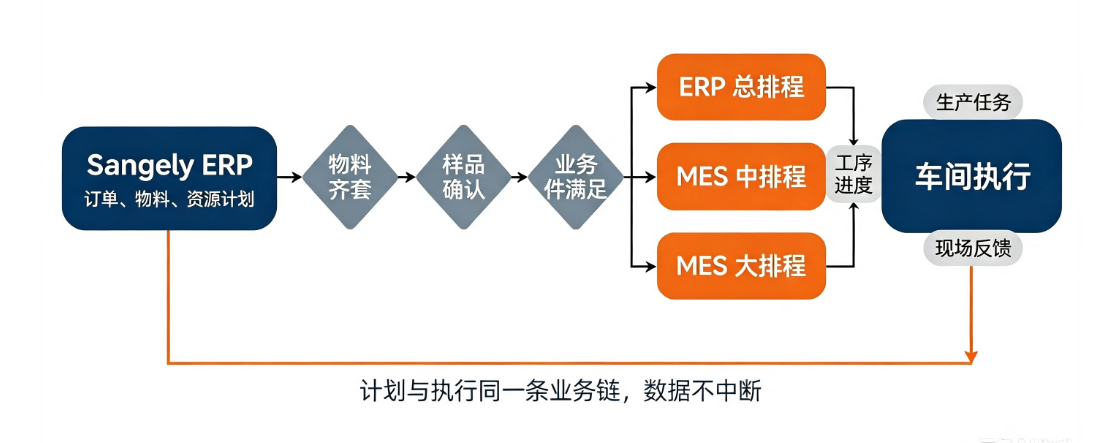
Starting from the order, Sangely ERP's master scheduling combines material status, production resources and process routing in an overall plan, and further establishes the expected start and completion times for different production stages. At this point, product data begins to enter enterprise resource management.
The data no longer describes only “what the product is.”
It also begins to answer:
When should it be produced, and what resources are required?
5. MES Brings the Plan into Shop-Floor Execution
If an ERP plan still has to be printed, forwarded and reinterpreted by people, the data chain breaks at this point.
The relationship between Sangely ERP and MES is intended to let the plan continue into execution.
Once defined business conditions such as confirmed material readiness and sample approval have been met, the relevant plan can continue into MES mid-level scheduling, detailed scheduling and shop-floor execution.
This creates the following flow:
ERP Master Scheduling → MES Mid-Level Scheduling → MES Detailed Scheduling → Shop-Floor Execution.
MES then carries the production tasks, process progress and shop-floor feedback.
The real question for ERP and MES is therefore not whether “the two systems have an interface.”
It is whether planning and execution form continuous data within the same business chain.
6. Real Digitalization Means Fewer Data Breakpoints, Not More Systems
A manufacturer's level of digitalization should not be measured only by how many software systems it has purchased.
More useful questions are:
How many times must product information be re-entered manually after a product enters the company?
When a data item changes, how many people must notify one another?
After a plan is generated, how many manual conversions are still required before it can reach the shop floor?
If these activities remain common, the company may own many systems while still relying mainly on people to connect them.
A mature data chain should look like this:
Product Data → Resource Planning → Manufacturing Execution → Data Feedback.
*Through collaboration among PDM, ERP and MES, Sangely seeks to connect product, operational and production data within one continuous manufacturing process.*
Conclusion
Manufacturers do not lack data. What is truly scarce is:
Data that can continue to flow and be used by the next business activity.
*Sangely.PDM establishes the source of product data. Sangely.ERP handles resource planning. Sangely.MES handles manufacturing execution. When the three are connected, the enterprise can move from “every department has a system” to “the entire manufacturing process uses continuous data.”*
*This is the problem that Sangely's manufacturing digitalization system is designed to address.*
FAQ
Q1: Why do data breakpoints often appear between ERP and MES?
ERP primarily handles enterprise-level resource planning, while MES handles shop-floor execution. If plans still have to be exported and rearranged manually, a breakpoint forms between the planning and execution layers.
Q2: What are the respective roles of PDM, ERP and MES?
PDM manages product development and product data. ERP manages orders, materials and enterprise resource planning. MES manages production tasks, progress and shop-floor data feedback.
Q3: What is the core value of connected manufacturing data?
The goal is not to remove one software system. It is to make the data created in one business stage the working foundation for the next, reducing repeated entry, repeated confirmation and manual relays.