
Manufacturers of bags and handbags for export are familiar with translation.
When customer product documents arrive, sales must first understand them. Customer product and material names must then map to internal naming and material systems. After confirmation, the information continues into sample development, quotation, orders and downstream operations.
Manufacturers therefore face more than a language problem.
The real challenge is whether translated customer information can continue as enterprise business data.
If files are translated outside the system and sales must reorganize them, rebuild sample information and maintain names again, the language has changed but the information still has to be moved manually.
Sangely focuses on this business handoff: customer-document processing should not stop at “understanding the text,” but should connect with sample development, material data and downstream manufacturing.
1. Export manufacturing must solve more than “understanding what the customer said”
Ordinary translation tools convert language.
Entering text and receiving another language is sufficient for daily communication. Customer manufacturing documents, however, are received not simply to be read, but to continue work.
After sales understands the requirement, sample data must be created; engineering must understand products and materials; internal names and codes must be used; and the data must continue into quotation, orders and manufacturing.
If translation remains outside the business system, the path becomes:
Customer Documents → External Translation → Manual Organization → Re-entry into the Business System
The repeated work is not translation itself, but reorganizing the translated information into data the enterprise system can use.
A more practical question for export manufacturers is therefore:
How does customer correspondence move from language information into enterprise operations?
2. Sangely connects customer PDF processing with sample development
Sangely supports translation of customer PDF correspondence.
Employees can manually revise and save the translation, gradually forming the company’s own translation dictionary. Confirmed customer expressions do not have to be handled from zero every time and can support similar future correspondence.
More importantly, customer PDF processing can continue into the sample order.
The business logic can be understood as:
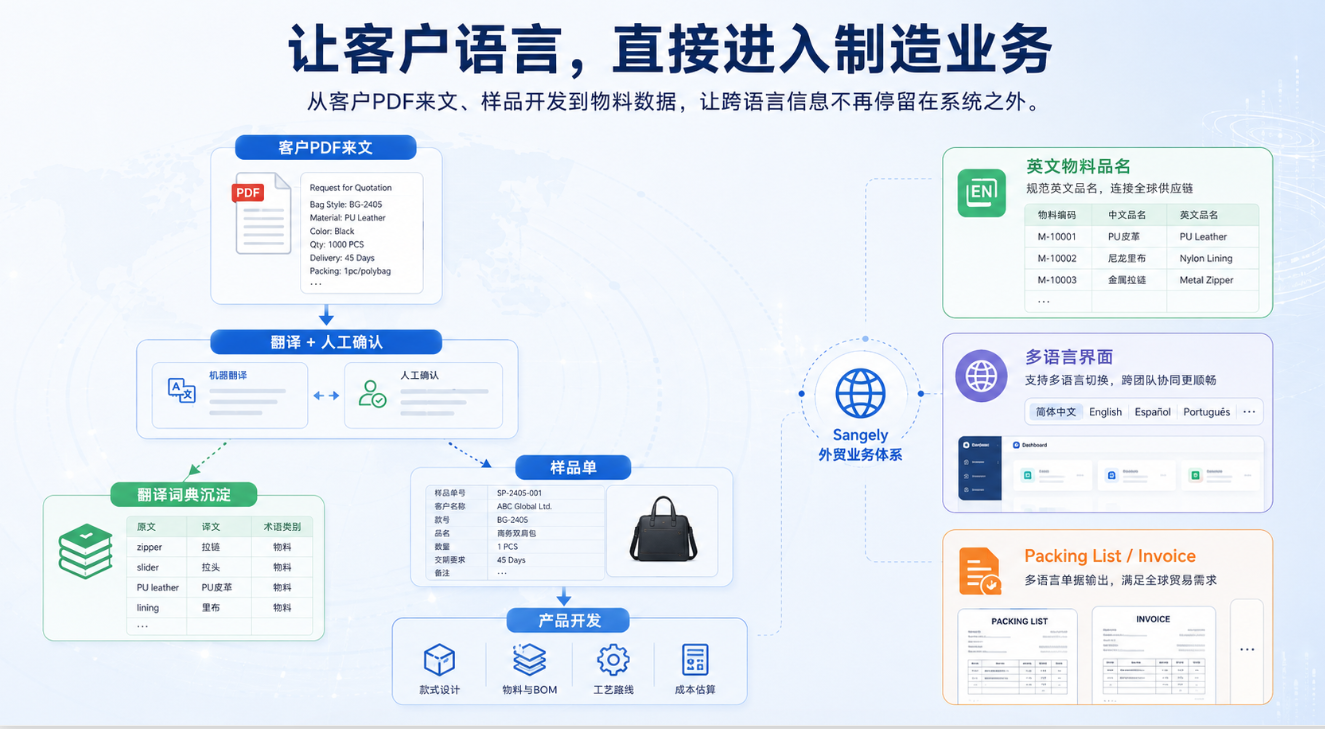
Customer PDF → System Translation → Human Confirmation and Revision → Dictionary Accumulation → Sample Order → Downstream Product Development
This changes the position of translation.
Previously, it may have been a preliminary task performed by sales in another tool. In Sangely, language processing begins to relate directly to the company’s sample-development workflow.
The reduction is not in professional human judgment, but in the additional information transfer after translation.
3. Why must manufacturing translation retain human confirmation?
Bag and handbag manufacturing contains extensive professional terminology.
A customer may use one name for a material, a supplier another, and the enterprise may have its own standardized material name. An ordinary translation may be linguistically correct but unsuitable inside the real manufacturing process.
Translation in a manufacturing system should therefore not pursue “automation” alone.
It must fit the company’s actual terminology and usage.
Sangely allows employees to revise customer PDF translations and save results into a translation dictionary. The system performs basic language processing, sales and engineering judge professional meaning, and confirmed expressions accumulate.
This is closer to actual manufacturing work:
Machines improve processing efficiency, people protect business meaning, and the system retains confirmed results.
With continued use, the company accumulates not only translations, but also long-term language conventions shared with customers.
4. Move from the customer’s language to the company’s internal material language
Customer correspondence is only the first language entry in export manufacturing.
Once work enters ERP, many material names must also be managed.
Customers may use their own English names, while the company requires unified material names, attributes and codes. Maintaining every Chinese and English name separately becomes repetitive as products and materials increase.
In Sangely material master data, material names and codes can be formed from material-composition attributes, with support for automatic translation of English material names.
English names therefore do not have to exist separately from the internal material system; they can be based on the company’s material master data.
For export manufacturers, the value goes beyond entering fewer English words.
More importantly:
The customer’s language and the company’s internal data language can gradually form more unified mappings.
As material names become standardized, sales, purchasing, warehousing and downstream manufacturing can work from shared data.
5. Multilingual capability serves system users as well as customers
When a manufacturer internationalizes, cross-language work extends beyond customer documents.
Group headquarters, overseas factories, local sales teams and employees in different regions may all work in different language environments.
Multilingual capability therefore also asks whether the system itself can accommodate users in different languages.
Sangely supports multilingual operating interfaces so employees can use interfaces appropriate to their language environments.
Cross-language capability in Sangely can therefore be divided into two levels:
Business data, such as customer PDF translation and English material names;
System use, in which different employees work through multilingual interfaces.
Together they do not mean “automatically translating everything into every language,” but allowing more cross-language work to occur directly inside the business system.
6. From customer correspondence to the sample order, reduce repeated reinterpretation
Information loss in export manufacturing often occurs not when the customer file first arrives, but during repeated relaying.
Sales interprets the customer information, engineering rebuilds product information, and the result then enters sample development and downstream operations. Every manual reorganization adds another interpretation and data entry.
When a company handles many customers and new products, this work expands.
By connecting customer PDF processing with sample orders, Sangely allows customer information to extend into product development through the business relationship:
Customer Correspondence → Translation and Confirmation → Sample Order → Product Development
The important result is not saving several seconds of translation time.
It is that original customer information does not become separated from the business and repeatedly rebuilt by different roles after entering the enterprise.
Translation becomes an entry through which external customer information enters enterprise product data.
7. Downstream business still requires standard business documents
After customer requirements are developed and confirmed, they continue into actual orders, delivery and export operations.
Sangely ERP supports generating sales Packing Lists and Invoices.
Two concepts must be distinguished.
Customer-document translation addresses how external information enters the enterprise. Packing Lists and Invoices are business documents formed after enterprise operations proceed.
They should not be understood as “the system automatically translates a customer file into a multilingual Invoice.”
More precisely, Sangely establishes appropriate digital capabilities at different business stages:
Customer correspondence and sample information at the front end;
Product and material data in the middle;
And Packing Lists, Invoices and other business documents after downstream operations.
Translation is no longer isolated; it sits in the same system architecture as internal data formation, product development and business processing.
8. Reduce the need to “do everything again after translation”
For many export manufacturers, the largest time cost is not one complex operation but small repetitive tasks every day.
The customer file is translated, sales organizes it again, material names are maintained again, sample data is entered again, and a similar phrase is processed again for the next customer.
Each step seems minor, but as customers, products and materials grow, these repeated actions consume increasing sales and engineering time.
Multilingual manufacturing capability should therefore answer more than:
“Can you translate this paragraph?”
It should also answer:
“After translation, can this information continue to participate in the business?”
Through customer PDF translation, human confirmation and dictionary accumulation, Sangely brings customer language into sample development. English material names and multilingual interfaces extend cross-language capability into master data and system use. As operations continue, ERP can generate Packing Lists and Invoices.
These capabilities occur at different stages but point in one direction:
Reduce repeated manual conversion after customer information enters the enterprise.
Conclusion: Export manufacturing needs customer language to become manufacturing data
Owning translation software does not automatically digitize export operations.
Response efficiency depends on how many manual conversions customer requirements undergo before becoming usable data.
If customer files are translated outside the system, results are reorganized, sample data rebuilt and English material names maintained separately, every step remains dependent on individual experience.
Sangely is intended to change this path.
From PDF translation and human confirmation to dictionaries and sample orders; from material master data to English names; and then to multilingual interfaces, Packing Lists and Invoices, cross-language work gradually enters the manufacturing business system.
The direction is not to let machines perform all language work.
It is:
Move customer language from outside the system into data that product development, material management and operations can continue to use.
For export bag and handbag manufacturers, this matters more than simply “translating faster.”
Customer response depends not on how many seconds one sentence takes, but on:
Whether a customer requirement can move smoothly toward products, materials and manufacturing after entering the enterprise.
FAQ
Q1: Can Sangely translate customer PDF correspondence directly?
Sangely supports customer PDF translation. Employees can revise results according to actual customer expressions and industry terminology and save confirmed content for future customer-document processing.
Q2: Can revised translations be reused?
Yes. Confirmed and revised translation content can gradually form an enterprise translation dictionary so previously processed customer expressions continue to be used.
Q3: Can translated customer PDFs enter sample development directly?
Sangely connects customer PDF processing with sample-order creation so translated and confirmed information can enter sample development, reducing reorganization after external translation.
Q4: Does Sangely support English material names?
Yes. Sangely material data can form names and codes from composition attributes and supports automatic translation of English names, connecting them with internal material master data.
Q5: Does Sangely support multilingual system interfaces?
Yes. Multilingual operating interfaces support employees working in different language environments.
Q6: Can Sangely generate Packing Lists and Invoices?
Sangely ERP supports generating sales Packing Lists and Invoices. This is an export-business document capability at a different stage from customer PDF translation; together they support cross-language and export operations.