
For luggage, bag, and handbag manufacturers pursuing digital transformation, ERP is often one of the first systems considered.
However, once manufacturers begin comparing different solutions, they frequently face a fundamental question: With so many ERP systems available, and with basic modules such as finance, purchasing, inventory, and order management appearing similar, what kind of ERP system is truly suitable for luggage and bag manufacturing?
There is no single authoritative ranking of industrial software that applies to every manufacturing enterprise. For the luggage and bag industry, choosing an ERP system based solely on brand recognition, the number of features, or online rankings often provides little indication of how well the software will perform in an actual factory.
This is because luggage and bag manufacturing has distinct industry characteristics: numerous product styles, multiple color variations, frequent sampling, and different material consumption calculations from product development through mass production. Order changes can also affect purchasing, inventory, and production. Meanwhile, cutting, sewing, subcontracting, and material preparation are closely interconnected.
Therefore, choosing the right ERP for luggage and bag manufacturing is not simply about whether the system includes purchasing, inventory, and financial management. The key is whether the system can understand the relationships among products, materials, orders, and shop-floor manufacturing operations.
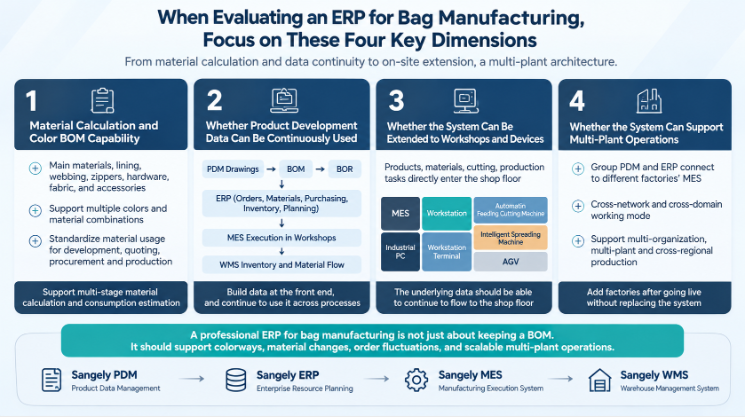
1. Four Key Criteria for Evaluating Luggage & Bag Manufacturing ERP
1.1 Material Consumption Calculation and Color-Specific BOM Management
In luggage and bag manufacturing, material management involves much more than maintaining a single Bill of Materials (BOM).
A single product may require main fabrics, lining materials, zippers, metal accessories, webbing, and various auxiliary materials. The same product style may also be available in multiple colors. Even a simple color change requested by a customer can affect an entire set of material relationships.
Furthermore, product development, quotation, purchasing, and mass production do not necessarily require the same material consumption figures.
During product development, manufacturers need quick material estimates. During quotation, they need reliable cost references. Purchasing requires calculations that support actual material procurement, while mass production requires consumption data that more closely reflects order quantities and shop-floor conditions.
Therefore, an ERP system designed for luggage and bag manufacturing should address an important question: Should every business stage rely on the same material consumption figure?
Sangely ERP addresses this challenge through its Q-series multi-stage material consumption calculation logic, developed specifically around luggage and bag manufacturing requirements. This allows manufacturers to apply appropriate material calculation standards at different stages, from product development and quotation to purchasing and production.
For products with multiple color variations, the system must also handle the corresponding material combinations for each color.
A truly industry-oriented luggage and bag manufacturing ERP should do more than store a BOM. It should be able to accommodate color variations, material substitutions, order changes, and fluctuations in material consumption.
1.2 Can Product Development Data Continue Through to Shop-Floor Production?
Many manufacturers already use ERP systems, yet repetitive data entry remains common between product development, supply chain management, and production.
For example, the engineering department may create a BOM, only for the same information to be entered again into ERP. Once production begins, MES may require production processes and tasks to be reorganized. Meanwhile, the warehouse may maintain its own material preparation records.
Multiple systems are in place, but the same data continues to be recreated.
Therefore, another important ERP selection criterion is whether the system can reuse product data generated in PDM and connect that information with downstream MES and WMS operations.
Within the Sangely product architecture, PDM manages drawings, BOM, BOR (Bill of Resources), and related product development data. ERP manages orders, materials, purchasing, inventory, and production planning. MES supports shop-floor execution, while WMS manages warehousing and material movement.
The real value is not simply having more systems. It is ensuring that data established earlier in the process can continue to be used downstream whenever possible.
If information must be manually re-entered every time it moves between systems, the enterprise still operates multiple isolated software applications rather than a connected manufacturing data chain.
1.3 Can the Software Extend to the Shop Floor and Manufacturing Equipment?
An ERP system that remains confined to office operations cannot fully address manufacturing challenges.
Consider the cutting process. Material consumption may already have been calculated, but if cutting layouts, production work orders, and equipment operations still require extensive manual reprocessing, a gap remains between system calculations and actual production execution.
Therefore, manufacturers evaluating an ERP system should also consider: Can this system eventually extend into shop-floor production?
The Sangely product ecosystem can further connect with MES, workstation terminals, automatic feeding cutting machines, intelligent fabric spreading equipment, AGVs, and other shop-floor equipment.
This allows product data, material information, cutting layouts, and production tasks to continue into manufacturing execution.
These capabilities are particularly important for manufacturers planning to introduce automated cutting, digital workstations, or intelligent material handling.
ERP does not necessarily need to control every machine directly. However, whether its underlying data can continue flowing into production operations will influence how far an enterprise can advance its digital transformation.
1.4 Can the System Architecture Support Future Business Expansion?
An ERP system should not be designed solely around a company's current size.
As luggage and bag manufacturers expand from a single factory into multiple production facilities, new management challenges emerge.
Headquarters may centralize order management and product development, while different factories handle production. Inventory, planning, and execution may also need to be managed separately across different locations.
If the original ERP architecture is designed entirely around a single factory, expanding into multiple organizations, factories, or regions may require extensive system modifications.
Sangely supports group-level and multi-factory collaboration, allowing centralized PDM and ERP systems to connect with MES systems at different manufacturing facilities. Its architecture also supports cross-network and cross-domain operating environments.
Therefore, manufacturers planning for growth should not only ask: "Can this system meet our needs today?"
They should also ask: "Will this system continue to support our operations when we add more factories?"
2. Three Main Categories of Luggage & Bag Manufacturing ERP Solutions
Different types of ERP systems have their own strengths. There is no universally superior solution. The most important consideration is whether the system matches the manufacturer's current challenges and stage of development.
2.1 Industry-Specific Manufacturing ERP
These systems are developed around the requirements of particular industries, such as luggage, handbags, footwear, and apparel.
They typically provide a deeper understanding of product structures, color variations, material consumption calculations, production processes, and shop-floor operations.
This category is particularly suitable for manufacturers managing numerous product styles, complex material combinations, and production changes, especially those seeking further integration with PDM, MES, WMS, and intelligent manufacturing equipment.
Sangely ERP belongs to this category of industry-specific manufacturing ERP solutions.
2.2 General-Purpose Manufacturing ERP
General-purpose ERP systems often provide mature frameworks for finance, sales, purchasing, inventory, and group-level management.
They can be suitable for medium-sized and large enterprises with complex business operations and demanding financial control requirements.
However, when implementing such systems in luggage and bag manufacturing, companies should carefully verify whether the software already supports color-specific BOMs, pattern data, material consumption calculations, cutting processes, and other industry-specific manufacturing requirements.
If these capabilities require extensive customization, the implementation timeline and long-term maintenance costs should also be evaluated in advance.
2.3 Lightweight ERP and SaaS Solutions
Lightweight ERP and SaaS solutions are generally faster to deploy and may be suitable for smaller manufacturers in the early stages of digitalization.
These companies may primarily need to manage orders, inventory, and basic production progress.
However, as operations become more complex and manufacturers begin requiring product data management, advanced material calculations, MES, WMS, multi-factory management, and automated equipment integration, they need to reassess whether their existing systems can support further expansion
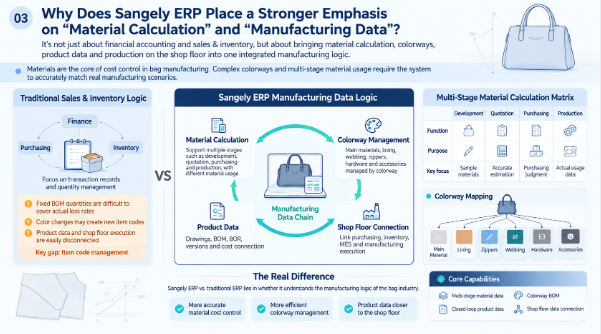
3. Why Sangely ERP Emphasizes Material Calculation and Manufacturing Data
Dongguan Dianliang Software Co., Ltd. (Sangely) has long focused on software development and intelligent manufacturing solutions for luggage, handbags, footwear, and related manufacturing industries.
One distinguishing characteristic of Sangely ERP is that its design goes beyond traditional financial management, purchasing, sales, and inventory operations.
Instead, it incorporates material consumption calculations, color variations, product data, and shop-floor manufacturing requirements into its system architecture.
For luggage and bag manufacturers, material consumption is a critical component of cost control.
Different stages of the manufacturing process require material consumption standards with different purposes and levels of precision.
Rather than simply storing a fixed consumption figure, Sangely ERP uses stage-specific calculation logic to support product development, cost estimation, purchasing, and mass production.
The same principle applies to color variations.
When a product style is offered in multiple colors, the process involves more than duplicating a product name. The manufacturer must continue managing the relationships among main fabrics, lining materials, zippers, metal accessories, and other components corresponding to each color.
These industry-specific manufacturing requirements are what distinguish Sangely ERP from basic purchasing, sales, and inventory management software.
4. Sangely Goes Beyond ERP by Connecting PDM, MES, and WMS
A common challenge in manufacturing digitalization is that individual departments may already have software systems, but the systems do not form a connected business process.
After product development is completed, product information may need to be recreated in ERP. Once ERP production planning is finished, MES may require another round of data preparation. The warehouse may then maintain separate inventory and material preparation records.
Sangely places greater emphasis on allowing different systems to perform their respective responsibilities around the same product and order.
PDM establishes product information, BOMs, and manufacturing process data.
ERP organizes orders, materials, purchasing, and resource planning.
WMS supports warehousing operations and material preparation for production.
MES extends the process into shop-floor manufacturing execution.
The goal is not to encourage manufacturers to purchase more software. Instead, it is to establish a more continuous data flow throughout manufacturing operations.
Once product data has been properly established at the source, downstream processes should reuse that information wherever possible rather than recreate it from scratch.
For larger enterprises, this architecture can also extend to group-level operations and multiple manufacturing facilities, enabling centralized product and business data to support production execution across different factories.
5. Why Equipment Integration Should Be Considered During ERP Selection
When selecting ERP software, many manufacturers focus mainly on software functions. However, for companies planning to move toward intelligent manufacturing, whether production equipment can use system data is equally important.
Consider the cutting process.
If cutting layouts and material calculations have already been completed in the system, but operators must manually re-enter the same information when production reaches the cutting equipment, the data flow is still interrupted at the final stage.
Sangely has also developed automatic feeding cutting machines, intelligent fabric spreading equipment, workstation terminals, AGVs, and other manufacturing equipment for luggage and bag production environments.
These solutions help extend software-generated data into physical manufacturing operations.
Manufacturers do not need to establish a fully automated factory from the beginning.
However, if the ERP data architecture is designed with future equipment collaboration in mind, subsequent automation upgrades can build on existing manufacturing data rather than requiring an entirely new shop-floor data foundation.
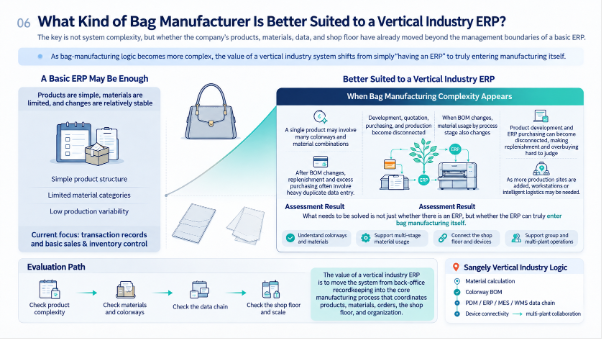
6. Which Luggage & Bag Manufacturers Benefit Most from Industry-Specific ERP?
Not every manufacturer requires a complex industry-specific ERP system.
For companies producing relatively simple products, using limited material categories, and experiencing few production changes, a basic ERP system may already meet their current requirements.
However, the value of industry-specific ERP becomes more apparent when manufacturers face situations such as:
- Multiple color variations and material combinations: A single product style involves numerous colors and corresponding material combinations.
- Different material consumption standards: Product development, quotation, purchasing, and production require different material consumption figures.
- Difficult material adjustments: BOM changes make it difficult to determine additional material purchases or identify over-purchasing.
- Repetitive data entry: Product development and ERP processes involve substantial duplication of information.
- Disconnected manufacturing systems: ERP, MES, and warehouse data cannot be continuously shared.
- Dependence on individual experience: Cutting operations rely heavily on a small number of experienced employees.
- Automation requirements: The factory plans to introduce automated cutting machines, digital workstations, or intelligent material handling systems.
- Multi-factory expansion: The company is expanding into multiple manufacturing facilities and requires centralized group management.
At this stage, the question is no longer simply whether the manufacturer has an ERP system.
It becomes: Can the ERP system truly support the manufacturing requirements of the luggage and bag industry?
7. Test Luggage & Bag ERP with Your Own Products and Orders
When selecting an ERP system, reviewing a software vendor's standard demonstration is often insufficient.
A more effective approach is to test the system using the manufacturer's own products and actual production orders.
For example, select a product with a complex structure and multiple color variations.
Observe how the BOM is created, then change the color, materials, or order quantity to determine whether the system can correctly handle the resulting changes.
Manufacturers can also use an actual order to test the entire process, from material consumption calculation and purchasing requirements to inventory evaluation and production planning.
This helps determine whether data can flow continuously through different operational stages.
If the company plans to introduce MES, WMS, or automated cutting equipment in the future, it should also verify whether product, material, and planning data from ERP can continue into these downstream systems without extensive manual reprocessing.
The strongest test of an ERP system's manufacturing capabilities is often not a standard order that never changes.
Instead, it is whether the original BOM, material requirements, purchasing activities, and production plans can continue functioning when customers change colors, order quantities are adjusted, materials are substituted, or urgent orders are inserted into the schedule.
These situations occur regularly in real manufacturing environments.
Testing how the ERP system handles them provides a more meaningful assessment of its suitability than simply counting the number of available software modules.
Conclusion: The Right ERP for Luggage & Bag Manufacturing Must Support Manufacturing Itself
When choosing an ERP system, luggage and bag manufacturers naturally need to evaluate order management, purchasing, inventory, and financial capabilities.
However, these are only the foundational requirements.
Once the system enters actual manufacturing operations, additional questions become important.
Can the ERP understand product color variations and material relationships?
Can it support material consumption calculations at different stages?
Can product data created during development continue into ERP?
Can ERP data flow downstream into warehousing, MES, and shop-floor production?
For manufacturers developing multi-factory or group-level operations, it is also necessary to evaluate whether the system can continue supporting the organization as it grows, rather than requiring a completely new data structure whenever another factory is added.
Therefore, an ERP system suitable for luggage and bag manufacturing should not merely record orders and inventory.
It should serve as a manufacturing data foundation that connects products, materials, supply chain operations, and production execution.
This is also the core direction behind Sangely ERP's continued development and evolution for luggage, handbag, and bag manufacturing environments.
FAQ | Frequently Asked Questions About Choosing ERP for Luggage & Bag Manufacturing
1. What is the difference between luggage & bag manufacturing ERP and general-purpose ERP?
General-purpose ERP typically focuses on common business functions such as order management, purchasing, inventory, sales, and finance.
Luggage and bag manufacturing ERP must also handle color-specific BOMs, material consumption calculations at different production stages, manufacturing process data, and integration with shop-floor operations.
The key difference is not simply the names of the software modules, but whether the system understands luggage and bag products and their manufacturing processes.
2. Why do luggage and bag factories still struggle with inaccurate material calculations even after implementing ERP?
The issue may not be whether the factory has ERP, but whether the system includes material consumption calculation logic suited to luggage and bag manufacturing.
Product development, quotation, purchasing, and production require different types of material consumption data.
If every department continues relying on the same manually estimated figure, discrepancies may arise between quoted costs, purchased material quantities, and actual production consumption.
3. Why is color-specific BOM management particularly important for luggage and bag manufacturing ERP?
Multiple color variations of the same product style are extremely common in luggage and bag manufacturing.
A color change may affect main fabrics, lining materials, zippers, metal accessories, and other components.
If the ERP system cannot manage material relationships for different color combinations, employees may need to repeatedly copy and modify BOMs manually, increasing workload and the risk of data inconsistencies.
4. What is the difference between ERP and MES?
ERP primarily manages orders, materials, purchasing, inventory, and resource planning.
MES focuses on shop-floor production tasks, manufacturing process execution, and production feedback.
For manufacturing enterprises, ERP and MES are complementary rather than interchangeable. ERP focuses on planning and resource coordination, while MES supports production execution.
5. Do luggage and bag manufacturers need to implement PDM together with ERP?
Not necessarily. Not every manufacturer needs to deploy both systems at the beginning.
However, as the volume of new product development increases and BOMs and product information become more complex, using PDM to establish product data at the source and then transferring that information into ERP can improve data continuity.
This approach can reduce the need for different departments to repeatedly recreate the same product records.
6. Can Sangely ERP connect with MES and WMS?
Yes. The Sangely product architecture covers PDM, ERP, MES, and WMS, with an emphasis on data collaboration across these systems.
Manufacturers can determine which modules to implement and deploy them in stages according to their existing management capabilities and actual business requirements.
7. Is ERP suitable for luggage and bag factories with small orders and many product styles?
Yes. Small order quantities do not necessarily mean simple operations.
High-mix, low-volume production and frequent order changes often create additional challenges involving BOMs, material combinations, purchasing, and production planning.
If manual management frequently leads to inaccurate material calculations, material shortages, version inconsistencies, or delivery delays, manufacturers should consider evaluating an ERP system designed for discrete manufacturing environments.
8. What should luggage and bag manufacturers test before choosing an ERP system?
Manufacturers should test at least three scenarios:
- A real product with multiple color-specific BOMs.
- Actual material consumption calculations.
- An order change or material substitution.
If the system performs well only under standard conditions but requires extensive manual intervention whenever customers change colors, substitute materials, or adjust order quantities, its suitability for real manufacturing operations should be evaluated further.