
In multi-style manufacturing industries such as bags, handbags, footwear, and apparel, it is very common for one product style to come in multiple colors.
Black, brown, gray—or a customer may suddenly request a different main material color during product development. On the surface, this may look like a simple appearance change. But once that change enters the manufacturing data structure, it can affect an entire set of material relationships.
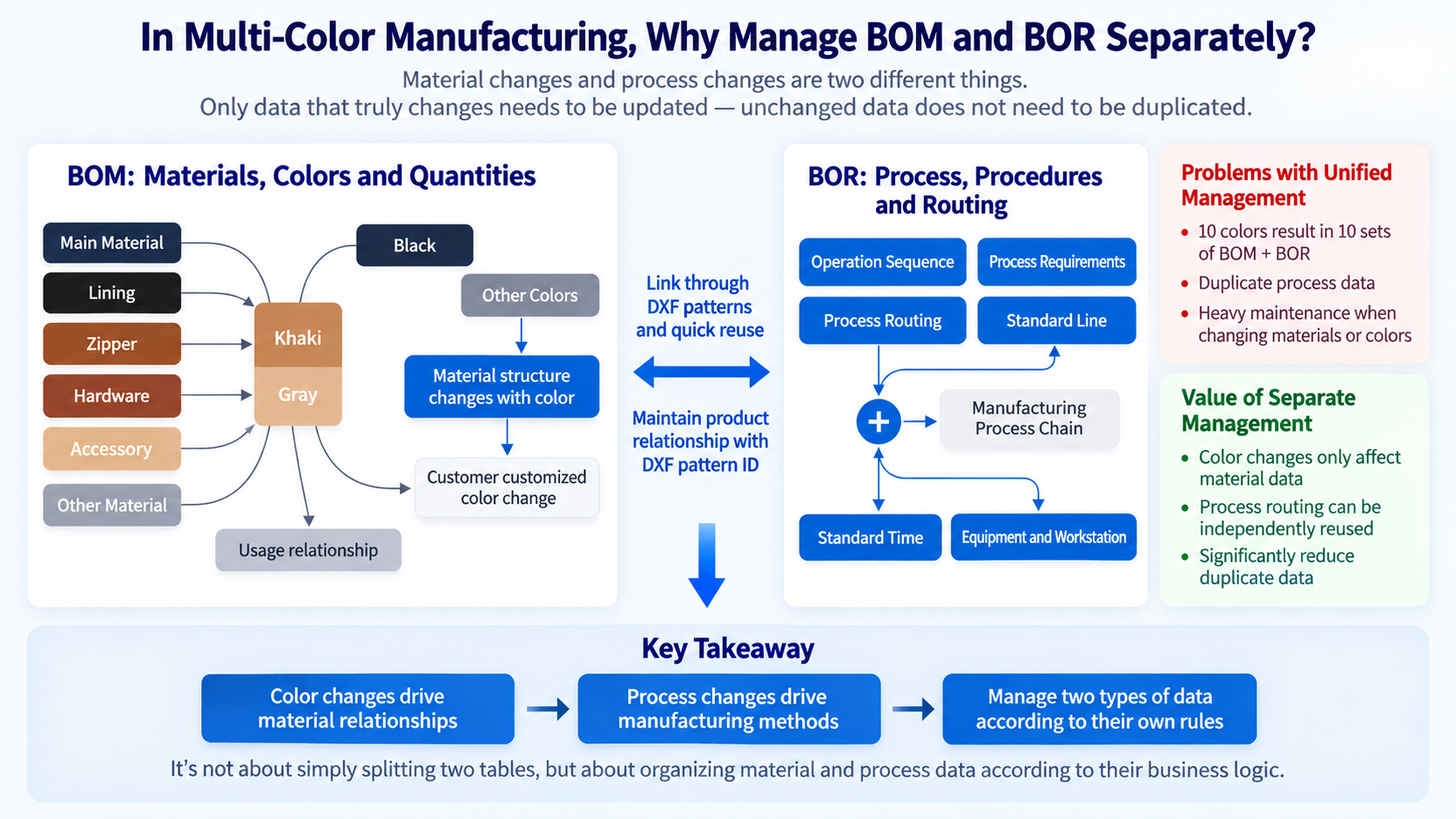
When the main material color changes, the lining, zipper, hardware, and certain accessories may also need to be changed accordingly.
As a result, many manufacturers naturally adopt a management approach in which each colorway has its own BOM.
There is nothing inherently wrong with this approach.
The real problem begins when material structures and manufacturing routings are tightly bound together inside the same complex data structure.
If one product has ten colorways, each with its own BOM, and the BOR is embedded into every BOM structure, the system may end up maintaining large amounts of duplicated routing data—even when all ten colorways are manufactured in exactly the same way.
The more colors a product has, the more duplicated structures are created. The more frequently customers request color or material changes, the heavier the maintenance burden becomes.
After years of designing systems around multi-color manufacturing scenarios in the bag and handbag industry, Sangely has developed a clear principle:
Only the data that actually changes should change. Data that remains unchanged should not be duplicated simply because of the way the system structure is designed.
This is why BOM and BOR serve different purposes in Sangely's product data architecture.
BOM primarily manages materials, colorways, and consumption quantities, while BOR primarily manages operations, processes, and manufacturing routings.
Each type of data follows its own business logic and hierarchy, while DXF pattern pieces and their corresponding IDs maintain the relationship between them.
This is not simply a matter of “splitting one table into two.”
It addresses a more fundamental issue:
A material change and a process change are not the same thing.
1. Why Do Multi-Color Products Make BOM Structures Increasingly Complex?
Consider a common bag manufacturing scenario.
A product was originally designed in black, and the customer now requests an additional brown version.
At first glance, only the color has changed. But from a BOM perspective, the change may require a different main material, a new lining combination, a different zipper color, and adjustments to hardware or accessories.
Therefore, it is reasonable for the BOM to change when the colorway changes.
This is because the BOM fundamentally answers two questions:
What materials are required to make this product, and how much of each material is needed?
Sangely's current product architecture supports color-specific BOMs, allowing different colorways and material combinations to maintain clear relationships.
The important point, however, is that a change in color does not necessarily mean a change in manufacturing method.
If the structure of the bag remains the same, and cutting, processing, sewing, and assembly operations remain unchanged, changing the product from black to brown does not require rebuilding an identical manufacturing routing from scratch.
In other words:
Color changes mainly affect materials, but they do not necessarily affect processes.
This is why Sangely does not want a BOR to be automatically duplicated every time a colorway changes.
If the material changes, update the BOM.
If the process does not change, continue using the existing BOR.
Change only what actually changed.
This is an important principle when managing product data for multi-color products.
2. Why Doesn't Sangely Simply Embed the Entire BOR into a Multi-Level BOM?
At first glance, placing all product information into a single multi-level structure tree may seem more complete.
Materials, semi-finished components, and processes can all be displayed together, allowing engineering teams to view a large amount of information from one structure.
However, in real multi-color bag manufacturing environments, this design quickly encounters a practical problem:
Materials and manufacturing processes do not change according to the same rules.
Suppose one product has ten colorways, all of which use the same manufacturing process.
If the BOR is fully embedded into each color-specific BOM, every new colorway may also create a duplicate copy of the same routing data.
The system may appear to contain ten different product structures, even though the only meaningful difference is the material configuration.
As a result, identical manufacturing processes are repeatedly stored and maintained.
When the product changes again, engineering teams must determine which data has actually changed and which data exists only because it was copied.
As product volumes and color variations increase, this duplicated data can become increasingly significant.
Sangely therefore follows a different design principle:
Different types of manufacturing data should be managed within the structures that actually belong to them.
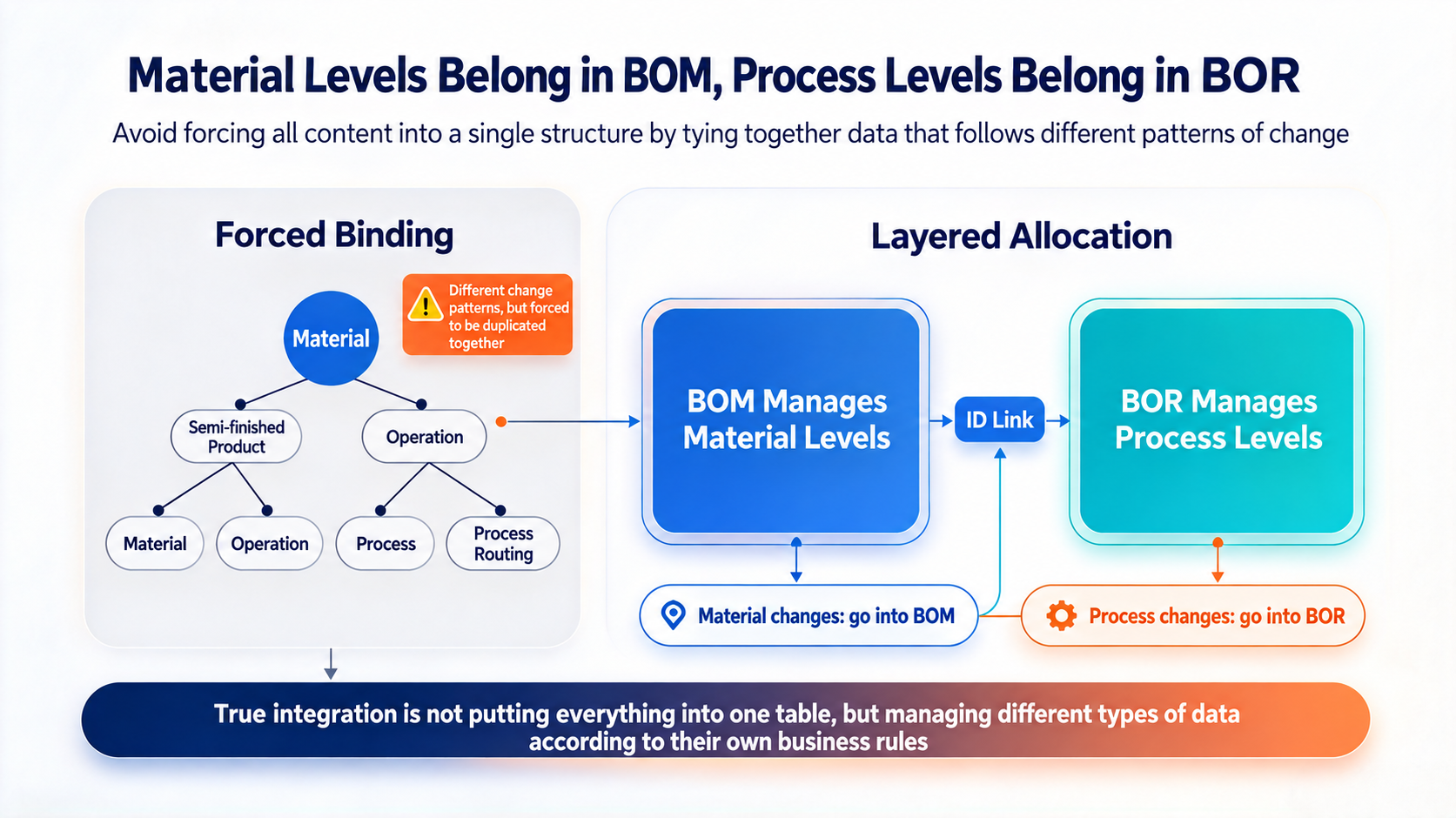
The BOM has its own material hierarchy for managing main materials, lining materials, hardware, accessories, colorways, and consumption quantities.
The BOR has its own process hierarchy for organizing manufacturing steps, operation relationships, and routing logic.
Sangely is not eliminating hierarchy.
Instead, it places each hierarchy back into the data object where it belongs.
Material hierarchy belongs to the BOM. Process hierarchy belongs to the BOR.
What should be avoided is forcing different types of data—each with different patterns of change—into one structure simply because it appears convenient to keep everything in a single tree.
3. If BOM and BOR Are Managed Separately, How Do They Still Belong to the Same Product?
Managing BOM and BOR separately does not mean the two become disconnected.
If engineers still have to manually determine which material corresponds to which operation or which process belongs to which pattern piece, then the system has merely turned one table into two without solving the underlying problem.
Sangely focuses on a different principle:
Data responsibilities can be separated, but product relationships must remain connected.
In bag product development, CAD/DXF files and pattern pieces are already important sources of product data.
Sangely.PDM can use CAD/DXF product data as a basis for developing BOM and BOR information, while pattern pieces and their corresponding IDs help maintain relationships between product objects.
Within the BOM, the system focuses on questions such as:
- Which material is used for a particular pattern piece?
- Which colorway does it belong to?
- How much material is required?
Within the BOR, the system focuses on questions such as:
- What processing does this pattern piece require?
- Which operation does it belong to?
- How does it move through the manufacturing process?
The ID associated with each pattern piece helps the system understand that the BOM and BOR are describing two different dimensions of the same product object.
This allows the system to distinguish more clearly between material changes and process changes, while maintaining a consistent connection to the same product.
The real value of separating BOM and BOR is therefore not to fragment product data.
It is to:
Help the system understand more accurately what each type of data actually represents.
4. Why Don't BOM and BOR Always Need to Be Completed at the Same Time?
Manufacturing software also needs to reflect a practical reality:
In real factories, BOM and BOR are often not created by the same people or completed at the same time.
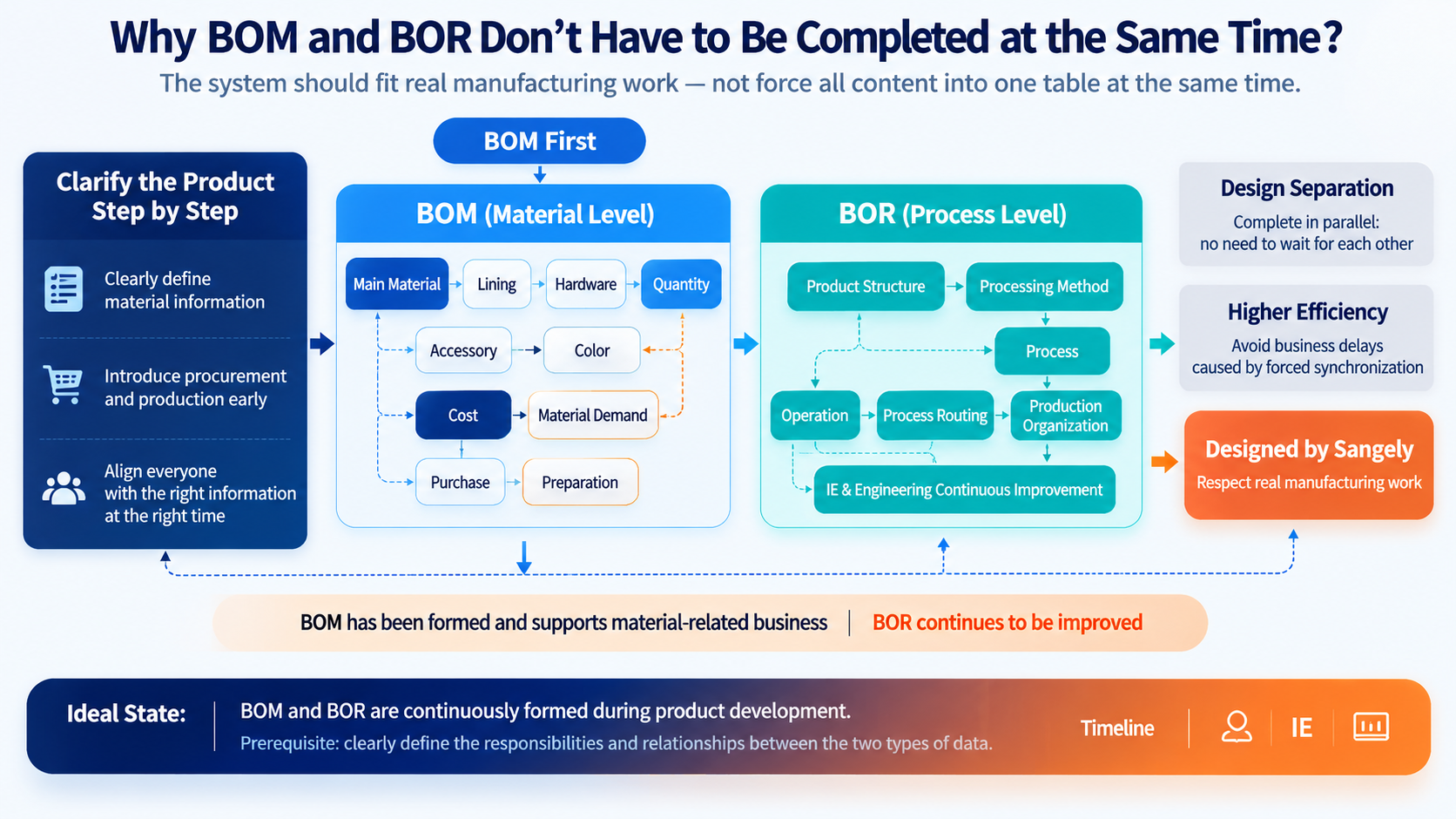
As a product becomes more clearly defined, purchasing and production planning teams may already need to know what materials are required, how much is needed, and which raw materials should be prepared in advance.
As a result, the BOM often enters actual business processes earlier, supporting costing, material planning, purchasing, and preparation.
The BOR may follow a different timeline.
Industrial engineering and engineering teams may still need to refine operations and process routings based on product structure, manufacturing methods, and actual production organization.
A very common situation is therefore:
The BOM has already been established and is supporting material-related activities, while the BOR is still being refined.
If software requires the BOM and BOR to be completed simultaneously simply to satisfy the structure of the system, a business activity that could otherwise move forward may be forced to wait.
This reflects another principle that Sangely values in manufacturing software design:
The system should follow the actual working rhythm of the factory as much as possible, rather than forcing every department to adapt its workflow to the software.
As product data automation continues to improve, it may eventually become possible for BOM and BOR data to be generated more continuously during product development.
However, that requires a clear understanding of the responsibilities of each type of data and the relationships between them first.
5. Separating BOM and BOR Does Not Mean Asking Users to Maintain Two Independent Sets of Data
If “separating BOM and BOR” simply means that purchasing maintains one BOM while industrial engineering manually maintains a separate BOR, with both sides repeatedly checking information against each other, then separation itself does not improve efficiency.
What Sangely is really addressing is the responsibility and structure of the underlying data.
- Which information belongs to materials?
- Which information belongs to manufacturing processes?
- Which data changes when a colorway changes?
- Which process information can continue to be reused?
- Which pattern piece corresponds to which material and manufacturing process?
Only when these relationships are clearly defined can a system create better conditions for data reuse and automation.
Sangely.PDM can already establish BOM and BOR information based on CAD data and can also use a single product image to search for similar historical products.
After users confirm an appropriate reference product, existing process routings can be reused as a basis. Relevant nodes can then be adjusted according to the requirements of the new product, supporting the creation of new BOMs, process routings, and costing information.
Therefore, clarifying the responsibilities of BOM and BOR is not ultimately about separating data.
The real purpose is to enable better integration.
The clearer the responsibilities at the data layer, the easier it becomes to build data reuse and automation on top of them.
In other words:
Clearer design makes future automation more natural.
6. What Does This Design Actually Reduce in Multi-Color Manufacturing?
For bag manufacturers, one of the main reasons product data expands rapidly is the continuous increase in styles and colorways.
A single style may have many colors.
Different colors may use different materials.
Customers may later request additional material substitutions or new color combinations.
If every material change also generates a duplicate set of manufacturing processes, the more products the company develops, the more redundant data the system accumulates.
By separating the responsibilities of BOM and BOR, Sangely aims to make data growth reflect actual business changes as closely as possible.
When a color changes, a new color-specific BOM can be created around the corresponding material combination.
If the manufacturing process has not changed, the existing BOR can continue to serve as a reference or reusable basis.
If the process itself changes, the relevant manufacturing routing can then be adjusted within the BOR.
At the same time, both sides remain connected through pattern pieces and corresponding IDs.
In this way, data growth is driven by real product changes rather than by unnecessary duplication caused by tightly coupled structures.
This is particularly important for bag and handbag manufacturers dealing with many styles, many colors, and frequent material or color changes.
7. Why Is This Actually a Manufacturing Data Foundation?
At first glance, separating BOM and BOR may appear to be only a system architecture decision.
But when viewed from a broader perspective, it affects how manufacturing data can be used throughout the rest of the business.
Once the BOM has been established, it can continue to provide a data foundation for ERP orders, material planning, and resource planning.
Once the BOR has been established, it can provide manufacturing information for process planning, standard time management, and MES production execution.
CAD/DXF files, pattern pieces, and corresponding IDs allow product data created during product development to maintain its relationships as it moves downstream.
Therefore, what is established during the PDM stage is not simply a collection of product documents.
It is a manufacturing data foundation that can continue to support downstream operations.
In simple terms:
Product drawings tell the system what the product is. The BOM tells the system what materials are needed. The BOR tells the system how the product should be manufactured. ERP then organizes orders, materials, and resources, while MES carries the information forward into shop-floor execution.
This data structure becomes equally important as AI begins to participate more deeply in manufacturing processes.
Whether AI is searching for historical similar products from a single product image or Sangely.PDM AI Assistant is helping users read customer documents and create sample development records, meaningful AI participation still depends on clearly structured product data.
This is why BOM and BOR design is not only about making engineering work easier today.
It also affects whether product data can later be understood, reused, and called by both software systems and AI.
8. This Design Reflects More Than Just BOM and BOR Functionality
After years of designing systems around real manufacturing scenarios in industries such as bags and handbags, Sangely has increasingly focused not on whether every piece of information can be placed on the same screen, but on understanding why different types of data exist, when they change, and who ultimately needs to use them.
For BOM and BOR, the important questions include:
What actually changes when a product color changes?
Do materials and processes always change together?
Which departments are responsible for the BOM and BOR?
Must they always be completed at the same time?
How can duplicated work be reduced without losing product relationships?
And if the company wants to pursue further automation in the future, how should the underlying product data be structured?
Based on these questions, Sangely has developed a product data design approach that is better suited to multi-color bag manufacturing:
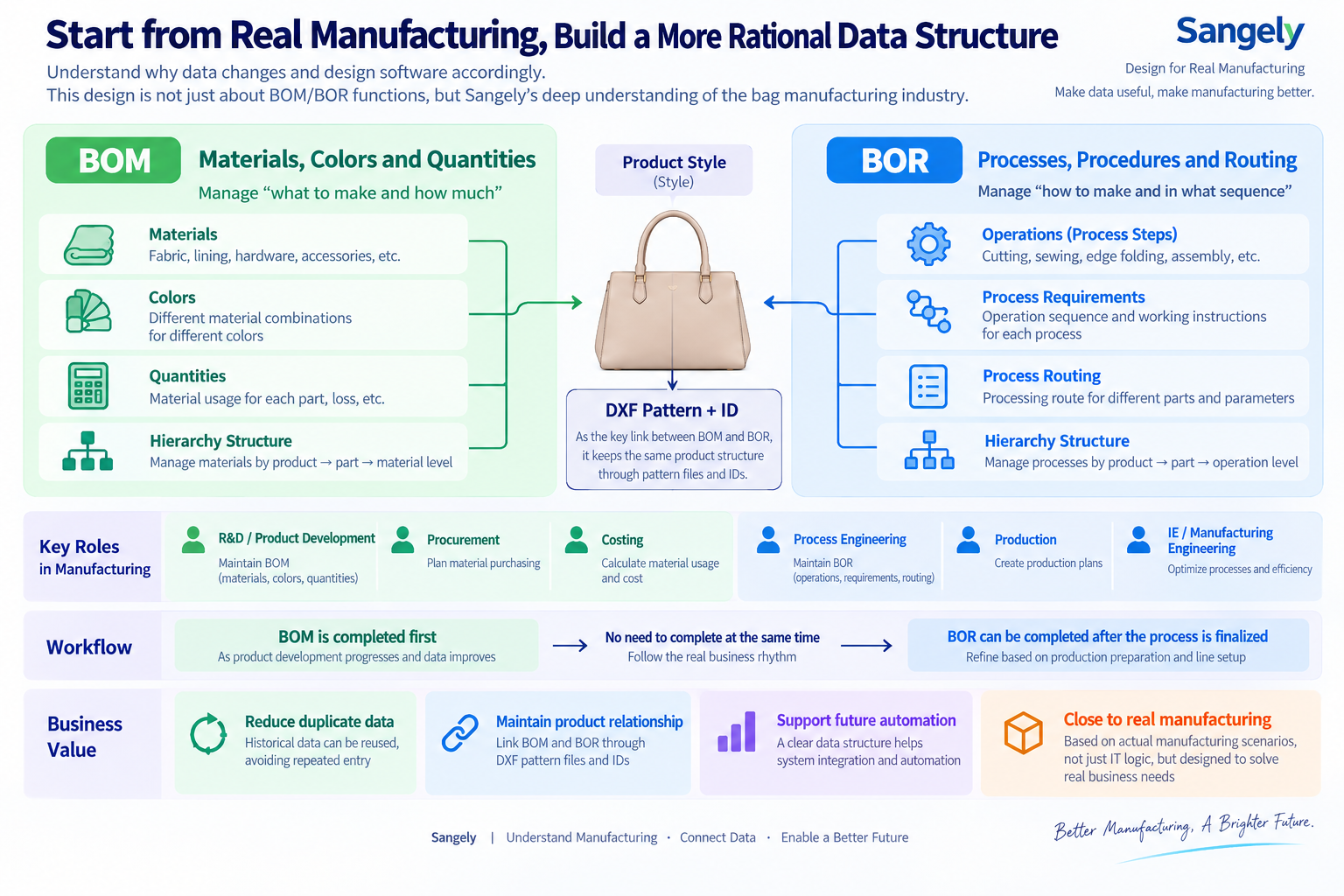
Materials, colorways, and consumption quantities belong to the BOM. Operations, processes, and manufacturing routings belong to the BOR. Each manages its own hierarchy, while DXF pattern pieces and their corresponding IDs maintain the relationship between them.
Business data can then be developed according to the actual rhythm of product development and manufacturing, while creating a foundation for historical data reuse and future automation.
This also reflects Sangely's broader view of manufacturing software design:
Do not begin with a generic system structure and force the factory to adapt to it. First understand why manufacturing data changes in real business scenarios, and then determine how the software architecture should represent those changes.
Conclusion: Not All Manufacturing Data Should Be Bound Together
How BOM and BOR should be designed may appear to be a very specific software question.
But the real industry capability of manufacturing software is often revealed through details like these.
If materials, colorways, and process routings are tightly bound together simply because “everything should exist in one structure tree,” then in a multi-color and frequently changing bag manufacturing environment, one material change may create a large amount of unnecessary duplicate data.
Sangely takes a different approach.
First determine whether the material has changed.
Then determine whether the process has changed.
Ask whether both types of data follow the same pattern of change.
Understand which departments need the information and at what stage.
Only then determine how the system should organize the data.
Based on this business logic, Sangely assigns materials, colorways, and consumption quantities to the BOM, assigns operations and manufacturing routings to the BOR, and uses DXF pattern pieces and corresponding IDs to maintain the product relationship between them.
The objective is not simply to “separate” BOM and BOR.
It is to:
Keep each type of data where it truly belongs, while ensuring that all of it still belongs to the same product.
This can reduce unnecessary duplication, allow different departments to work according to a more realistic business rhythm, and provide a clearer foundation for future product data reuse and automation.
If something truly changes, update it. If it does not change, it should not have to be duplicated simply because of the system structure.
That is the multi-color product data problem Sangely aims to solve through its BOM and BOR design.
FAQ: Common Questions About BOM, BOR, and Multi-Color Product Management
1. What are BOM and BOR?
A BOM, or Bill of Materials, primarily describes the material structure of a product, including which materials are required, which materials are used for different colorways, and the required consumption quantities.
A BOR, or Bill of Routing, primarily describes the manufacturing routing of a product, including the operations, processes, and production steps required to manufacture it.
In Sangely's architecture, BOM and BOR remain connected to the same product while separately managing the material and process dimensions.
2. Why does the number of BOMs increase when a bag has multiple colorways?
Different colorways may require different combinations of main materials, lining materials, zippers, hardware, and accessories.
Creating different BOMs for different colorways can therefore be reasonable.
What should be avoided is duplicating manufacturing process data that has not changed simply because the material colorway has changed.
Sangely therefore uses the BOM to manage material and colorway changes, while the BOR is managed according to actual changes in manufacturing processes.
3. Does the BOR need to be rebuilt whenever a product color changes?
Not necessarily.
If only the color or material combination changes while the product structure and manufacturing method remain the same, the existing manufacturing routing can continue to serve as a reusable basis.
If the product structure or manufacturing method changes, the BOR can then be adjusted accordingly.
A simple principle is:
Material changes are handled in the BOM. Process changes are handled in the BOR.
4. If BOM and BOR are managed separately, how does Sangely keep them connected?
Sangely can use CAD/DXF pattern pieces and their corresponding IDs to maintain relationships between product data objects.
The BOM can record the materials, colorways, and consumption associated with particular pattern pieces, while the BOR records the processing and manufacturing routing associated with those product objects.
The two structures manage different dimensions of data while remaining connected to the same product.
5. Do BOM and BOR need to be completed at the same time?
Not necessarily.
In real manufacturing environments, BOM and BOR may be managed by different teams and completed at different stages.
The BOM may need to support costing, purchasing, and material preparation relatively early, while industrial engineering and engineering teams continue to refine manufacturing routings.
Sangely places greater emphasis on supporting actual business workflows rather than forcing all product information to be completed at exactly the same time simply to satisfy a system structure.
6. Does Sangely support multi-color BOM management?
Yes.
Sangely's current product architecture supports color-specific BOMs for different product colorways, allowing different colors and material combinations to maintain clearer data relationships.
The specific colorway rules, material combinations, and downstream workflows used in an implementation should still be configured and validated according to the manufacturer's actual product structure and business requirements.
7. Does separating BOM and BOR increase the workload for engineering teams?
The purpose of separating them is not to create two independent sets of manual work.
The design objective is to make the responsibilities of material data and process data clearer, reduce unnecessary duplication of process information caused by color changes, and provide a better foundation for historical data reuse and future automation.
Sangely.PDM can also establish BOM and BOR information based on CAD data and combine this with historical similar-product data to support the creation of new BOMs, manufacturing routings, and costing information.
8. Can BOM and BOR data continue to be used by ERP and MES?
Yes.
BOM data created during the PDM stage can continue to provide a foundation for ERP order management, material planning, and resource planning.
BOR and other process data can also support downstream manufacturing activities and MES production execution.
The value of BOM and BOR therefore extends beyond product development.
The clearer the product data is at the beginning, the easier it becomes for resource planning and production execution to continue using the same manufacturing data foundation.