
AI is changing the software industry.
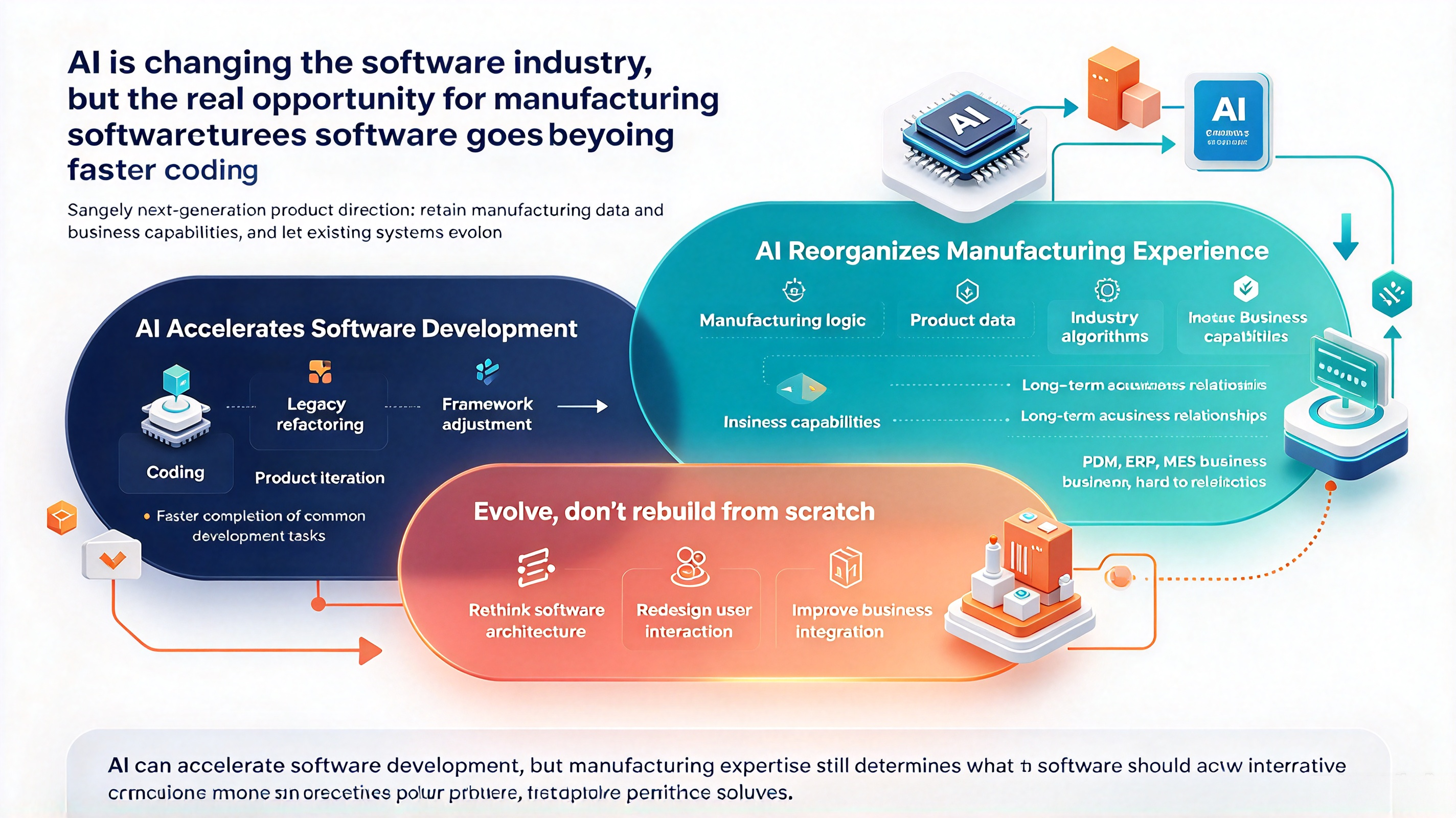
The most visible change is the acceleration of software development. Tasks that once required developers to spend significant time on coding, legacy system refactoring, framework adjustments, and product iteration can now be completed more efficiently with the help of AI.
But for manufacturing software, the real opportunity created by AI is not simply about “writing code faster.”
A more important question is:
Can the manufacturing logic, product data, industry algorithms, and business capabilities accumulated over many years be reorganized and restructured with the help of AI?
This is also one of the key directions Sangely is exploring for its next generation of products.
Sangely does not intend to discard its existing PDM, ERP, and MES systems and rebuild an entirely new so-called “AI software” platform from scratch.
Instead, the goal is to retain the manufacturing data and business capabilities accumulated over the years, while using AI to rethink software architecture, user interaction, and business integration so that existing systems can continue evolving under new technological conditions.
AI can accelerate software development, but manufacturing expertise still determines what problems the software should actually solve.
AI Can Accelerate Software Development, but Manufacturing Processes Cannot Be “Guessed” from Scratch
Today, AI can already participate in software coding, code refactoring, system architecture design, and functional iteration. This is clearly changing how software is developed.
However, once AI enters enterprise software, one fundamental question remains:
How should a system be designed so that it truly fits real manufacturing processes?
AI does not inherently understand why a bag manufacturer manages BOMs in a particular way.
It does not automatically understand why a product may go through repeated sampling, color changes, and material substitutions.
Nor does a powerful AI model naturally know how an ERP system should receive product data, organize materials and production resources, and then pass production tasks to MES.
These capabilities come from long-term manufacturing experience, project implementation, customer requirements, and the business judgment formed through solving real shop-floor problems.
For Sangely, meaningful AI transformation is not about removing everything that has already been built.
It is about reassessing which manufacturing logic should be retained, which processes can be redesigned, which repetitive tasks can be assisted by AI, and which professional capabilities can be connected to mature external systems through APIs.
The real difference is not simply whether software “has AI,” but what manufacturing capabilities that AI is combined with.
AI Is Already Entering Real Product Development Workflows in Sangely.PDM
This integration is not limited to concepts.
When manufacturing companies receive information for a new product from a customer, a significant amount of document processing is often required at the beginning of product development.
Customer documents need to be reviewed. Product information, dimensions, colors, and material requirements need to be organized before sample development records can be created.
Today, the Sangely.PDM AI Assistant can already participate in this process.
The AI Assistant can read customer documents, extract and organize key information such as product details, dimensions, color requirements, and material specifications. After the user reviews and confirms the information, applicable data can be entered into the PDM sample record to assist with the transition from customer documents to structured product development data.
This means AI is no longer only “answering questions.”
It is beginning to participate directly in business workflows.
Information from customer files can be identified and organized by AI, reviewed by users, and then entered into the PDM product development process.
Work that previously required manual reading,整理, and item-by-item data entry can gradually become more continuous.
AI helps understand and organize information, people make the critical decisions, and the system continues to carry the business process forward.
This is much closer to what manufacturing companies actually need from AI than simply adding an AI chat window to existing software.
From PDF and DXF to BOM and BOR: AI Is Entering Deeper Stages of Product Development
Sangely has already built a number of foundational capabilities around customer documents, drawings, and product development.
In earlier software workflows, complex PDF customer documents often required dedicated interpretation logic.
With AI, new possibilities are emerging for understanding, parsing, and organizing this type of external information, creating more flexible ways for customer data to enter the product development process.
Within PDM, Sangely is also continuing to connect CAD/DXF files, pattern data, BOMs, and BORs into a more continuous product data structure.
Sangely.PDM can use CAD drawings as a basis for further building BOM material structures and BOR process routes.
It also supports searching for historical similar products using a single product image.
After users confirm a reference product, they can reuse existing process routes, adjust relevant process nodes based on the differences in the new product, and then continue building new BOMs, process routes, and cost estimates.
What matters here is not whether AI will “replace BOMs and process routes.”
In fact, the opposite is true.
The deeper AI enters product development, the more it depends on clearly structured BOMs, BORs, and product data.
AI changes how data is created and used, but it does not eliminate the need for foundational manufacturing data.
3D Is Not an Isolated Feature, but an Extension of Product Data Capabilities
3D modeling is another distinctive capability already available in Sangely.PDM.
After pattern images are submitted, the system can further process them and generate a 3D model, allowing sales and development teams to view product effects more intuitively during the development stage and reducing repeated communication based only on 2D information.
However, Sangely does not view 3D simply as a standalone visualization feature, nor does it simply describe it as “AI-generated.”
Its greater value comes from connecting 3D with image recognition, historical product data, and other product information.
For example, a company can use one product image to search for similar historical products and then refer to related pattern data, process information, and material pricing.
In this way, product images, patterns, 3D models, historical products, BOMs, process data, and costing information are no longer isolated from one another.
They gradually become connected around the same product.
3D makes the product more visual, image recognition helps locate historical references, and the real foundation for new product development and rapid costing is the ability to retrieve, connect, and reuse accumulated enterprise data.
BOM and BOR Remain Critical Manufacturing Data Foundations in the AI Era
No matter how AI technology evolves, manufacturers still have to turn product designs into physical products.
What materials are required?
What processes are involved?
What should purchasing, planning, and production use as their operational basis?
These questions do not disappear because AI exists.
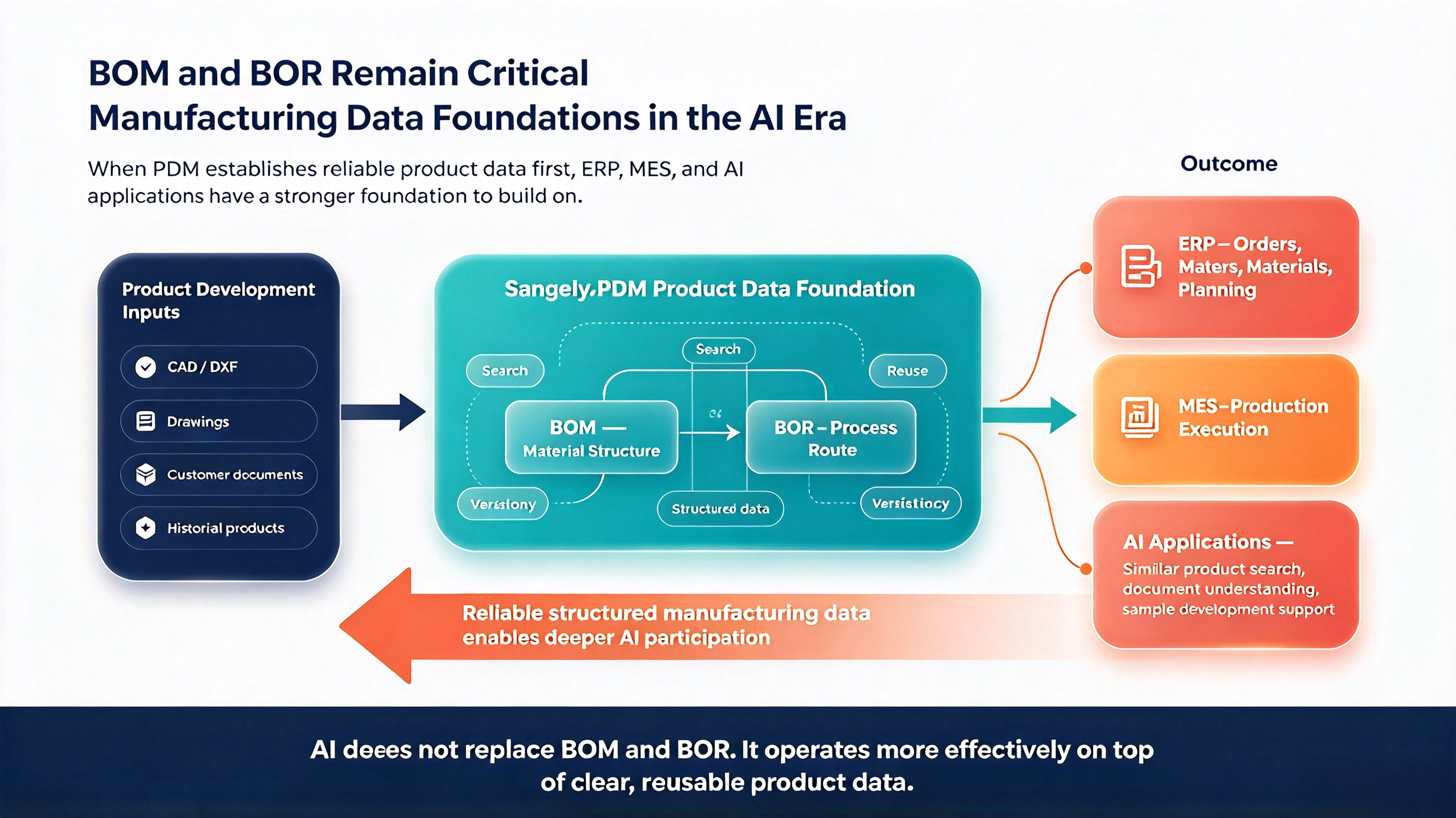
That is why CAD/DXF, BOM, and BOR remain important data foundations in the development of Sangely.PDM.
A BOM describes the material structure of a product.
A BOR describes its process route.
These data structures do not only support product development. They can also continue to provide the basis for Sangely ERP to manage orders, materials, and resource planning, while supporting Sangely MES in production execution.
As drawings, BOMs, BORs, and historical product data become increasingly connected around products, companies are no longer accumulating only a collection of files.
They are building a structured data foundation that can be continuously searched, reused, and carried forward into subsequent manufacturing processes.
This data foundation also determines how deeply AI can participate in manufacturing workflows in the future.
If AI is expected to search for similar historical products, read customer documents, assist with sample development, or eventually participate in more business processes, it needs to operate on top of clearly structured manufacturing data.
When PDM establishes reliable product data first, ERP, MES, and AI applications have a stronger foundation to build on.
APIs Give the Next Generation of Manufacturing Software More Open Boundaries
Another major change in the AI era is that software no longer needs to keep every professional capability inside a closed system.
Through APIs, manufacturing software can connect its own industry-specific capabilities with mature systems that companies are already using.
For example, Sangely ERP can currently connect with financial systems such as Kingdee and Yonyou through interfaces, allowing manufacturing business data to continue flowing into an enterprise’s existing financial environment.
This represents a more open approach to software architecture.
The next generation of manufacturing software does not necessarily need to rebuild every professional capability internally.
What matters more is retaining the manufacturing business capabilities that truly create value, while using AI, APIs, and external professional systems to expand the boundaries of the software.
For Sangely, this architecture can be understood as:
Manufacturing Business Capabilities + Product Data + AI + APIs + Mature External Ecosystems
The competitiveness of software is not determined only by how many features are developed in-house.
It also depends on whether those capabilities can be organized into a system that genuinely works for manufacturing companies.
Third-Generation ERP Is Another Practice of Reintegrating Manufacturing Expertise with AI
This thinking is also being applied to Sangely’s next-generation product development.
Sangely is currently developing its third-generation ERP.
The goal is not simply to build another traditional ERP system, nor is it to add an AI entry point to the existing menu structure.
Instead, Sangely aims to use AI-driven development efficiency, architectural restructuring, and improved business collaboration to reorganize the manufacturing logic accumulated through years of ERP development and implementation.
Existing capabilities around orders, materials, resource planning, master scheduling, and manufacturing business logic do not lose their value simply because AI has emerged.
The real questions are:
Which capabilities should continue to be retained?
Which workflows can be redesigned?
Which operations are suitable for AI assistance?
And which data should be connected more naturally with PDM, MES, and external systems?
At this stage, the development direction of Sangely’s third-generation ERP can be summarized as:
Deep Integration of Manufacturing Expertise and AI
Specific product functions and modules will be subject to official product releases.
In the AI Era, the Real Difference in Manufacturing Software Will Not Come Only from the Model
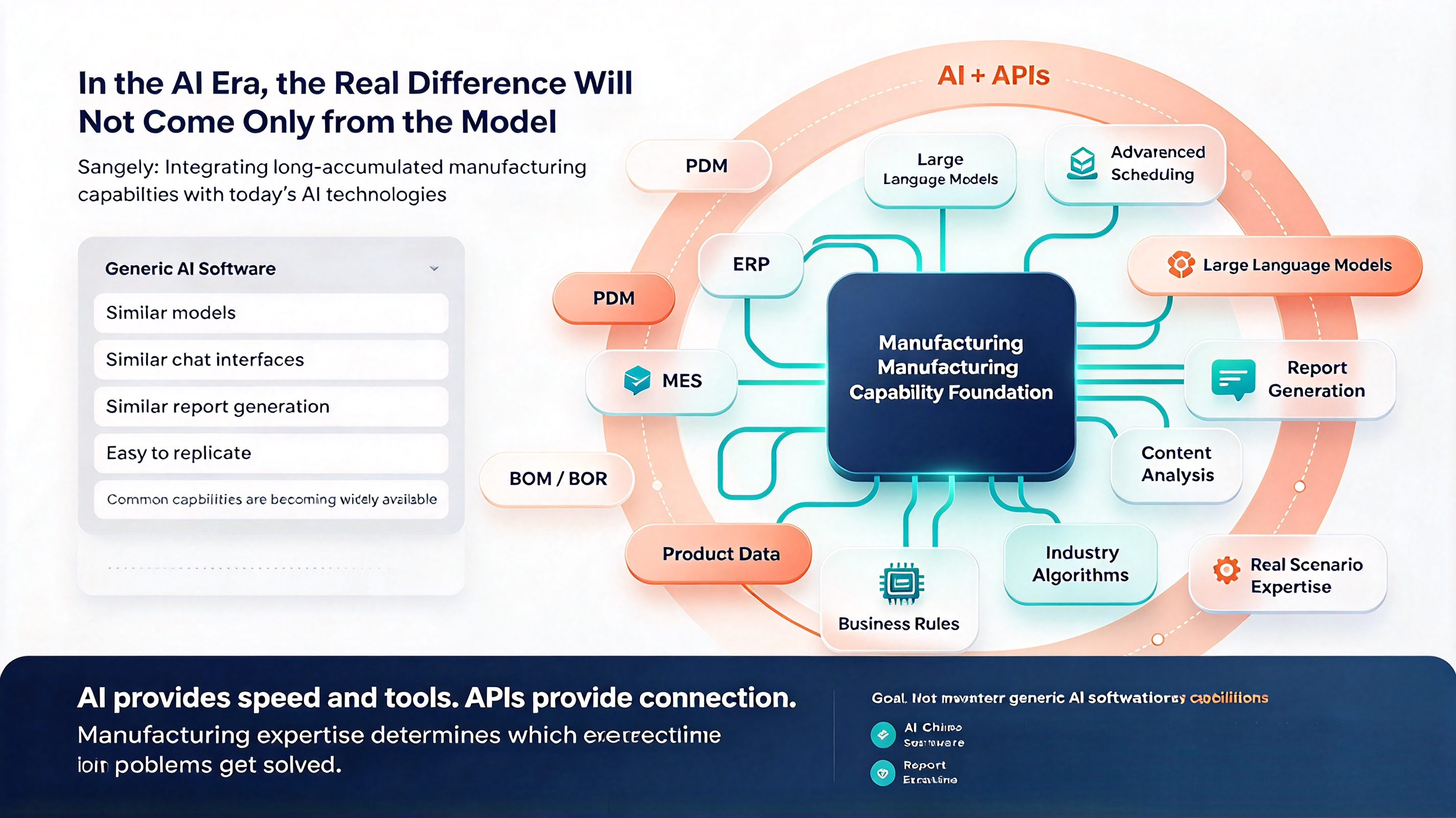
In the future, more and more software products may use similar large language models.
Chat interfaces, report generation, content analysis, and even certain parts of software development may gradually become common capabilities.
If every software provider can access AI, then the real difference between manufacturing software products will no longer be determined simply by “which model they use.”
What is more difficult to replicate is long-term industry understanding, product data, business rules, professional algorithms, and the software systems formed through real manufacturing scenarios.
For Sangely, PDM, ERP, MES, BOM/BOR, advanced scheduling capabilities, and accumulated manufacturing expertise are themselves important foundations in the AI era.
AI provides new speed and new tools.
APIs provide more open methods of connection.
Manufacturing expertise still determines which problems those tools should ultimately solve.
That is why Sangely is not trying to create another generic “AI software” product that looks similar to everything else in the market.
Instead, the goal is:
To truly integrate the manufacturing capabilities accumulated over time with today’s AI technologies.
Final Thoughts: New Technology Should Not Erase What Has Already Been Built
No one can say with certainty today whether AI will completely rewrite the software industry.
But for manufacturing software companies, a more practical question is:
How can the manufacturing capabilities already accumulated continue to evolve in the AI era?
Sangely is re-examining its existing PDM, ERP, MES, BOM/BOR, advanced scheduling capabilities, product development logic, and system interfaces in the context of AI.
The goal is not to discard all existing software.
Nor is it simply to add a few AI buttons.
It is about using new technology to redesign the architecture and working methods of the next generation of manufacturing software.
AI brings new speed. Manufacturing expertise determines the direction.
Sangely’s goal is to bring the two together.
From customer documents to product development;
from CAD/DXF to BOM and BOR;
from PDM to ERP and MES;
and further to 3D, financial systems, and broader open ecosystems.
Sangely is gradually working toward a new generation of manufacturing digitalization driven by:
Manufacturing Expertise + Product Data + AI + Open Ecosystems
---
FAQ: Common Questions About Sangely Manufacturing Software and AI
1. What AI applications does Sangely currently have?
Sangely has already introduced AI into several real manufacturing business scenarios.
For example, the Sangely.PDM AI Assistant can read customer documents, organize product information, dimensions, colors, and material requirements, and, after user confirmation, enter applicable information into PDM sample records.
Sangely.PDM also supports searching for historical similar products using a single product image. Historical product data can then be used as a reference for subsequent BOM creation, process routing, and costing.
In these scenarios, AI primarily supports information recognition, organization, and processing, while critical product decisions remain under human control.
2. Why Are BOM and BOR Still Important in the AI Era?
Because the deeper AI enters manufacturing operations, the more it depends on reliable structured data.
A BOM defines the materials required for a product, while a BOR defines the process steps involved in producing it.
These data structures support not only product development, but also ERP resource planning and MES production execution.
AI does not eliminate BOM and BOR. Instead, AI depends on clearly structured product data.
3. How Is Sangely.PDM’s 3D Capability Related to AI?
Sangely.PDM already provides 3D modeling capabilities. After pattern images are submitted, the system can further process them and generate a 3D model.
3D itself should not simply be equated with AI.
Sangely focuses more on connecting 3D, image recognition, historical product data, and PDM product data.
For example, users can search for historical similar products from a single product image and then refer to similar patterns, process routes, and material pricing to support new product development and rapid costing.
4. Why Does Sangely Still Connect with Other Systems Through APIs?
Manufacturing software does not need to rebuild every professional function internally.
Sangely retains its own capabilities in manufacturing operations, product data, and production management, while using APIs to connect with mature systems already used by enterprises.
For example, Sangely ERP can connect with financial systems such as Kingdee and Yonyou through interfaces.
As a result, the next-generation architecture increasingly emphasizes collaboration between Sangely’s manufacturing capabilities, AI, APIs, and mature external systems.
5. How Is Sangely’s Third-Generation ERP Different from Previous ERP Systems?
Sangely is currently developing its third-generation ERP.
Its development direction focuses on the deep integration of manufacturing expertise and AI.
The objective is not simply to rebuild a traditional ERP system. Instead, Sangely aims to combine AI-driven development efficiency, architectural restructuring, and improved business collaboration with the manufacturing expertise and ERP capabilities accumulated over the years.
Specific functions and modules will be announced through official product releases.