
When manufacturing enterprises pursue product digitalization, they often encounter two concepts: PDM and PLM. PLM (Product Lifecycle Management) focuses on managing the broader product lifecycle, while PDM (Product Data Management) concentrates more directly on product development and product data management.
For manufacturers of bags, handbags, footwear, and related products, the most pressing question is often not how extensive a system's coverage should be, but something more fundamental: When a customer's product enters the company, how should its material data, process data, and manufacturing methods be established?
If product development still relies on Excel to organize BOMs, industrial engineers (IE) maintain process routings separately, and standard times depend heavily on individual experience, data may still need to be repeatedly organized and transferred between departments and systems—even after ERP and MES have been implemented.
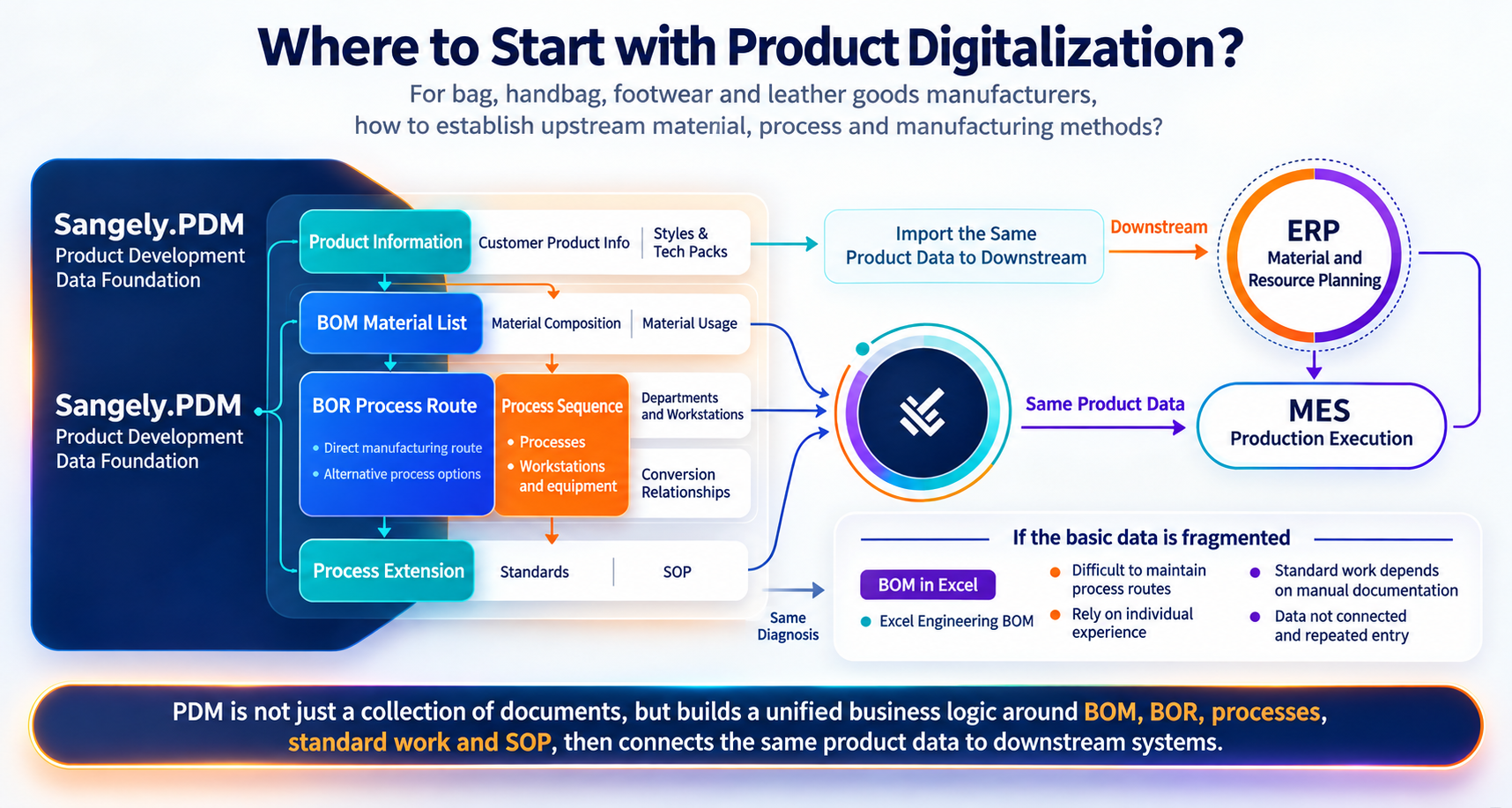
Sangely.PDM focuses on establishing this data foundation at the product development stage. Rather than simply collecting all product information in one system, it first distinguishes between different types of manufacturing data: BOM manages materials, while BOR manages manufacturing processes. Process data then extends into work methods, standard times, and Standard Operating Procedures (SOPs).
These data structures are established according to their respective business requirements and remain connected to the same product as information moves into ERP and MES.
1. PDM or PLM? Start with the Problems Your Business Needs to Solve
PLM covers a broader product lifecycle, while PDM addresses product development more directly. For enterprises primarily seeking to improve product development, engineering-to-production transfer, and manufacturing data creation, PDM often provides a closer fit to their immediate operational needs.
When a bag manufacturer begins developing a new product, the challenges are usually very specific: How should a product be created from customer drawings? How should the BOM be generated? How should different colors and sizes be managed? Where should process routings be defined? And how can this information be passed to purchasing, industrial engineering, and production?
If these foundational data relationships have not been properly established, adding more system modules may still leave employees dealing with manual data preparation, repeated explanations, and data conversion.
Sangely.PDM therefore emphasizes building a deeper manufacturing data foundation from the product development stage. The priority is to clearly define "what the product is, what materials it requires, and how it should be manufactured" before transferring that information into downstream manufacturing operations.
Choosing between PDM and PLM is therefore not simply a matter of comparing which system covers more functions. The more important question is:
At which stage of the business are the company's most urgent problems occurring?
2. BOM Manages Materials, BOR Manages Processes: Why Separate Them?
BOM and BOR are both essential to transferring a product from development into manufacturing, but they answer different questions.
BOM (Bill of Materials) defines the materials required for a product. It primarily manages which materials are needed, their quantities, and how material combinations vary across different colors and sizes.
BOR (Bill of Routing) defines the manufacturing process route. It manages which operations a product must undergo, how those operations are connected, and the manufacturing sequence required to complete the product.
The two differ significantly in their applications, data structures, and downstream uses.
This distinction is particularly important in multi-color bag manufacturing.
For example, consider a bag available in black, brown, and gray. When the color changes, the main fabric, lining, sewing thread, zipper, and even hardware may also need to change. The BOM must therefore account for color and size variations.
However, if the product's structure and manufacturing method remain unchanged, processes such as cutting, stitching, edge binding, and assembly do not necessarily need to be recreated. A process route established for a particular product structure can continue to apply across different colors and sizes of that structure.
This is why Sangely.PDM manages BOM and BOR separately.
The objective is not simply to divide the system into two modules, but to avoid repeatedly maintaining unchanged process data whenever material configurations change.
3. Sangely's BOR Is More Than a List of Process Names
Managing BOM and BOR separately does not mean isolating their data. Sangely's approach is to keep both connected through the same product, pattern pieces, and component relationships.
In bag manufacturing, many operations are directly related to the product's physical structure. Which pattern pieces must be joined, where edge binding is required, which sections need stitching, and where hardware must be installed all influence the manufacturing process route.
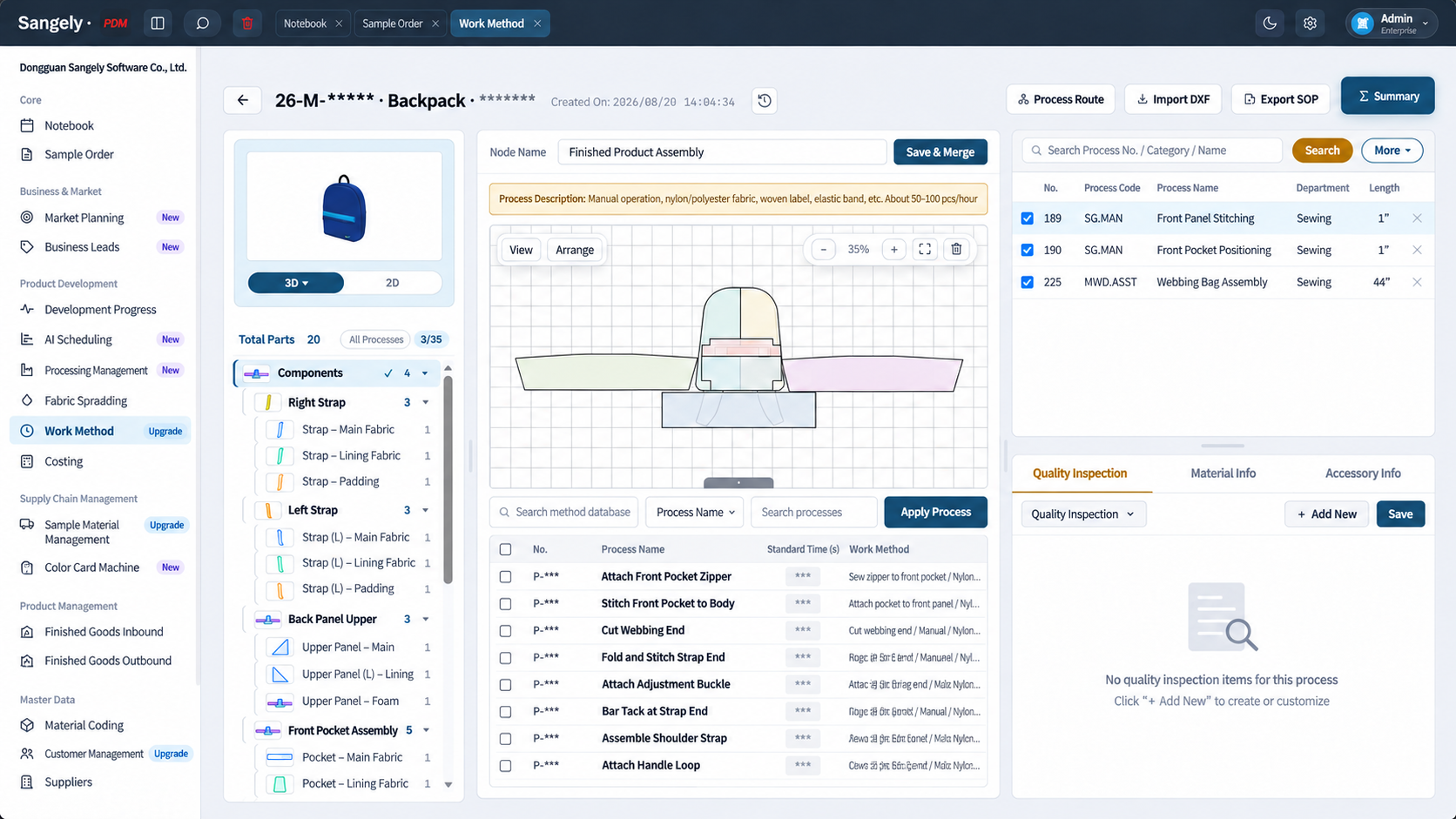
Therefore, BOR in Sangely.PDM does more than record a simple sequence of "Operation 1, Operation 2, Operation 3." It can establish process routings based on pattern-piece assembly relationships, related components, and hardware.
Each operation can remain associated with the actual product structure.
Instead of merely recording:"There is an edge-binding operation here."
The system can further identify:
"Which part of the product this operation applies to, and which pattern pieces or accessories are involved."
Once process routings are connected to product structures, BOR is no longer just a static list of operations. It becomes a data foundation for downstream work methods, standard times, and SOPs
4. From BOR to Work Methods, Standard Times, and SOPs: Turning Manufacturing Know-How into Data
A process routing explains which operations must be performed. However, once production reaches the shop floor, knowing the operation names alone is not enough.
Manufacturers also need to understand: How should each operation be performed? What production standards should be followed? How much time should the operation normally require?
In Sangely's product architecture, BOR is therefore not the endpoint of manufacturing process data. It extends further into work methods, standard times, and SOPs.
BOM primarily supports materials, purchasing, and warehouse management, while SOPs communicate specific operating standards to the production floor. These types of information naturally differ in their data structures, applications, timing, and responsible personnel.
Consider an interior edge-binding operation on a bag.
Although two operations may share the same name, the factors influencing their standard times may be very different. Processing length, starting motions, ending motions, whether a fabric label must be inserted during the operation, turns caused by the product's shape, and allowances for interruptions during extended processing can all affect the required operating time.
For this reason, Sangely's standard times are not simply fixed values manually entered by industrial engineers.
Instead, the system incorporates processing length, starting motions, ending motions, additional motions, shape variations, and allowances for extended operations into a unified calculation framework.
By establishing relationships among work methods, standard motion elements, and product parameters, Sangely aims to reduce dependence on individual experience when calculating standard times.
This also provides a more consistent data foundation for labor costing, capacity analysis, and production efficiency evaluation.
What matters most is not a particular calculation formula, but a broader approach to manufacturing data:
Manufacturing methods that previously existed mainly in the experience of industrial engineers can gradually be broken down into structured data that a system can understand, calculate, and reuse.
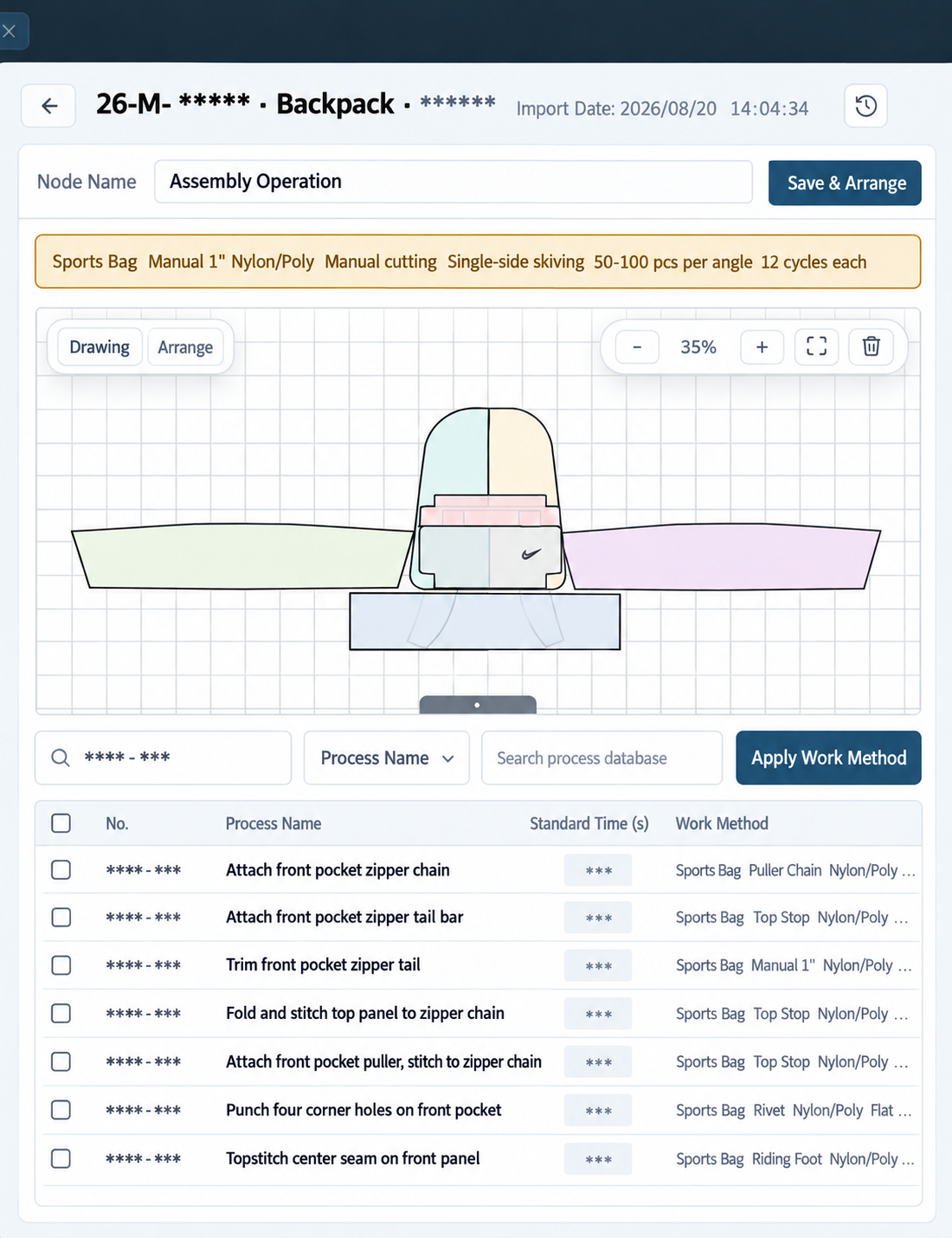
Figure: Sangely.PDM Workstation Management Interface — Linking Pattern Assembly, Manufacturing Methods, and Standard Working Hours.
5. How Sangely Transforms Industrial Engineering Methods into System Capabilities
Establishing reliable standard times for actual manufacturing operations requires more than adding software fields.
Since 2005, Sangely has continuously invested in shop-floor industrial engineering (IE) research. Through process observation, time measurement, and the study of manufacturing operations, the company has accumulated fundamental parameters for different processes and gradually organized them into a structured system of work methods and standard times.
This research focuses on practical questions: How do operators perform their tasks? What motions make up an operation? Which product characteristics affect processing time? And which aspects of manufacturing experience can be standardized for long-term use?
Only after this knowledge has been studied and structured can it be incorporated into software.
In Sangely, work methods can also be linked to standard motion element data to support the calculation of standard times.
This is the underlying significance of what Sangely refers to as "Rigid Standard Time."
In manufacturing operations, it is not unusual for different industrial engineers to assign different standard times to the same process.
When standards depend heavily on individual experience, changes in IE personnel can also affect the benchmarks used for labor rates, capacity planning, efficiency analysis, and production scheduling.
Sangely aims to preserve standardized work methods, motions, and product conditions within the system. Under the same work methods and product conditions, standard times can be calculated according to consistent rules, reducing variations caused by personnel changes.
This does not diminish the value of industrial engineers. Instead, it transforms their most valuable and repeatable expertise into long-term operational standards that the enterprise can continue to use.
People may change, but the standards used to measure manufacturing efficiency should remain consistent.
6. The Ultimate Purpose of PDM: Carrying Product Development Data into Manufacturing
Once the responsibilities of BOM and BOR are clearly defined, their downstream applications become easier to understand.
BOM manages material information that can support material planning, purchasing, inventory, costing, and ERP resource planning.
BOR manages manufacturing process information that can extend into work methods, standard times, SOPs, and MES production execution.
At this point, PDM is no longer simply a software application used by the product development department. It becomes the starting point for creating structured manufacturing data.
BOM preserves material relationships. BOR preserves process routings. Work methods capture manufacturing knowledge. Standard times establish relatively consistent efficiency benchmarks. SOPs carry operating requirements onto the shop floor.
This information can then continue into ERP and MES.
In practice, many manufacturers have been operating ERP systems for years. Their order management, purchasing, inventory, and financial processes may already be functioning reliably. What they lack is the connection between product development and engineering-to-production transfer.
In such cases, implementing PDM does not necessarily require replacing the existing ERP system.
Sangely.PDM can integrate with third-party ERP systems through APIs, allowing PDM to manage product development and manufacturing data while transferring relevant information into the company's existing business systems.
System integration, therefore, does not mean every software application must come from the same vendor.
What manufacturers truly need to avoid is a situation where:
Every time product data crosses a system boundary, employees must return to Excel spreadsheets, manual data exports, and repetitive data entry.
The real objective of Sangely.PDM is to establish a manufacturing data foundation during product development that downstream operations can continue to use.
Conclusion: Instead of Asking PDM or PLM, Ask Whether Product Data Can Truly Reach Manufacturing
For manufacturing enterprises, the choice between PDM and PLM is not simply a matter of terminology.
The more important question is whether customer product information can be gradually transformed into the company's own structured material, process, and manufacturing knowledge.
If BOMs are still maintained in Excel, process routings are still organized manually by individual industrial engineers, and standard times change whenever personnel change, manufacturing knowledge has not truly been institutionalized—even if the enterprise uses a system with extensive functional coverage.
Sangely.PDM manages BOM and BOR separately because materials and manufacturing processes naturally follow different patterns of change.
BOR then extends into work methods, standard times, and SOPs because product development data must ultimately serve real manufacturing operations.
As knowledge that once existed primarily in engineering departments, industrial engineering teams, and shop-floor experience is gradually incorporated into the enterprise's own structured data system, PDM becomes more than aplace to store product information.
It becomes the starting point for building manufacturing data.
FAQ | Frequently Asked Questions About Sangely.PDM
1. What is the difference between PDM and PLM?
PDM focuses more directly on product development and product data management, while PLM covers a broader range of activities across the product lifecycle.
If a manufacturer's current priorities include new product development, BOM management, process routing, standard time management, and engineering-to-production transfer, it should carefully evaluate the product development data capabilities of a PDM system.
2. Why does Sangely.PDM manage BOM and BOR separately?
Because these two types of data follow different business rules.
BOM manages materials, colors, sizes, and quantities, while BOR manages manufacturing processes, operations, and process routings.
When the color of a bag changes, its materials may change, but its manufacturing process does not necessarily change.
3. Will separating BOM and BOR create data silos?
No. Separate management does not mean the data operates independently.
Sangely's BOR can establish process relationships based on product structures, pattern pieces, and related components. Therefore, although BOM and BOR are managed separately, they remain connected to the same product.
4. What makes Sangely's BOR different?
Sangely's BOR does more than record operation names.
It can establish process routings based on pattern-piece assembly relationships, product structures, and related components, while extending further into work methods, standard times, and SOPs.
5. Are Sangely's standard times manually entered by industrial engineers?
The primary approach is not simply to enter a fixed number of seconds.
Sangely incorporates processing length, starting motions, ending motions, additional motions, shape variations, and relevant allowances into a unified calculation framework.
Standard times are then established using work methods, standard motion elements, and product parameters.
6. What is "Rigid Standard Time"?
The core principle is to calculate standard times according to consistent rules under the same work methods and product conditions, reducing variations caused by changes in industrial engineering personnel.
This provides a more stable basis for labor costing, production capacity analysis, efficiency evaluation, and continuous improvement.
7. Can a company use Sangely.PDM if it already has an ERP system?
Yes, depending on the company's existing system architecture and integration requirements.
Sangely.PDM supports API integration with third-party ERP systems. Manufacturers therefore do not necessarily need to replace a stable, existing ERP system when implementing PDM.
8. What types of manufacturers are best suited for Sangely.PDM?
Sangely.PDM is particularly relevant to manufacturers of bags, handbags, footwear, and related products that handle frequent new product development, complex BOM and process data, multiple colors and sizes, and close coordination between product development, industrial engineering, ERP, and MES.
A practical way to evaluate the value of PDM is to ask one question:
Can the data established in PDM continue to be used by purchasing, industrial engineering, ERP, and production without repeated manual entry?