
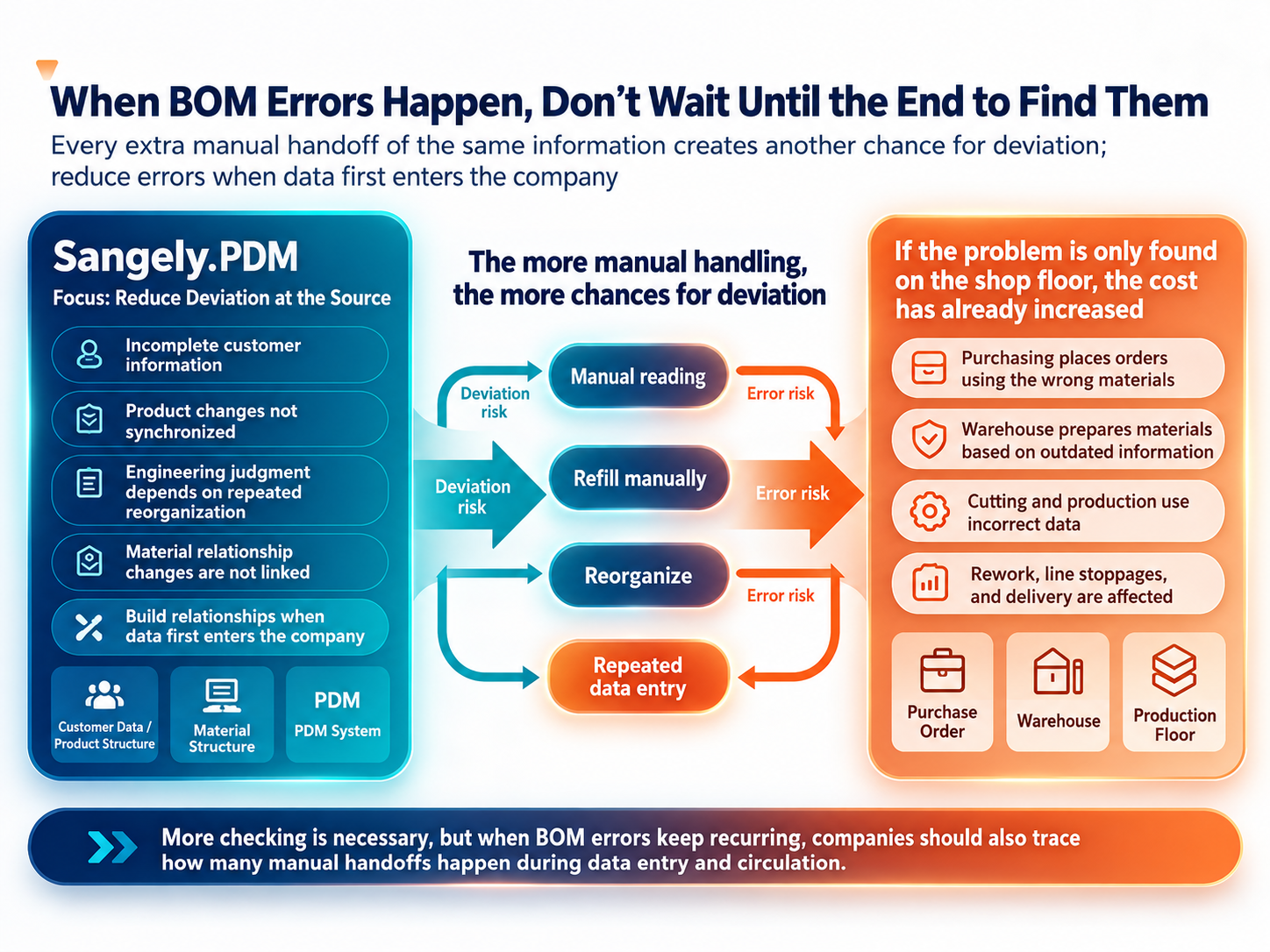
Anyone involved in new product development for bags, handbags, and leather goods is likely familiar with BOM (Bill of Materials) errors. A sewing thread may be assigned the wrong color, a pattern piece may be omitted, or a customer may have changed a material while downstream product records still reflect an outdated version.
These may seem like minor issues during product development. However, once inaccurate data moves into purchasing, warehousing, and production, its impact can spread throughout the manufacturing process.
Purchasing teams may order incorrect materials, warehouse staff may prepare materials based on outdated specifications, and production teams may discover discrepancies only when cutting or manufacturing begins. At that point, the cost is no longer limited to the time required to correct a BOM.
When BOM errors occur, many factories respond by adding more approval procedures or asking engineering staff to double-check their work. These measures are necessary, but if similar errors continue to occur, manufacturers should investigate a more fundamental question:
Are these errors really caused by employee carelessness, or is the same product information being manually transferred too many times as it enters and moves through different systems?
Duplicate data entry is not the only cause of BOM errors. Incomplete customer specifications, product changes, engineering decisions, and changes in material relationships can all create data discrepancies. However, every additional step of manually reading, re-entering, or reorganizing the same information introduces another opportunity for inconsistencies.
This is one of the key considerations behind the continuous development of Sangely.PDM:
Instead of focusing only on detecting errors after a BOM has been created, manufacturers should also reduce the opportunities for errors to occur when product data first enters the organization.
1. BOM Errors May Begin Before the BOM Is Created
New product development does not begin with a BOM.
In bag and handbag manufacturing, customers typically provide Tech Packs (TPs), product images, specifications, and other development documents before production begins.
After receiving these documents, manufacturers need to interpret customer requirements, establish sample development records, and gradually organize style numbers, colors, materials, pattern files, BOMs, and manufacturing process data.
Problems can arise when information moves between these activities.
For example, a customer Tech Pack may already contain the necessary product information. The merchandising team reads and reorganizes it once. The engineering team enters similar information again when creating sample records. During BOM preparation, the same details may need to be reviewed and entered yet another time.
If the customer changes a color, replaces a material, or modifies the product structure during development, those changes must also be reflected in subsequent product data.
Each manual transfer effectively becomes another data conversion step.
A sewing thread color specified in the original customer document may be entered incorrectly in the sample record. A pattern piece may be omitted when product information is reorganized. A customer may approve a material change, but one of the downstream documents may still contain the previous specification.
When the discrepancy is eventually discovered, the issue is often summarized in a single statement:
"The BOM is incorrect."
However, tracing the problem back through the development process may reveal that the discrepancy originated when customer information first entered the company.
2. Why Does Sangely.PDM Start with Customer Tech Packs?
An important principle behind Sangely's product design is straightforward:
Information already provided by customers should not have to be manually entered again by every department.
Under suitable document conditions, the Sangely.PDM AI Assistant can help read customer correspondence and Tech Packs, extracting and organizing information relevant to sample development.
After the relevant personnel review and confirm the information, it can be incorporated into the PDM sample development workflow to assist with creating sample records.
Traditionally, merchandising or engineering staff may need to open customer documents, review each requirement, and manually enter the corresponding details into sample forms.
Sangely aims to gradually shift more employee effort toward verification, decision-making, and professional judgment, rather than repeatedly copying information that already exists.
The significance of this approach goes beyond having AI populate several fields automatically.
It is about enabling customer-provided information to remain usable throughout subsequent development activities.
Every unnecessary manual transcription step eliminated represents one fewer potential source of data inconsistency.
3. Why Does Duplicate Data Entry Still Occur After Implementing PDM?
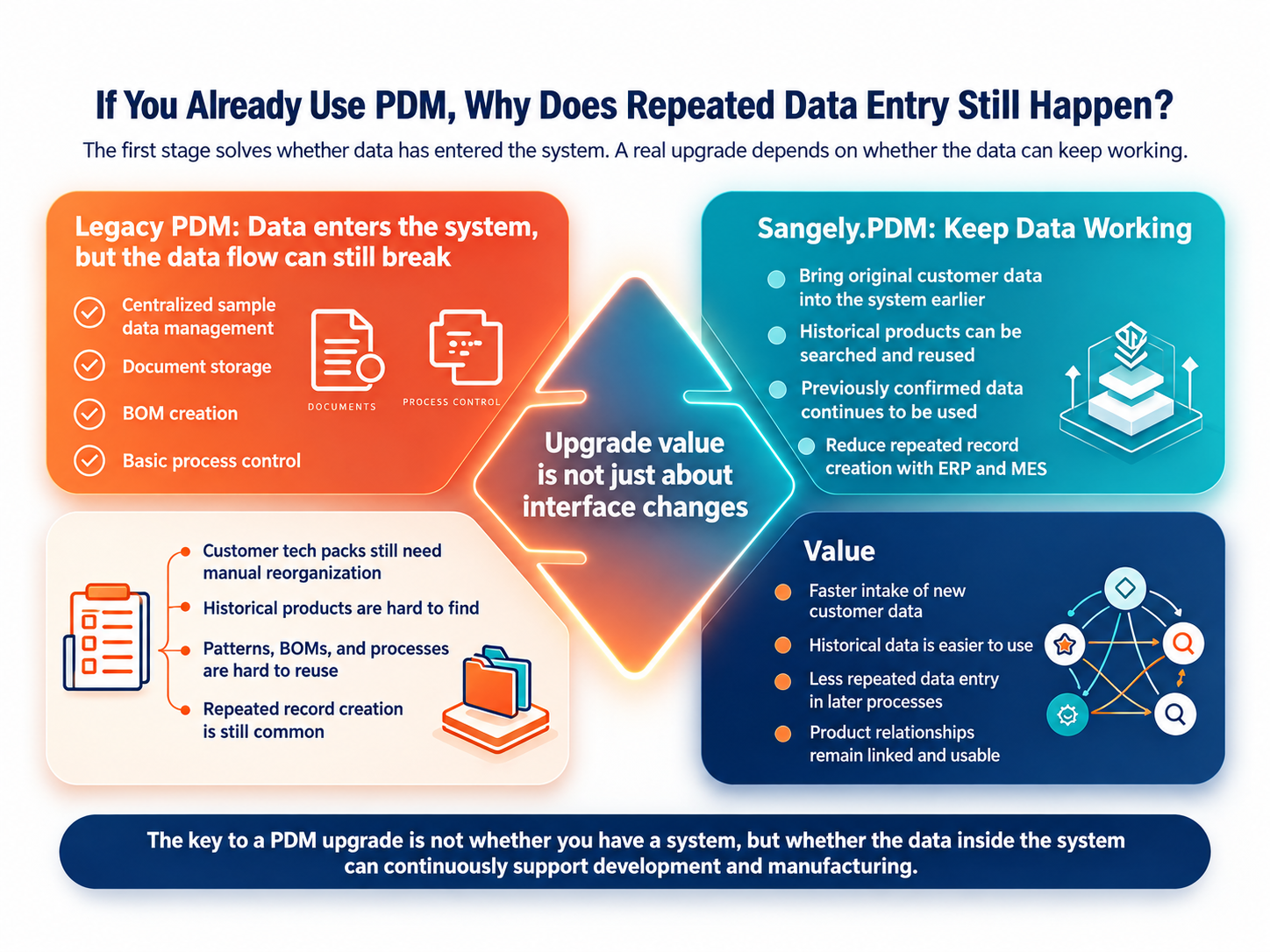
Many bag manufacturers have already implemented PDM systems.
During the initial stage of digitalization, the primary objective is often to ensure that product information is stored and managed within a system.
Typical capabilities include centralized sample documentation, design file management, BOM creation, and basic workflow control.
However, as the number of customers, product styles, and development projects increases, new challenges often emerge.
Customer Tech Packs may already be available as electronic files, yet employees still need to manually reorganize their contents after receiving them.
Historical products may be stored in the PDM system, but locating relevant designs when developing a new style may remain difficult.
Previously created pattern files, BOMs, and process data may exist in the database without becoming resources that can be directly reused in future development.
At this stage, the key question is no longer simply whether a company has implemented PDM.
The more important question is whether the data stored in PDM can continue to support subsequent business operations.
One of the ongoing development priorities of Sangely.PDM is to bring original customer information into the system earlier, make historical product data easier to retrieve and reuse, and enable previously confirmed information to remain available throughout downstream workflows.
For manufacturers already using older PDM systems, the value of an upgrade should not be measured only by changes to the user interface.
Instead, companies should evaluate whether customer information can be processed more efficiently, historical product data can be reused more effectively, and duplicate record creation between PDM, ERP, and MES can be reduced.
4. Why Are Bag Manufacturing BOMs Particularly Sensitive to Small Changes?
Bags and handbags involve numerous detailed relationships between materials, components, and manufacturing specifications.
A single product may contain outer materials, lining, sewing threads, zippers, metal hardware, webbing, accessories, and different material consumption requirements associated with individual pattern pieces.
The same style may also be offered in multiple colorways.
During product development, customers frequently request color changes, material substitutions, size adjustments, or structural modifications.
As a result, what appears to be a minor change can affect an entire set of product data.
Consider a customer requesting that a black bag be changed to brown.
The actual engineering requirements may involve more than changing the product's displayed color.
The team may also need to verify whether the outer material, sewing thread, zipper tape, lining, and certain accessories require corresponding changes.
This is why a BOM in bag manufacturing should not be treated as an isolated material list.
A BOM is connected to product structures, color combinations, material specifications, consumption quantities, and pattern relationships.
These product details must also maintain appropriate connections with downstream manufacturing processes.
5. How Does Sangely Manage the Relationship Between BOM and BOR?
Another important question is often overlooked:
When materials change, does the manufacturing process also need to be recreated?
Not necessarily.
In Sangely's product data architecture, BOM and BOR serve different purposes.
- BOM (Bill of Materials) primarily manages materials, color combinations, and consumption quantities.
- BOR (Bill of Routing) primarily manages manufacturing operations, processes, and routing sequences.
Although both belong to the same product, they do not necessarily change at the same time.
For example, a bag may change from black to brown. The outer material, lining, zipper, and other components may need to be updated in the BOM.
However, if the product structure and manufacturing method remain unchanged, the existing cutting, sewing, and assembly processes may still be applicable.
This is why Sangely emphasizes a differentiated approach to BOM and BOR management in multi-colorway manufacturing:
When materials change, update the BOM. When manufacturing processes remain unchanged, there is no need to recreate the BOR simply because the colorway has changed.
This approach helps reduce unnecessary duplication of process data across different color variants.
Managing BOM and BOR separately does not mean disconnecting them.
Both can remain linked through product records, DXF pattern files, and their corresponding data identifiers, ensuring that material and process information continue to belong to the same product data structure.
6. Why Is Eliminating One Data Entry Step Often More Valuable Than Adding Another Inspection?
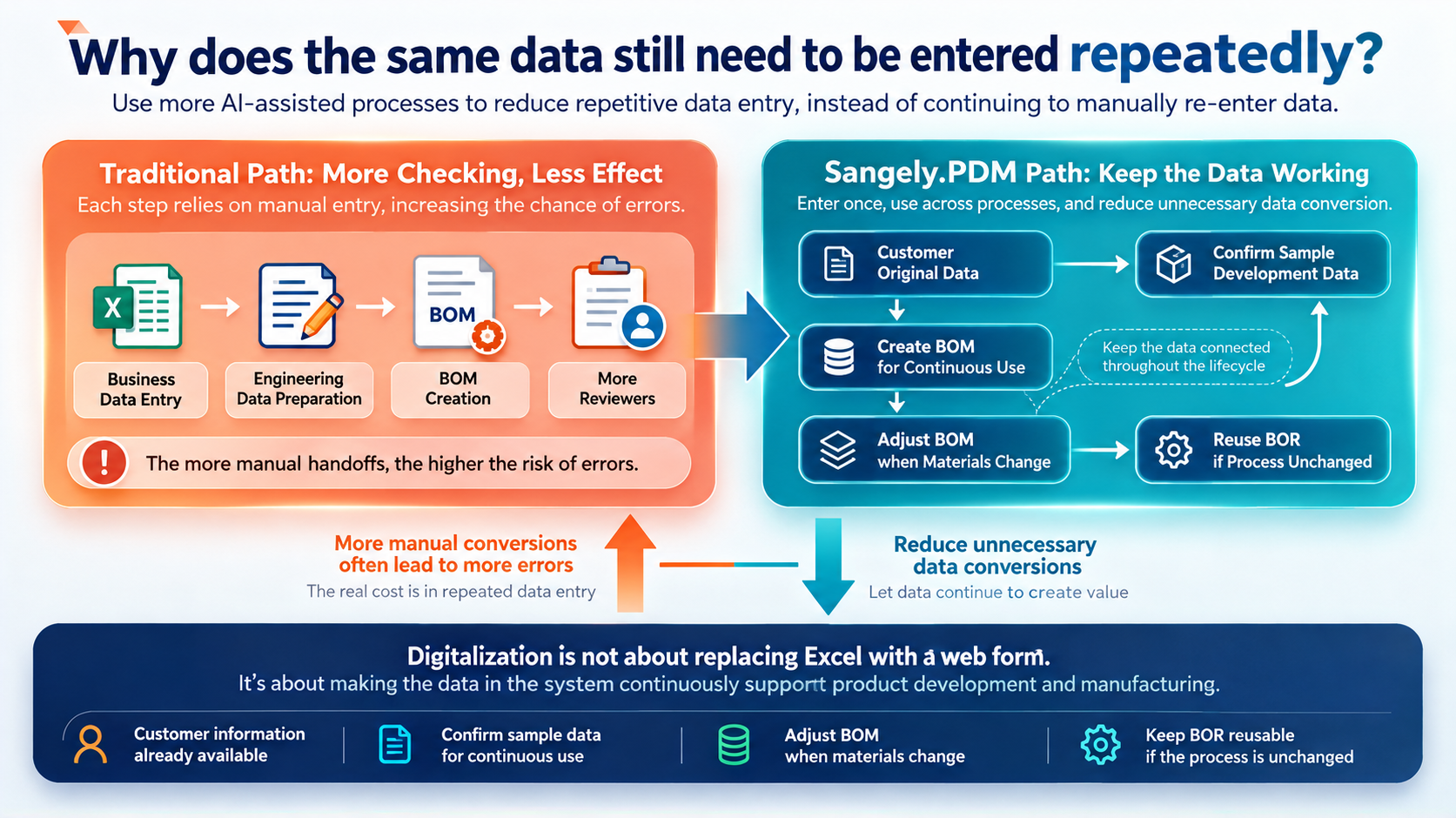
A traditional method of improving BOM accuracy is to increase inspection and approval procedures.
The merchandising department enters information, engineering reorganizes it, and an additional reviewer checks the BOM after it is completed.
These procedures can identify certain mistakes, but they also rely on more manual effort to compensate for discrepancies that may have been introduced during earlier data transfers.
A more sustainable digital approach is to reuse information that has already been established.
If customer documents already contain the necessary information, merchandising staff should not have to copy it again unnecessarily.
If sample development records have already been confirmed, that information should continue to support BOM creation.
If BOM changes affect materials but do not affect the manufacturing process, there is no need to duplicate an unchanged BOR.
This is how Sangely approaches product data continuity.
Digitalization should not simply replace Excel-based data entry with web-based forms.
Its value should also come from reducing data conversion activities that do not need to occur in the first place.
7. What Kind of Product Data Foundation Does Sangely.PDM Aim to Establish?
Within a manufacturing digitalization architecture, PDM occupies an important position at the beginning of the product data lifecycle.
Once customer requirements enter the organization, they gradually develop into sample records, design files, pattern files, BOMs, BORs, and associated material and process information.
If this data is properly organized during product development, downstream ERP, MES, purchasing, planning, and production activities can reduce repeated verification and manual data entry.
Sangely.PDM is therefore designed with a broader objective than simply centralizing development documents.
It aims to make previously confirmed data more reusable throughout subsequent business processes.
For example, information extracted and organized during sample development can continue to serve as a foundation for downstream product data.
BOM manages materials, color combinations, and consumption quantities, while BOR manages manufacturing operations, processes, and routing.
Both types of information follow their respective business logic while maintaining connections at the product level.
The earlier product data relationships are clearly established, the less downstream departments need to reinterpret, reorganize, or recreate the same information.
Data that has already been confirmed should remain usable wherever appropriate. Human expertise should be focused more on professional decisions and verifying actual changes.
8. Can AI Eventually Help Detect BOM Errors?
As AI becomes capable of assisting with customer document processing, another question naturally arises:
Can AI also help identify incorrect sewing thread colors, missing pattern pieces, or incomplete material relationships?
This is a promising direction for further exploration.
However, intelligent BOM validation requires more than adding an automatic checking function.
For AI to determine whether a BOM entry is potentially incorrect, it must first have access to meaningful relationships between product data.
For example, the system needs to understand which pattern pieces belong to a product, which materials correspond to those pieces, how different colorways are related, what the BOM represents, which operations are defined in the BOR, and what the customer has changed in the latest revision.
Without a clear underlying product data structure, AI may only receive a collection of disconnected fields and documents.
This is why Sangely emphasizes the following development sequence:
First establish clear relationships between product data, then gradually enable AI to participate in more advanced analysis and decision support.
Currently, a more clearly established application of the Sangely.PDM AI Assistant is helping read customer correspondence, organize relevant information, and support sample development under suitable document conditions.
AI-assisted BOM anomaly detection and intelligent validation remain areas for further exploration, rather than capabilities that should be assumed to be fully automated today.
9. Why Does Sangely Pay Attention to These Seemingly Small Problems?
An incorrect thread color, a missing pattern piece, a customer specification that has been entered multiple times, or a duplicated set of BOR data that has not actually changed.
Individually, these may not appear to be major smart manufacturing challenges.
However, inside a real factory, larger operational problems often begin with relatively small data discrepancies.
An inaccurate BOM can affect purchasing decisions.
Incorrect purchasing information can affect warehouse operations.
Unclear material relationships can eventually disrupt production.
If product data and manufacturing processes are not properly connected, ERP and MES users may need to repeatedly verify and reinterpret information that should already be available.
This is why Sangely's software development approach goes beyond asking what additional features can be introduced.
It also involves examining questions such as:
- Does this information already exist at an earlier stage?
- Why does it need to be entered again in the next department?
- If an error is discovered in the BOM, could it have originated much earlier in the development process?**
Effective manufacturing software should not only help companies identify errors more quickly. It should also reduce the opportunities for those errors to occur.
10. When Selecting a PDM System for Bag Manufacturing, Look Beyond Standard Demos
A standard demonstration prepared by a software provider may not be sufficient to determine whether a PDM system fits a manufacturer's actual requirements.
This becomes especially important as AI is introduced into product development.
Customer Tech Packs vary considerably in format, structure, language, and level of detail. Actual document recognition and processing performance should therefore be evaluated using the manufacturer's own files.
When evaluating a PDM solution, manufacturers can prepare one to three real customer Tech Packs in different formats and request a practical demonstration.
During the evaluation, they should examine which information the system can identify, which details can be incorporated into sample records, which fields still require manual confirmation, and how the resulting product data can be used in subsequent development activities.
Companies already operating older PDM systems should also test whether historical product records can be searched, retrieved, linked, and reused effectively.
Testing a PDM system with your own customer Tech Packs often provides a more reliable basis for evaluation than reviewing ten pages of feature lists.
Conclusion: Improving BOM Accuracy Starts with Reducing Unnecessary Data Transfers
Why do BOM errors continue to occur in bag manufacturing?
The answer is not necessarily that the engineering team is insufficiently careful.
A more important question is how many times the same product information is manually read, re-entered, and reorganized after customer documents first arrive.
If data must be manually transferred every time it moves between departments, even experienced employees cannot completely eliminate the risk of human error.
Sangely.PDM approaches this challenge from an earlier stage of product development.
Starting with customer Tech Packs and correspondence, its AI Assistant helps read and organize information for sample development.
Previously confirmed sample data can then provide a foundation for subsequent product records.
BOM manages materials, colors, and consumption quantities, while BOR manages operations and manufacturing processes.
These connected product data structures can further support downstream ERP and MES activities.
Sometimes, the real value of manufacturing software is not the addition of another complex feature.
It is something much more fundamental:
The same information should not have to be manually entered again and again.
Improving BOM accuracy does not always begin with adding another inspection step.
In many cases, it begins by eliminating one unnecessary data entry, one redundant transfer, and one avoidable break in the product data flow.
FAQ | Frequently Asked Questions About Sangely.PDM and BOM Management
1. Can Sangely.PDM Completely Prevent BOM Errors?
No PDM system should be assumed to eliminate all BOM errors.
Errors may originate from customer specifications, design changes, material substitutions, engineering decisions, or repeated manual data entry.
One of the objectives of Sangely.PDM is to reduce certain human data transfer risks by minimizing unnecessary transcription and establishing more continuous product data relationships.
Final product and engineering information still requires verification by qualified personnel.
2. Can Sangely.PDM Read Customer Tech Packs?
Under suitable document conditions, the Sangely.PDM AI Assistant can help read customer correspondence and Tech Packs, extract information relevant to sample development, and assist with incorporating confirmed information into the sample development workflow.
Because Tech Pack layouts, languages, and content structures vary between customers, manufacturers are encouraged to test recognition performance using their own documents.
3. Is It Necessary to Upgrade an Existing PDM System?
The decision to upgrade should depend on actual business limitations rather than software version numbers alone.
If customer Tech Packs still require extensive manual processing, historical product information is difficult to reuse, BOM and BOR data are repeatedly maintained, or duplicate records remain common between PDM, ERP, and MES, manufacturers should consider evaluating an upgrade.
4. Why Should BOM and BOR Be Managed Separately?
BOM and BOR serve different purposes.
BOM primarily manages materials, color combinations, and consumption quantities, while BOR focuses on manufacturing operations, processes, and routing.
In multi-colorway bag manufacturing, a color change may affect materials without changing the manufacturing process.
Managing BOM and BOR separately can reduce unnecessary process data duplication while maintaining relationships through products, pattern files, and corresponding data identifiers.
5. Can AI Automatically Detect Incorrect Thread Colors or Missing Pattern Pieces?
AI-assisted detection of such issues is a potential direction for further development.
However, effective validation requires clear relationships between products, pattern pieces, materials, BOMs, colorways, and manufacturing processes.
Currently, the more established Sangely.PDM AI application is assisting with customer document reading, information organization, and sample development.
Advanced BOM anomaly detection and intelligent validation should be considered areas for further exploration.
6. Does Historical Data from an Older PDM System Still Have Value?
Yes. Historical product data can remain an important resource for future development.
Historical product records, pattern files, BOMs, routing information, and related manufacturing data can provide an important foundation for future product development if they can be effectively retrieved, connected, and reused.
One of the potential benefits of upgrading PDM is not to discard existing information and start over, but to make previously accumulated product data more useful in future business processes.