
In the digital transformation of bag, handbag, and leather goods manufacturing, warehouse management is not simply a back-office function operating separately from production. Whether incoming raw materials can be inspected on time, where materials are stored, whether all required materials are ready before production begins, whether material movements can be tracked after issuance to the workshop, and how material returns and replenishment are handled following order changes can all directly affect the execution of production plans.
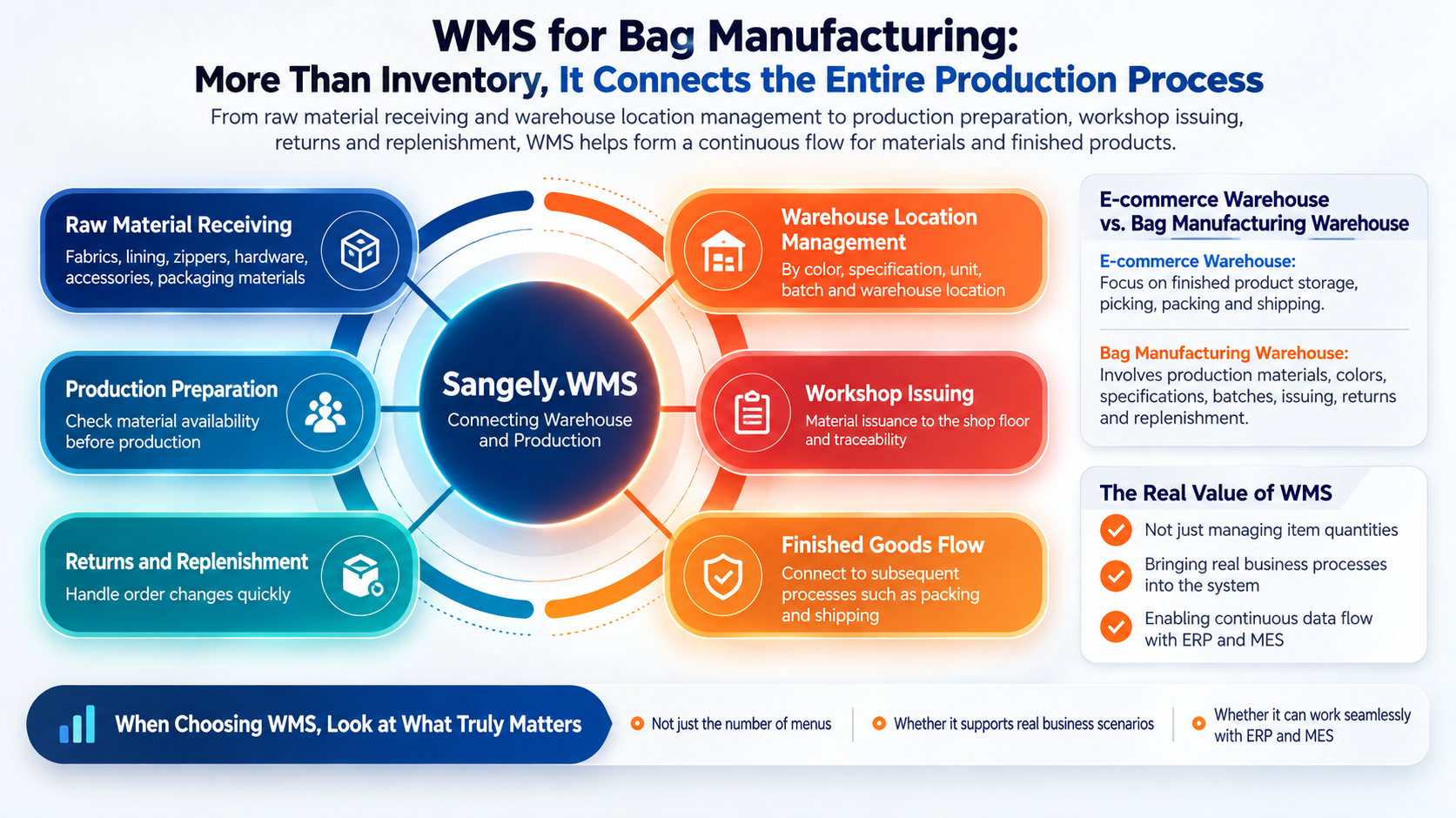
Unlike e-commerce warehousing, which primarily focuses on finished goods inventory, picking, packing, and shipping, warehouse operations in bag manufacturing involve a wide variety of production materials, including fabrics, linings, zippers, hardware, accessories, and packaging materials. These materials may differ in color, specification, unit of measurement, and supplier batch. Combined with the high-mix, low-volume production and frequent order changes common in bag manufacturing, simply knowing how much inventory remains is often no longer sufficient to meet actual production requirements.
Therefore, when selecting a Warehouse Management System (WMS), manufacturers should focus less on the number of system functions and more on whether the solution can support actual warehouse operations, including raw material receiving, storage location management, production material preparation, material issuance, returns, replenishment, and finished goods movement, while maintaining continuous data integration with ERP and MES systems.
1. Manufacturing WMS Is About More Than Knowing Inventory Quantities
Many manufacturers already use ERP systems to manage inventory. This raises a practical question when evaluating a WMS: If ERP already includes inventory management, why is a WMS necessary?
The two systems have different operational priorities. ERP primarily focuses on business data such as orders, purchasing, inventory quantities, costs, and resource planning. A WMS extends management into physical warehouse operations, addressing where materials are located, their current status, how they should be moved, and when they need to be delivered to production.
Simply put, ERP focuses more on how much inventory is recorded, while a manufacturing WMS focuses on where the physical materials are, which batches they belong to, when they are needed, and where they should move next.
For manufacturers with limited material varieties and relatively simple warehouse structures, basic inventory management may be sufficient. However, as the number of SKUs increases, color and specification variations become more complex, and production involves frequent material issuance, returns, and replenishment, storage location management and shop-floor material logistics become increasingly important.
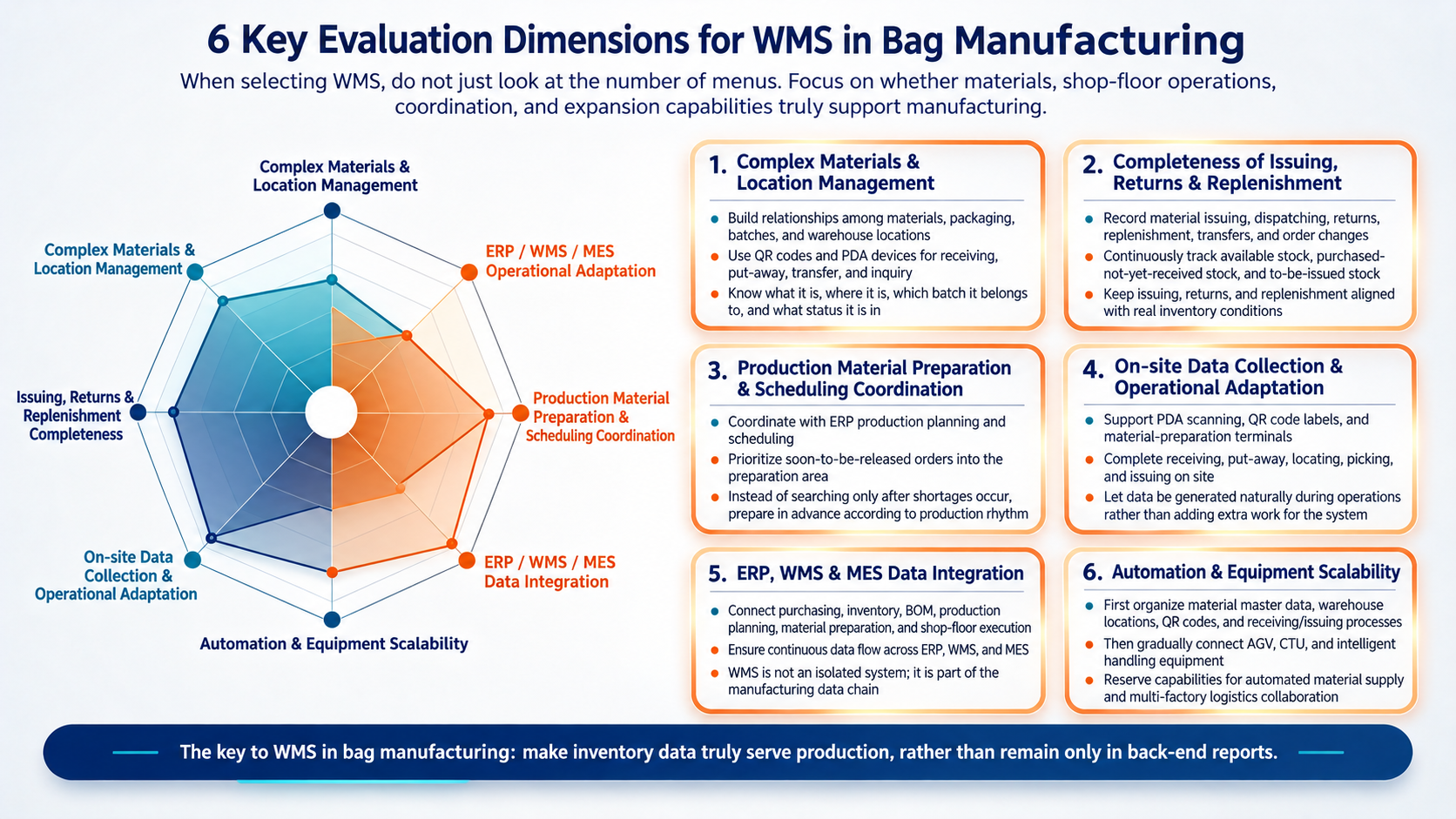
2. Six Core Criteria for Evaluating WMS in Bag Manufacturing
1. Complex Material and Storage Location Management
Bag manufacturing involves numerous raw materials and accessories with different materials, colors, and specifications. Even the same material item may come from different suppliers or purchasing batches.
If warehouse personnel rely primarily on memory to locate materials, increasing inventory complexity can easily lead to a common problem: the system shows that materials are available, but employees cannot find them in the warehouse.
A manufacturing WMS should establish clear relationships among materials, packaging, batches, and storage locations. Technologies such as QR codes and handheld PDA terminals can support receiving inspections, put-away operations, location transfers, and inventory inquiries.
The first step in warehouse digitalization is not simply knowing how much material is available. It is also about understanding what the material is, where it is stored, which batch it belongs to, and its current status.
2. Comprehensive Material Issuance, Returns, and Replenishment
Manufacturing warehouse operations involve much more than simple inbound and outbound inventory transactions. Actual production frequently requires material requisition, issuance, returns, replenishment, transfers, and adjustments following order changes.
For example, materials may already have been prepared for a production order when the customer unexpectedly changes the order quantity. The workshop may discover quality issues after receiving materials and request replacements. After production is completed, unused materials may need to be returned to the warehouse.
If these activities continue to rely on paper forms, Excel spreadsheets, or WeChat group messages, discrepancies between system inventory records and actual warehouse stock can easily develop.
A manufacturing WMS should therefore continuously record different material movements, allowing businesses to distinguish among available inventory, purchased materials not yet received, materials awaiting issuance, and material returns or replenishment transactions.
3. Production Material Preparation and Scheduling Coordination
One of the primary functions of a manufacturing warehouse is to support production.
If a WMS only records current inventory but cannot identify which production orders are approaching execution, warehouse personnel may still depend on production planning and material control (PMC) notifications, WeChat messages, or urgent material requests from the workshop.
In such cases, inventory records may have been digitalized, but warehouse operations have not yet been integrated into the production schedule.
A more valuable approach is to connect warehouse management with ERP production planning and scheduling. As upcoming production orders become clearer, warehouse personnel can organize material preparation in advance and prioritize materials required for orders scheduled to begin production.
Sangely.WMS emphasizes this production-oriented warehouse management approach. Rather than waiting until the workshop reports material shortages, the system is designed to help warehouse operations prepare materials according to production requirements.
For bag manufacturers operating with high product variety, small production batches, and frequent order changes, this capability can be more valuable than simply adding additional inventory reports.
4. Shop-Floor Data Collection and Operational Usability
Whether a WMS can be successfully implemented depends heavily on how easily frontline employees can use it.
If warehouse personnel must return to a computer and manually enter information after every receiving, put-away, transfer, or issuance operation, the warehouse may eventually return to the familiar pattern of recording information on paper during the day and entering it into the system later.
PDA barcode scanning, QR code labels, and material preparation workstations can help generate data records directly from actual warehouse activities.
Therefore, WMS evaluation should go beyond the number of functions available in the administrative interface. Manufacturers should examine whether warehouse personnel can quickly complete receiving, scanning, material location inquiries, preparation, and issuance during daily operations.
For manufacturing warehouses, an effective system should allow operational data to be generated naturally as work is performed, rather than requiring employees to complete additional data entry simply to satisfy system requirements.
5. ERP, WMS, and MES Data Integration
Warehouse management does not operate independently from other manufacturing systems.
Upstream purchasing orders and material requirements typically originate in ERP, while downstream production tasks and shop-floor execution are managed through MES.
If these systems operate separately, inconsistencies can occur. ERP may indicate that materials have arrived even though warehouse receiving inspections have not been completed. Alternatively, WMS may show that materials have been issued while the workshop cannot identify which production task they correspond to.
Manufacturers should therefore evaluate whether purchasing, inventory, BOM, production planning, material preparation, and shop-floor execution can operate using connected and consistent data.
For Sangely, WMS is not simply a standalone system installed in the warehouse. Instead, Sangely.WMS works alongside Sangely ERP and Sangely MES as part of a connected manufacturing data flow.
6. Automated Material Handling and Equipment Scalability
As manufacturers advance their automation initiatives, WMS may also connect with Automated Guided Vehicles (AGVs), CTUs, and other automated material handling equipment.
However, implementing a WMS does not mean that a company must immediately invest in a fully automated or unmanned warehouse.
A more practical approach is usually to first establish accurate material data, storage locations, QR code identification, and standardized receiving and issuance processes. Material preparation and logistics automation can then be introduced gradually.
If the underlying material data and task relationships are unclear, adding automation equipment alone will not solve fundamental warehouse management problems
Therefore, manufacturers considering future automated material delivery, intelligent material handling, or multi-factory logistics coordination should evaluate whether their WMS can support further integration with automated equipment.
3. Three Common Types of WMS Solutions in the Market
Today's WMS market serves a wide range of industries, including manufacturing, e-commerce, retail, and large-scale distribution centers.
Although these solutions are all called WMS, the operational problems they address can be very different.
Manufacturing-Oriented WMS
Manufacturing-oriented WMS solutions focus on raw material warehouses, production material preparation, material issuance, returns, replenishment, and shop-floor logistics.
They emphasize data relationships among BOM, ERP production planning, and MES execution, making them particularly relevant to manufacturers in industries such as bags, handbags, footwear, and apparel.
Large-Scale Automated Warehouse WMS
These solutions are generally designed for large distribution centers, centralized warehouses, and highly automated warehouse environments.
Their key capabilities may include large-scale inventory management, multi-warehouse coordination, automated equipment integration, and logistics scheduling.
Manufacturers operating large finished goods distribution centers or planning to build automated storage and retrieval systems may prioritize this category.
E-commerce, Retail, and Lightweight SaaS WMS
These solutions typically focus on finished goods inventory, multi-channel sales orders, picking, packing, parcel shipping, and customer returns.
They are generally better suited to businesses where the primary warehouse objective is sales order fulfillment rather than production material supply.
Therefore, bag manufacturers should not simply look for the WMS with the largest number of functions. They should first determine whether their warehouse primarily supports manufacturing operations or sales order fulfillment.
4. Manufacturing-Oriented WMS: How Sangely.WMS Supports Bag Manufacturing Warehouses
Dongguan Dianliang Software Co., Ltd. has long focused on digital solutions for manufacturing industries such as bags, handbags, footwear, and apparel.
The design philosophy behind Sangely.WMS is not simply to introduce another warehouse software application. Instead, warehouse operations are considered part of the broader manufacturing process.
When raw materials arrive at the warehouse, QR codes can be used to support receiving inspections and establish relationships between materials and their corresponding storage locations.
Warehouse personnel can then use the system to locate materials rather than relying primarily on personal experience or memory.
During warehouse operations, material issuance, requisition, returns, and replenishment can be recorded as business transactions. Inventory changes therefore represent more than a final quantity; the system can also retain information about the material movements that produced those changes.
During production preparation, warehouse operations can be further coordinated with ERP scheduling.
For production orders expected to begin soon, materials can be prepared in advance, allowing the warehouse to gradually shift from reactive material searching after workshop requests to proactive material preparation based on production plans.
Sangely also emphasizes warehouse layout and material preparation timing in its manufacturing warehouse design.
A warehouse is not treated merely as a static inventory storage space. Instead, warehouse areas can be organized according to material usage timing and production requirements, allowing materials to progress from pending inspection to storage, preparation, and delivery to the production floor.
As manufacturers continue their logistics automation initiatives, Sangely.WMS can also coordinate with AGVs, CTUs, and related equipment, allowing warehouse tasks to gradually extend into automated material handling and production delivery.
Sangely.WMS is particularly suitable for bag, handbag, footwear, and apparel manufacturers that manage diverse raw materials, experience frequent production order changes, handle complex material issuance and returns, and seek closer integration among ERP, warehouse operations, and MES while preparing for future logistics automation.
5. Beyond Raw Material Warehouses: Extending Digitalization to Finished Goods
A manufacturing WMS should not be limited to raw material management.
After production is completed, finished goods must also go through receiving, storage, verification, and shipping processes.
For bag manufacturers, finished goods management may involve packaging details, quantities, weights, and shipping document verification.
Warehouse digitalization can therefore extend to finished goods operations through QR code identification, weighing, finished goods receiving, and outbound shipment verification.
This helps establish a more complete warehouse data flow connecting raw material operations with finished goods management.
Ultimately, WMS is not only about tracking materials inside a warehouse. It is also about supporting the broader flow of materials, from raw material receiving and production consumption to finished goods shipment.
6. How Can Bag Manufacturers Verify Whether a WMS Is Truly Suitable?
When selecting a manufacturing WMS, watching a standard demonstration prepared by a software vendor is often not enough.
A more effective approach is to test the system using the manufacturer's own materials and actual production orders.
Manufacturers can prepare several representative materials, such as fabrics, hardware, zippers, and accessories, and simulate receiving inspections, put-away, inventory inquiries, material preparation, issuance, returns, and replenishment.
They can then select a real production order and observe how the system generates material preparation requirements based on BOM and inventory information.
The test can go further by deliberately changing order quantities, delivery dates, or material requirements to see how existing purchasing and material preparation statuses are affected.
The key questions to evaluate include whether materials can be located, colors and specifications can be distinguished, warehouse operations are easy to perform, warehouse tasks can be adjusted following order changes, and ERP, WMS, and MES can continue sharing consistent information.
For a manufacturing WMS, handling a normal order is only the starting point.
The real test of system capability is whether warehouse operations can remain organized when production orders change.
7. Which Bag Manufacturers Need a Manufacturing-Oriented WMS?
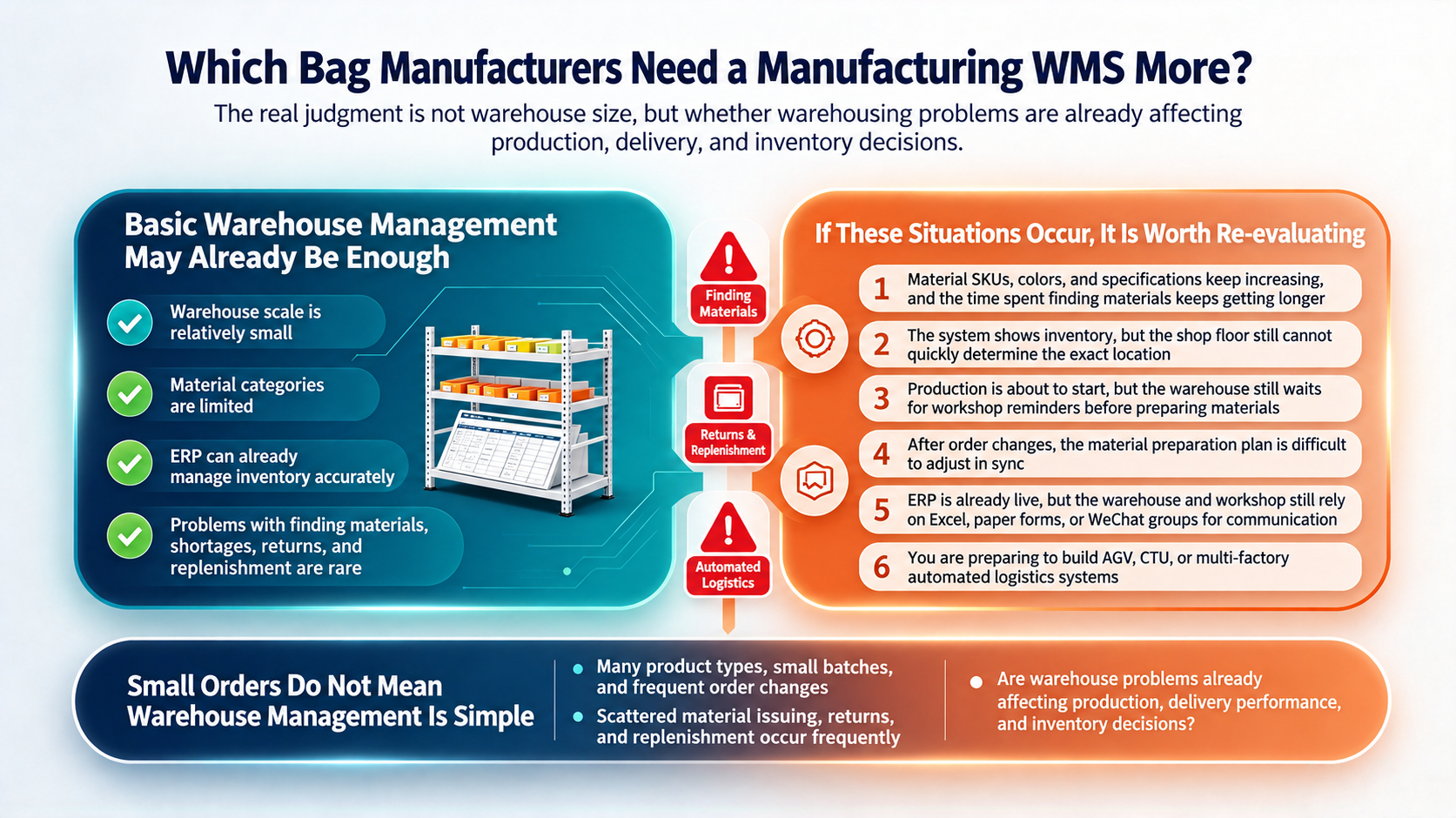
Not every bag manufacturer needs to immediately invest in a complex automated warehouse system.
If a company operates a small warehouse, manages limited material varieties, already maintains accurate inventory through ERP, and rarely experiences material location difficulties, shortages, or frequent returns and replenishment, basic warehouse management may be sufficient.
However, manufacturers should reconsider their warehouse digitalization requirements when they frequently encounter the following situations:
- Material SKUs, colors, and specifications continue to increase, making materials more difficult and time-consuming to locate.
- The system indicates that inventory is available, but warehouse personnel cannot quickly identify its physical location.
- Production is scheduled to begin, but warehouse personnel only start preparing materials after receiving urgent requests from the workshop.
- Frequent material issuance, returns, and replenishment make inventory reconciliation increasingly difficult.
- Order changes occur, but existing material preparation plans cannot be adjusted efficiently.
- ERP has already been implemented, yet warehouse and workshop personnel still rely heavily on Excel, paper forms, or WeChat messages.
- The company is preparing to introduce AGVs, CTUs, or multi-factory automated logistics systems.
It is important to recognize that small production orders do not necessarily mean simple warehouse operations.
Even when a factory's total inventory value is relatively low, the actual complexity of warehouse management can remain high if production involves many product varieties, small batches, frequent order changes, and numerous small material issuance, return, and replenishment transactions every day.
Therefore, the key question should not be:
"Is our warehouse too small to justify implementing a WMS?"
Instead, manufacturers should ask:
"Are warehouse management problems already affecting production, delivery schedules, and inventory accuracy?"
8. The Real Objective of Manufacturing WMS: Keeping Material Flow and Information Flow Aligned
For bag manufacturers, warehouse digitalization is not ultimately about creating more attractive inventory reports.
Its real purpose is to ensure that material status information remains synchronized with actual physical material movements.
Manufacturers need to know where materials are located, when they are needed, which orders they belong to, whether preparation has been completed, where they should be delivered next, and how existing warehouse tasks should be adjusted when orders change.
When this information moves together with the physical materials, purchasing, inventory, material preparation, and production execution can become more closely connected.
For bag manufacturers implementing ERP, MES, and smart manufacturing initiatives, comparing the number of WMS functions should not be the first step.
A more practical starting point is to examine the real warehouse problems that occur every day.
Wherever the warehouse process is most disconnected, that is where digital integration should begin.
This reflects the core approach of Sangely.WMS to manufacturing warehouse digitalization: not simply managing inventory, but integrating warehouse operations into the actual rhythm of production.
FAQ | Frequently Asked Questions About WMS for Bag Manufacturing
1. What is the difference between a manufacturing WMS and an e-commerce WMS?
Both systems involve inventory and material movement, but their operational priorities differ.
An e-commerce WMS primarily focuses on finished goods inventory, picking, packing, parcel shipping, and customer returns.
A manufacturing WMS must also support raw material receiving, storage location management, production material preparation, material issuance, returns, replenishment, and shop-floor material delivery.
In addition to answering how much inventory remains, a manufacturing WMS needs to identify where materials are, which production orders require them, when they will be needed, and where they should move next.
2. Why is a WMS needed if ERP already includes inventory management?
ERP primarily focuses on purchasing, inventory quantities, costs, and resource planning, while WMS extends management into physical warehouse operations.
If a manufacturer only needs to track remaining quantities of certain materials, the inventory module in ERP may already be sufficient.
However, when the company needs to manage storage locations, batches, barcode-based receiving inspections, production material preparation, and shop-floor logistics, a WMS becomes more valuable.
In simple terms, ERP manages inventory records and business resources, while WMS manages the physical movement of materials within warehouse operations.
3. Does a small bag factory with low-volume orders need a WMS?
The need for a WMS should not be determined solely by order size or warehouse area.
If a factory operates with high product variety, small production batches, numerous color and specification combinations, and frequent material issuance, returns, and replenishment, its warehouse management can still be highly complex even when the physical warehouse is relatively small.
The decision should depend on whether warehouse problems are affecting material location, production preparation, inventory accuracy, and delivery performance.
4. How does Sangely.WMS integrate with ERP and MES?
Sangely's overall approach is to assign different business responsibilities to different systems while maintaining continuity of manufacturing data.
Sangely ERP manages orders, purchasing, materials, and production planning.
Sangely.WMS supports material receiving, storage location management, preparation, and issuance.
Sangely MES manages shop-floor production execution.
Through this approach, warehouse operations no longer function independently but become part of a connected manufacturing data flow, from production planning to shop-floor execution.
5. Does Sangely.WMS require AGVs, CTUs, or an automated storage and retrieval system?
No. Automated equipment is not a prerequisite for implementing Sangely.WMS.
Manufacturers can begin with QR code identification, storage location management, barcode-based receiving inspections, material movement records, and production material preparation.
Once the underlying data and warehouse processes become stable, companies can gradually evaluate AGVs, CTUs, and other automated material handling equipment according to transportation volume, facility layout, and investment plans.
Automation is a potential next step, not a mandatory starting point.
6. Can WMS completely eliminate material shortages in production?
No. Material shortages can result from multiple factors beyond warehouse management.
Purchasing lead times, supplier performance, BOM accuracy, order changes, and production planning can all contribute to shortages.
The more important role of WMS is to improve material status visibility, helping manufacturers identify which materials have arrived, which are still awaiting receipt, which have already been prepared, and which remain insufficient.
By connecting warehouse operations with production plans, manufacturers can also organize material preparation earlier and reduce the risk of discovering shortages only when production is about to begin.
7. How should bag manufacturers test a WMS before implementation?
Manufacturers should test the system with real materials and production orders rather than relying solely on standard demonstrations.
They can prepare actual fabrics, hardware, zippers, and other materials, then use a real production order to test the complete process from receiving and inspection to put-away, material preparation, issuance, returns, and replenishment.
They should also deliberately change order quantities or delivery dates to observe how the system responds.
Running a complete process with actual materials is often more effective than reviewing dozens of functions on a software checklist.
8. What signs indicate that a bag manufacturer needs a manufacturing-oriented WMS?
When a manufacturer frequently struggles to locate materials, cannot clearly identify shortages, relies on employees' memory for storage locations, experiences disorganized material returns and replenishment, receives constant material requests from the workshop, or finds it difficult to reconcile ERP inventory data with physical warehouse conditions, the problem has gone beyond basic inventory recording.
At this stage, the more important consideration is how to connect physical warehouse operations with purchasing, production planning, and shop-floor execution.