
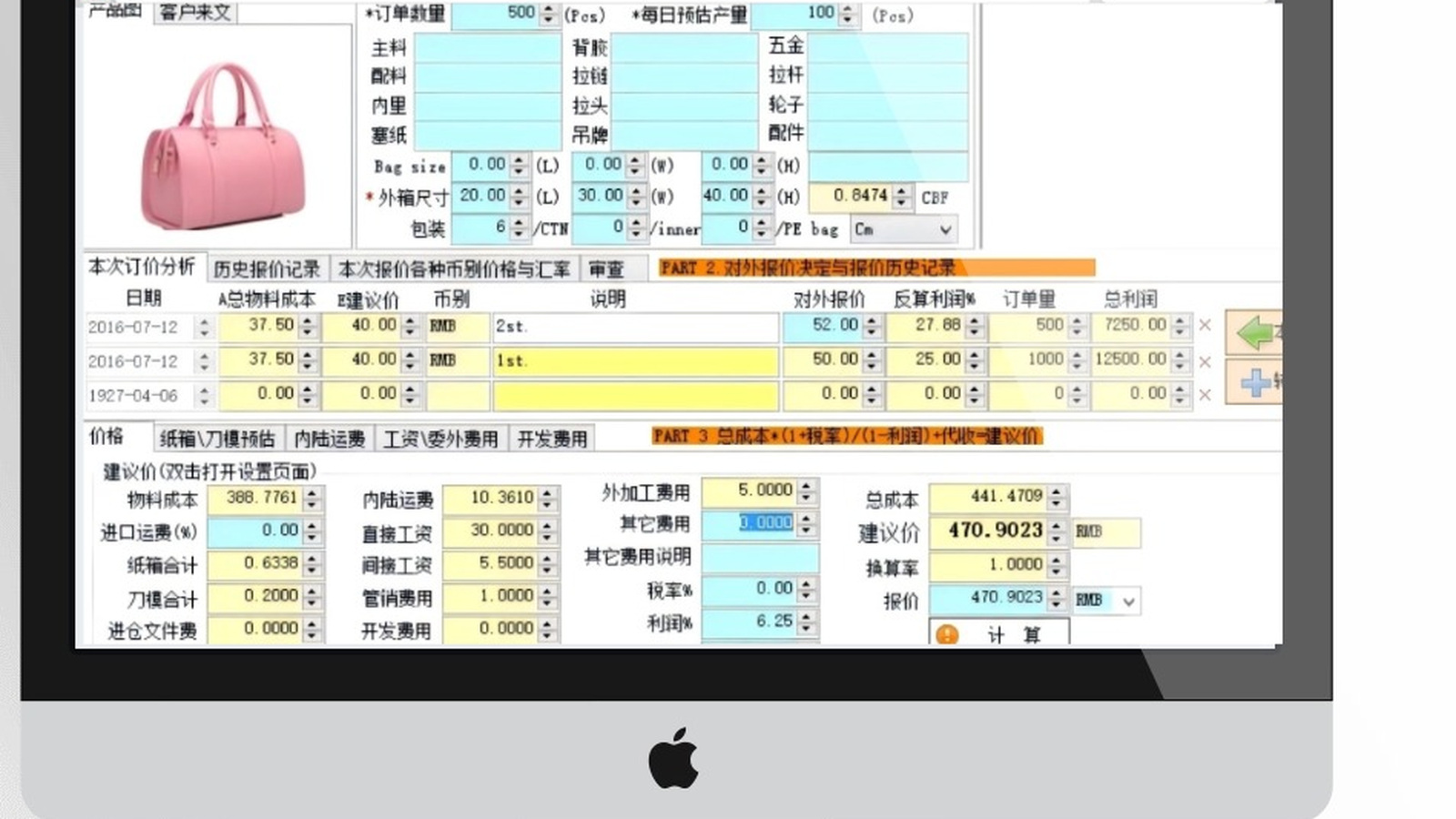
Understanding BOM Evolution and the Sangely Q-Series Standards
An intelligent path for production-document generation from development through manufacturing.
In manufacturing, a BOM is not only the basis for cost estimation. It is a core data structure connecting design, purchasing and production. In highly customized industries such as bags and footwear, a BOM is not static; it changes as design, sampling, quotation and production progress.
Many companies distinguish an M-BOM from a P-BOM, but in practice this division can still be too coarse for detailed, multi-version management.
The Sangely ERP Approach: Nine Q-Series Stages for Dynamic BOM Management
Sangely ERP divides BOM calculation into nine stage-specific standards, Q0 through Q8, corresponding to different needs from early development estimates to final production instructions. The standards are defined as follows:
•
Q0 — Early-Development Material Standard
Used for preliminary purchasing estimates during sampling or small-quantity prototyping, allowing development teams to respond quickly.
•
Q1 — Single-Piece Infinite-Length Manual Calculation Standard
Based on manual measurement and intended for scenarios in which digital CAD patterns in DXF format are not yet available. It retains a rigorous traditional calculation method for early development before paper patterns have been digitized.
•
Q2 — Set-Matching Standard for Quotation
Using DXF patterns, the Sangely nesting engine creates the marker automatically. The standard is designed mainly for commercial quotation estimates, balancing accuracy with the response speed required by the business team.
•
Q3 — Set-Matching Standard with ET-MARK High-Saving Automatic Nesting
Based on DXF data, ET-MARK applies free-form nesting logic to minimize material consumption. Material collection may be more complex, but the method can provide significant value in cost-sensitive scenarios.
•
Q4 — Set-Matching Standard with Zero-Cut-Loss Automatic Nesting
Also based on DXF data, this standard uses the Sangely nesting engine with the objective of maximizing utilization through a “zero cut-loss” arrangement. It is intended for pre-production calculation where material control and quality requirements are strict.
•
Q5 — Set-Matching Standard for Production-Control and Purchasing Estimates
The Sangely nesting engine uses DXF files to calculate material requirements for production-control and purchasing estimates, supporting internal procurement planning.
•
Q6 — Manually Optimized Version of Q2 or Q4
Starting from the automatic nesting result of Q2 or Q4, employees can make manual adjustments for special process requirements, irregular materials or customer instructions. Q6 provides a practical hybrid of automatic calculation and human refinement.
•
Q7 — Manually Optimized Version of Q5
Production-control or scheduling personnel refine the Q5 result according to experience, material width, order changes and other operational factors. Q7 commonly becomes the final data input for production planning.
•
Q8 — Final Production-Instruction Standard with Integrated Calculation
Using Q7 as the baseline, the APS master-scheduling system recalculates requirements according to actual incoming material width, order quantities, combined cutting of multiple styles using the same material and other factors. Q8 is the final version used for electronic production instructions on the shop floor and is designed for execution and system coordination.
Q8 also supports combining multiple styles in one nesting and cutting plan. This is especially useful for footwear factories or scenarios in which multiple specifications share the same material, improving cutting efficiency and reducing waste.
A BOM Is More Than a List; It Is the Starting Point of Intelligent Production
In a traditional factory, CAD is often limited to design drawings, ERP handles supply-chain management, and shop-floor execution still depends on paper documents. In Sangely ERP, nesting and production-instruction generation are integrated with ERP and can connect with intelligent equipment such as electronic cutting machines, creating a continuous flow from CAD → nesting → production instructions → equipment processing.
This means:
• Electronic production instructions replace paper documents. • Instruction data can be converted into NC processing code, reducing manual input errors. • Cutting equipment can read electronic marker layouts and execute according to the production order.
Q3, for example, can combine ET-MARK automatic nesting with a workflow that removes manual nesting intervention, improving marker-making efficiency for sampling or material-sensitive scenarios.
The Underlying Advantage of an Integrated Smart-Manufacturing System
From the beginning, Sangely ERP treated multi-version BOM evolution and alignment with actual manufacturing as key design goals. Through the Q-Series standards, the BOM becomes more than a static purchasing list. It carries design changes, supports material optimization, connects scheduling and production instructions, and drives equipment execution.
When BOM, CAD, nesting, scheduling, WMS and MES are integrated, the manufacturer can establish a connected operating flow from upstream product data to downstream execution. This system has been adopted in multiple manufacturing implementations, demonstrating its flexibility and adaptability.
Conclusion: Intelligent BOM Management Is a Core of Future Manufacturing
In a digital factory, an automated BOM is both a connection point among systems and a trigger for intelligent operations.
Through long-term implementation and iteration, Sangely ERP has established a complete Q-Series version framework and connected material definition, quotation estimates, nesting, production-instruction generation, execution and cost accounting into one process, providing manufacturers with a more consistent digital foundation.
Future smart manufacturing will not be a collection of isolated CAD, ERP and equipment tools. It will be a collaborative operating platform centered on BOM data and driven by connected systems. Sangely continues to develop along this path.