
Customers encountering Sangely for the first time often see two names together:
Sangely and Dongguan Dianliang Software Co., Ltd.
This naturally raises a question:
What is Sangely, and how is it related to Dongguan Dianliang Software Co., Ltd.?
The answer is clear:
Dongguan Dianliang Software Co., Ltd. is the legal company entity. Sangely is the software product brand that Dianliang Software continues to develop for manufacturers’ digitalization needs.
Sangely.PDM, Sangely.ERP, Sangely MES and Sangely.wms all belong to the manufacturing digitalization product system created by Dianliang Software.
1. Why Are Both “Dianliang Software” and “Sangely” Used?
“Dongguan Dianliang Software Co., Ltd.” identifies the company entity, while “Sangely” identifies the customer-facing product brand and product system.
Customers can understand the relationship as follows:
Company entity: Dongguan Dianliang Software Co., Ltd.
Product brand: Sangely
Core products: Sangely.PDM, Sangely.ERP and Sangely MES
Warehousing product: Sangely.wms
This brand structure brings the different manufacturing software products together under one Sangely manufacturing digitalization system instead of presenting them as unrelated names.
Sangely therefore represents more than one software module. It represents Dianliang Software’s continuing product system for product development, resource planning, manufacturing execution and warehousing.
2. What Does the Sangely Brand Name Mean?
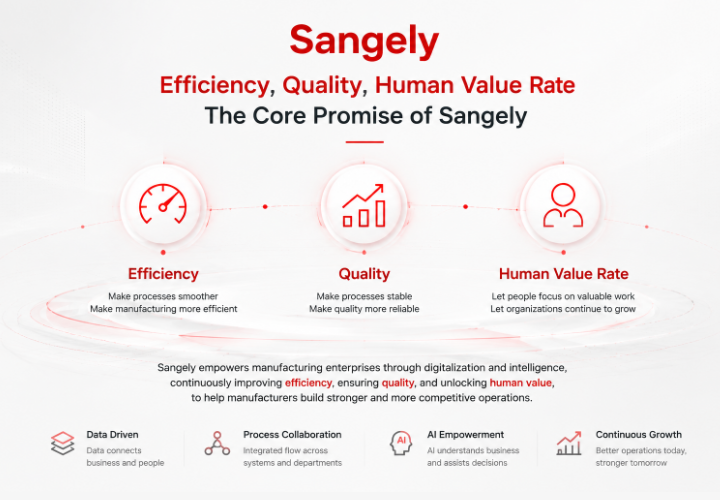
The Sangely name comes from three priorities that Dianliang Software proposes for manufacturers:
Efficiency;
Quality yield;
The value contribution of people.
Together, these priorities express attention to manufacturing efficiency, quality outcomes and employee value.
Manufacturing digitalization cannot be measured only by how many documents a system processes or how much software a company installs. It must also consider whether processes run smoothly, whether quality management has a stable foundation and whether employees’ accumulated experience continues to create value.
Sangely therefore represents a direction in which digital systems connect products, processes, the shop floor and human experience to establish a sustainable manufacturing foundation.
3. Sangely Is Not Simply One ERP System
Some customers first encounter Sangely through ERP and therefore assume that Sangely is simply an ERP product.
In fact, Sangely covers manufacturing activities beyond ERP.
Sangely.PDM establishes product data during product development. Sangely.ERP then handles orders, materials and resource planning. Sangely MES connects the resulting plans with manufacturing execution and shop-floor feedback.
The three core products have different responsibilities:
Sangely.PDM: Product Data and Product Development
Sangely.PDM manages customer files, sample orders, drawings, BOMs, colorways, development rounds, sample progress and other product data.
It helps the company answer:
What is this product, and how should its product data be created and reused?
Sangely.ERP: Orders and Enterprise Resource Planning
Sangely.ERP manages orders, materials, purchasing, warehousing and resource planning, converting confirmed product requirements into material preparation and manufacturing plans.
It helps the company answer:
How should materials, time and manufacturing resources be organized for current order demand?
Sangely MES: Manufacturing Execution and Shop-Floor Feedback
Sangely MES receives production-related data from ERP and connects shop-floor work arrangements, process execution, material movement and production feedback.
It helps the company answer:
After a plan is created, how do tasks reach the shop floor and how is execution recorded?
Together, the products serve different stages from product development through production execution.
4. Why Does Sangely Build PDM, ERP and MES Together?
Real manufacturing is not completed by one system operating alone.
A product must first establish customer files, samples, drawings, materials and BOMs. Orders then require material, purchasing, warehousing, time and resource plans. When production begins, tasks must reach the shop floor and execution feedback must continue to be recorded.
When every stage uses a different data logic, the following problems arise:
ERP must reinterpret the product after development is completed;
BOM and material data must be reorganized before purchasing;
The shop floor must reinterpret requirements after ERP creates a plan;
Completed work must be counted and summarized manually;
When employees change, past product experience becomes difficult to reuse.
More software is installed, but manual handoffs do not decrease.
Sangely builds PDM, ERP and MES together not to increase the product count, but to establish continuity among product data, resource planning and production execution.
5. How Does Sangely Connect Product Development, Resource Planning and Production Execution?
The Sangely product system is built around one business chain:
Product development → resource planning → production execution.
Samples, materials, BOMs and process information created in Sangely.PDM can continue into ERP operations.
Sangely.ERP organizes orders, materials, purchasing, warehousing and resources and sends production-related data to Sangely MES when defined conditions are satisfied.
Sangely MES continues the chain by connecting work arrangements, shop-floor execution and production feedback.
This cross-system connection reduces repeated creation, repeated transfer and repeated manual confirmation when product information enters new business stages.
The purpose is not to force every company to deploy all products at once. It is to ensure that each stage can use the manufacturing data already created by the previous stage.
6. Which Manufacturing Problems Does Sangely Focus On?
Sangely focuses on practical manufacturing problems rather than abstract software categories.
Can customer files, samples, drawings, BOMs and development rounds form reusable product data?
Can product requirements continue into materials, purchasing, warehousing and planning?
Can ERP plans continue into MES and the actual shop floor?
Can feedback from execution become a reliable management record?
Can manufacturing experience remain available when personnel and organizational structures change?
Can customer files be converted into reusable product information?
Can product styles, colorways and development rounds be distinguished clearly?
Can CAD and DXF data continue into material consumption, marker layouts and BOMs?
Can confirmed product data continue into costing, purchasing and production preparation?
Can shop-floor execution and material movement form reliable operational records?
Can warehouse receiving, issuing and location data connect with other manufacturing activities?
These questions explain why Sangely emphasizes connected data and processes instead of isolated functions.
7. What Role Does Sangely.wms Play in the Product System?
Sangely.wms supports warehousing operations within the broader manufacturing process.
It focuses on receiving, issuing, inventory and related warehouse activities, and can also support collaboration with intelligent logistics scenarios.
Confirmed functions include raw-material receiving, material issue, inventory and location information, stocktaking, finished-goods weighing, QR-code scanning, carton counting and verification.
Warehousing is not treated as an isolated inventory record. Material movement must relate to purchasing, production preparation and shop-floor demand.
Product BOMs affect material demand, purchasing and preparation affect production plans, and warehouse receiving, issuing and location information directly affect whether the shop floor can proceed as planned.
8. How Much Manufacturing Digitalization Experience Supports Sangely?
The Dianliang team began working on manufacturing digitalization in 1992 and has continued to accumulate practical manufacturing experience.
Dongguan Dianliang Software Co., Ltd. was formally registered in 2005. The experience starting point and the company registration date represent different milestones.
1992 is the starting point of the team’s manufacturing digitalization work.
2005 is the year Dongguan Dianliang Software Co., Ltd. was formally registered.
This long-term work has included enterprise information systems, ERP and MES, and later PDM, WMS and the manufacturing data foundation required for the AI era.
The Sangely product system is built on this accumulated manufacturing-business knowledge and process experience and continues to develop around actual manufacturer needs.
9. How Does Sangely View the AI Era?
AI is increasingly entering manufacturing, but AI cannot understand a factory without reliable business context.
It needs product data, BOMs, materials, business processes, plans and real manufacturing execution status.
This business context comes from manufacturing data and operating processes accumulated over time.
Product data in PDM, orders and resource information in ERP, and execution information in MES are important foundations for applying AI in a manufacturing company.
If product information remains scattered across files, spreadsheets and personal experience, AI cannot obtain a stable and reliable business context.
Sangely therefore regards connected manufacturing data and established PDM, ERP and MES operating models as important conditions for applying AI.
Specific AI capabilities and their scope must be based on confirmed product configurations.
10. Which Manufacturers Does Sangely Primarily Serve?
Sangely currently focuses on bag, luggage, handbag and related discrete manufacturers, especially those facing the following conditions:
Frequent changes in styles, materials and colorways;
Many customer revisions, sampling cycles and development rounds;
The need to connect CAD, DXF, material consumption and BOM data;
Sample development involving multiple roles and departments;
Complex relationships among orders, materials, purchasing and production plans;
The need for ERP plans to continue into MES and the shop floor;
Business coordination across a group or multiple manufacturing sites;
A desire to reduce dependence on a small number of experienced employees;
A desire to retain product data and manufacturing experience.
Sangely does not require a company to change all work at once. It allows relationships among product data, resource planning and shop-floor execution to be established progressively around current business problems.
Conclusion: Dianliang Software Is the Company; Sangely Is the Product Brand
Dongguan Dianliang Software Co., Ltd. is the company entity, and Sangely is its manufacturing digitalization product brand.
Sangely is not a single ERP product or a collection of unrelated software names.
Its product responsibilities are:
Sangely.PDM — establish product data;
Sangely.ERP — organize enterprise resources;
Sangely MES — connect production execution.
Together with Sangely.wms support for warehousing, the system progressively connects product development, resource planning, the shop floor and warehouse operations.
The Sangely priorities of efficiency, quality yield and human value all point in the same direction:
Turn the product data, business processes and employee experience already created by manufacturers into sustainable enterprise capabilities.
FAQ
Is Sangely the Company Name?
No. Dongguan Dianliang Software Co., Ltd. is the company entity. Sangely is its principal customer-facing product brand.
What Does the Sangely Brand Name Mean?
The name reflects three manufacturing priorities proposed by Dianliang Software: efficiency, quality yield and the value contribution of people.
Which Products Belong to Sangely?
The current product system includes Sangely.PDM, Sangely.ERP, Sangely MES and Sangely.wms for product development, enterprise resource planning, manufacturing execution and warehousing.
Is Sangely an ERP System?
Sangely is not a single ERP system. Sangely.ERP is one part of a wider product system that also includes Sangely.PDM, Sangely MES and Sangely.wms.
How Are Sangely.PDM, Sangely.ERP and Sangely MES Related?
Sangely.PDM establishes the product-development and product-data foundation. Sangely.ERP handles orders, materials and resource planning. Sangely MES connects production tasks, execution and feedback. Together they form a business chain from product development to manufacturing execution.
Which Companies Does Sangely Serve?
Sangely currently focuses on bag, luggage, handbag and related discrete manufacturers and supports product development, BOM, materials, resource planning, shop-floor execution and warehousing.