
Manufacturing digitalization is not simply the purchase of a software system.
As a company grows, product styles multiply, customer requirements change continuously, materials, colorways and processes are revised, and orders and production plans become more complex. Work once coordinated through experienced employees, Excel and offline communication begins to affect product development, resource allocation and production execution.
Manufacturers must address more than whether orders are recorded, inventory can be queried or progress can be viewed. They must answer more fundamental questions:
Is product information clear, complete and reusable over time?
Can different development rounds be distinguished accurately after a product changes?
Can product data, business plans and the shop floor remain connected?
Can years of manufacturing experience become less dependent on a small number of people?
When a company expands across departments or manufacturing sites, can its original working methods still operate reliably?
These are the questions Dongguan Dianliang Software Co., Ltd. has continued to address.
Dianliang Software develops the Sangely product system around manufacturers’ digitalization needs, connecting product data, resource planning and production execution to establish a data foundation from product development to the shop floor.
1. Long-Term Commitment to Manufacturing Digitalization
The Dianliang team began working on manufacturing digital transformation in 1992 and has continued to accumulate manufacturing-business experience. Dongguan Dianliang Software Co., Ltd. was formally registered in 2005.
These dates represent different milestones:
1992 marks the beginning of the team’s manufacturing digitalization experience;
2005 marks the formal registration of Dongguan Dianliang Software Co., Ltd.
From early enterprise information systems through the continuing development of ERP and MES, and later PDM, WMS and the data foundation for the AI era, Dianliang Software has remained focused on daily manufacturing operations.
Sangely is the principal customer-facing brand built by Dianliang Software. Its products grow from manufacturing activities involving products, materials, BOMs, planning, processes, the shop floor and warehousing rather than from abstract software concepts.
2. Starting from the Shop Floor to Understand What Digitalization Manufacturers Need
One defining characteristic of manufacturing is change.
Customer requirements, product versions, materials, colorways, orders and production plans all change. In bag and handbag manufacturing, a product involves not only drawings and orders, but also materials, BOMs, consumption, processes, resource plans and shop-floor execution.
Manufacturing software must therefore address three continuously related questions:
How is the product defined and developed?
How are the resources required for manufacturing organized?
How are production tasks executed and reported on the shop floor?
If software handles only one stage, employees may still have to re-enter, transfer, explain and reconfirm data among roles and systems.
Dianliang Software focuses on bringing data created during manufacturing into systems and allowing it to continue serving downstream operations. Software should record results and connect product development, resource planning and the shop floor.
3. Building the Sangely Product System around the Manufacturing Process
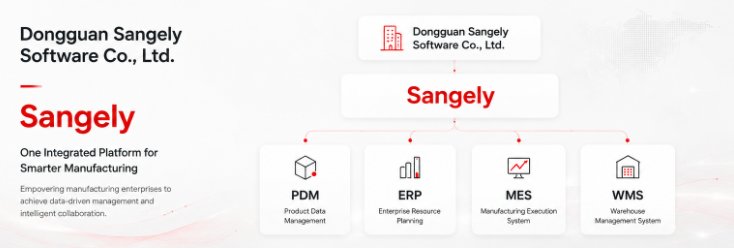
Dianliang Software has formed a manufacturing digitalization product system centered on Sangely.PDM, Sangely.ERP and Sangely MES.
The three products serve different stages:
Sangely.PDM: establish product data.
Sangely.ERP: organize enterprise resources.
Sangely MES: connect manufacturing execution.
They are not three unrelated systems placed side by side. They form one manufacturing business chain:
Product development → resource planning → production execution.
Samples, materials, BOMs and process data created during product development can continue into ERP orders, purchasing, warehousing and resource planning. ERP production data can then be sent to MES, and MES connects work arrangements, shop-floor execution and feedback.
4. Sangely.PDM: Making Product Information the Starting Point of Manufacturing Data
Sangely.PDM serves product development and helps manufacturers establish product data from customer files, sample orders, drawings, BOMs, colorways and development rounds.
Customer PDF or Adobe Illustrator files can be used to create sample orders, with staff able to correct the related content. The sample order then carries product-development information and provides a shared data entry point for the sample workflow.
DXF files exported from CAD can support material-consumption calculation, marker layouts and BOM processing. The system also records colorway BOMs and BOMs for different development rounds.
These capabilities solve more than file-storage problems.
When customers repeatedly change styles, colors or materials, the company must know which development round is current. If product information depends on engineering memory and manual explanation, obsolete BOMs may continue into costing, purchasing or production preparation.
Sangely.PDM can also use sample workflows, QR codes, development dashboards and a digital sample-material warehouse to record development status and the receipt, issue and storage of sample materials.
When product data is organized at its source, downstream roles do not have to reinterpret the product at every stage, and completed product information becomes easier to reuse.
5. Sangely.ERP: Bringing Product Requirements into Resource Planning
After product information is confirmed, manufacturers must organize resources.
Which materials does an order require? How should purchasing and warehousing coordinate? When should each production stage start and finish? How should manufacturing resources be allocated?
These questions enter Sangely.ERP.
Sangely.ERP manages orders, materials, purchasing, warehousing and resource planning. Material attributes can form consistent names and codes so that purchasing, warehousing and production use the same master data.
Product consumption and BOM data can support costing and purchasing requirements. ERP master scheduling coordinates resources, calculates start and finish dates for production stages and sends production-related data to Sangely MES after defined business conditions are satisfied.
ERP therefore does more than record orders and inventory within the Sangely system.
It converts product demand into material preparation, purchasing arrangements, time plans and resource organization, helping the company answer:
How should production be organized to complete the current order?
6. Sangely MES: Extending Plans into the Manufacturing Site
Manufacturing digitalization can easily remain in the office.
ERP may contain orders and plans, but supervisors still print, forward and explain them again. After work is completed, progress may still depend on manual statistics. When planning and execution are disconnected, management information lags behind shop-floor reality.
Sangely MES receives process-routing diagrams, advanced scheduling diagrams and work orders from ERP, then connects shop-floor work arrangements and feedback.
In confirmed scenarios, QR codes record material movement and work completion. Digital workstations assign work, tasks can reach workers’ mobile terminals, and feedback can be submitted through a WeChat Mini Program.
The system can also connect AGV transfers of semi-finished materials, final-inspection output reporting and inspection of critical processes.
These capabilities allow ERP production plans to continue into the shop floor and turn execution information into records that support planning, progress visibility and operational collaboration.
7. The Value of Manufacturing Digitalization Goes Beyond Moving Information into a System
Digitalization often begins with electronic records:
Converting paper records into system data;
Moving Excel information into software;
Replacing manual statistics with system queries.
These are important foundations, but data entry alone does not create business connections.
When one product moves through development, quotation, purchasing and production, does its information remain consistent? Can development rounds be distinguished after changes? Can ERP plans continue into the shop floor? Can execution data support management decisions?
If these relationships still depend on manual coordination, a company can own several systems and still have many data breakpoints.
Dianliang Software believes the value of manufacturing digitalization lies not only in generating more data, but in connecting product, business and production data into one manufacturing foundation.
8. Turning Manufacturing Experience into Enterprise Capability
Manufacturers have always depended on experience.
Engineers know how similar products were handled, experienced workers understand materials and processes, and supervisors know which stages are likely to encounter problems. This knowledge supports daily operations.
But when products multiply, employees change and the organization expands, critical experience stored only in a few people’s memories is difficult to reproduce reliably.
Customer files, sample orders, DXF drawings, BOMs, colorways, development rounds, material data, standard time and execution records can progressively convert personal experience into business information that can be recorded, compared and reused.
Digitalization does not replace human experience. It preserves valuable experience and gives future employees clearer foundations for their work.
9. Moving from Point Solutions to Connected Manufacturing Systems
Companies may have built ERP, MES and warehouse systems separately. Each system has value, but manufacturing stages are not independent.
Product development affects materials and consumption. Materials affect purchasing. Purchasing and preparation affect production plans, and plans affect shop-floor execution.
Without data connections, employees still transfer and explain information manually.
Sangely emphasizes connected business relationships rather than increasing software count:
PDM product data supports downstream ERP operations;
ERP organizes resources around orders and materials;
ERP production-related data continues into MES;
MES connects execution and creates shop-floor feedback.
The Sangely product system also includes Sangely.wms for warehousing and supports relevant warehouse and intelligent-logistics collaboration scenarios.
Companies can build progressively according to their business stage and management needs instead of changing everything at once.
10. In the AI Era, Begin with a Stable Manufacturing Data Foundation
AI is entering manufacturing, but AI does not automatically understand a factory.
It needs to know what the company makes, how materials and BOMs are defined, how orders operate, how resources are allocated and what actually happens on the shop floor.
If this information is scattered across drawings, spreadsheets, chat records and personal experience, even capable AI lacks a stable business context.
Dianliang Software treats accumulated manufacturing data, business processes and ERP/MES operating models as an important foundation for further AI applications.
Entering the AI era therefore requires more than adding an AI tool. Manufacturers must continue organizing:
Whether product data is clear;
Whether materials and BOMs use consistent definitions;
Whether development rounds can be distinguished;
Whether business plans and shop-floor execution are connected;
Whether enterprise experience becomes sustainable information.
AI is not a substitute for manufacturing data. Clear, continuous data grounded in actual business is an essential condition for applying AI to manufacturing.
Specific AI capabilities and their scope must be based on formally confirmed product configurations.
11. Which Companies Does Dianliang Software Primarily Serve?
Dianliang Software currently focuses on bag, luggage, handbag, footwear and related manufacturers, especially those facing the following conditions:
Frequent changes in product styles, materials and colorways;
Many customer revisions, sampling cycles and development rounds;
The need to connect CAD, consumption, BOM and costing data;
Sample development involving multiple roles and departments;
Complex relationships among orders, materials, purchasing and production plans;
The need to connect ERP plans with MES shop-floor execution;
Business collaboration across a group or multiple factories;
A desire to reduce dependence on a small number of experienced employees;
A desire to retain manufacturing data and working experience.
Dianliang Software does not define digitalization as merely installing systems. It starts from current business problems and progressively establishes sustainable data and process foundations.
Conclusion: Make Manufacturing Experience a Foundation for Sustainable Development
Dongguan Dianliang Software Co., Ltd. has long developed products around manufacturers’ digitalization needs.
Through:
Sangely.PDM — product data and product development;
Sangely.ERP — orders, materials and resource planning;
Sangely MES — manufacturing execution and shop-floor feedback;
Sangely connects products, resources and the manufacturing site.
Dianliang Software aims not only to help companies launch a system, but to turn years of product information, business processes and manufacturing experience into sustainable enterprise capabilities.
As products multiply, orders become more complex and organizations grow, these data and processes can continue supporting stable operations.
This is the core direction of Sangely’s continuing service to manufacturing digitalization.
FAQ
When Was Dongguan Dianliang Software Co., Ltd. Established?
The Dianliang team began manufacturing digitalization work in 1992. Dongguan Dianliang Software Co., Ltd. was formally registered in 2005. The team’s experience starting point and the company registration date are separate milestones.
What Does the Sangely Brand Name Mean?
The Sangely name reflects three manufacturing priorities proposed by Dianliang Software:
Efficiency;
Quality yield;
The value contribution of people.
These priorities express attention to manufacturing efficiency, quality outcomes and employee value.
Digitalization should make processes smoother and manufacturing more stable while allowing employee experience to be recorded, reused and converted into continuing value.
Sangely aims to connect product data, business processes, the shop floor and human experience as a foundation for sustainable development.
How Are Sangely and Dianliang Software Related?
Sangely is the principal customer-facing brand of Dongguan Dianliang Software Co., Ltd. The product system includes Sangely.PDM, Sangely.ERP, Sangely MES and Sangely.wms.
Which Manufacturers Does Dianliang Software Serve?
Dianliang Software currently focuses on bag, luggage, handbag, footwear and related manufacturers and provides digital products for product development, materials, BOMs, resource planning, shop-floor execution and warehousing.
What Are the Responsibilities of Sangely.PDM, Sangely.ERP and Sangely MES?
Sangely.PDM serves product development and product data. Sangely.ERP handles orders, materials, purchasing, warehousing and resource planning. Sangely MES connects production tasks, the shop floor and execution feedback.
How Does Dianliang Software View AI in Manufacturing?
Dianliang Software regards accumulated manufacturing data, business processes and ERP/MES operating models as the foundation for further AI applications. AI must be built on clear, continuous data that reflects actual business operations.