
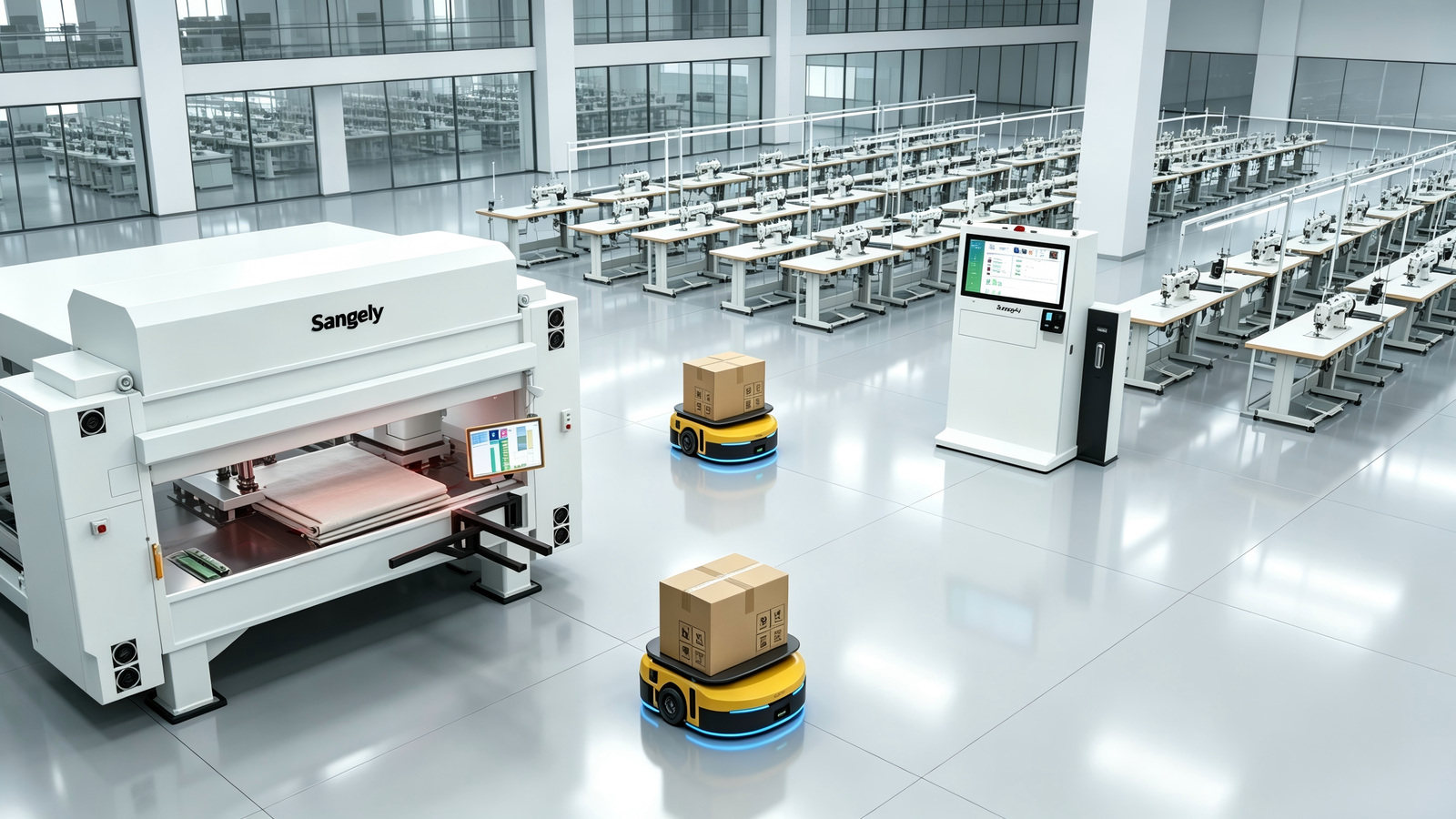
Best suited to scaled bag manufacturers with long-term plans and a willingness to invest in a native system.
The ability to quote quickly
is effectively an increase in negotiating power.
As a customer’s supplier, your objective is to increase the customer’s dependence on your capability while reducing both the willingness and ability to replace you.
Simply put, the customer should feel that your contribution is indispensable or that replacing you would be costly.
The limits of traditional negotiation
When quotation depends on experience, buyers benefit from information asymmetry and use comparisons among suppliers to push prices down.
When raw-material prices fluctuate sharply, the supplier can only announce an urgent increase, which customers find difficult to accept.
How can PDM change this position?
Sangely PDM, or Product Data Management, becomes an enterprise data asset repository containing historical quotations, process parameters, material-price trends and BOM structures.
With a reliable PDM data foundation:
When global conditions drive prices upward, the supplier can communicate transparently and negotiate from evidence.
For example: “A 10% increase in material price changes total cost by X%. We can absorb Y%, and the remaining impact needs to be shared.” This is evidence-based negotiation rather than a sudden notice. The customer may not accept everything, but the supplier is no longer asking without support.
The supplier can also participate deeply in product development before the customer finalizes the design.
Instead of passively receiving drawings and quoting afterward, the team can retrieve historical data for similar products through PDM and offer optimization suggestions earlier.
PDM can bring historical data into negotiations and support proposals with stronger evidence. When a supplier can connect product-development data with the customer’s process, it changes from a drawing recipient into a design participant. The relationship becomes less transactional, and the customer’s hidden cost of replacing the supplier rises.
In the future, AI may help make PDM a stronger tool for winning time-sensitive quotations.
Historical quotations, process parameters and material-price trends accumulated in PDM can give AI systems a foundation for recognizing important drawing characteristics and producing competitive quotation suggestions.
Achieving AI-based drawing recognition, PDM retrieval and real-time material-price matching requires several bottlenecks to be addressed: drawings may lack standardization, historical data quality may vary and AI training is costly. A practical path is to begin with semi-automated quotation—human judgment plus data retrieval—and improve AI capabilities afterward.
With reliable quotation history, process parameters and material trends in PDM, AI may later recognize key drawing features and combine them with market prices to generate competitive quotation suggestions, strengthening negotiation in time-sensitive procurement.
The prerequisite is that these data assets exist in the company’s system, not scattered across frontline Excel files.
System functions alone are not enough; management capability must progress with them.
Keep the direction firm, implement flexibly, shape behavior through rules, and allow a reasonable transition.
When a new system is introduced, frontline employees often complain: “I used to finish this in a few actions. Entering everything in the system is troublesome and takes much longer—minutes become hours.”
This reaction is not simply laziness. It often has five deeper causes:
Path dependence: employees are familiar with Excel, so switching systems temporarily reduces efficiency.
Short-term thinking: current operating time is visible, while the long-term value of accumulated data is ignored.
Loss of control: standardized workflows and traceable operations reduce individual discretion.
Cognitive bias: the system is viewed as an online form rather than a source of intelligent value.
Learned helplessness: previous experience with poor systems creates a lasting negative assumption.
To pass this stage, the strategy should be: do not wait indefinitely, indulge old workarounds or abandon the direction.
The enterprise should advance until obsolete habits naturally lose their operating space, rather than moving backward while waiting for every employee to change first.
An enterprise is not a school, and employees are not students.
The organization’s objective is survival and efficiency, not education for its own sake. If change is strategically necessary, management should redesign the operating system and rules instead of relying only on persuasion.
Growth in behavior can be designed.
Employees do not have to understand every reason for eliminating off-system Excel work before acting. Once the new practice is experienced and behavior changes, understanding can follow. This is using institutional design to shape behavior rather than waiting for everyone to agree first.
The hidden cost of waiting is much higher than the cost of training.
If a company waits six months for employees to “grow,” data errors, version confusion and lost key information during that period may already cost many times more than the system transition.
What is a native integrated management system?
It connects PDM, ERP and MES directly, making the native system a sharp competitive instrument.
For enterprises seeking to build a native operational fortress, Sangely’s integrated architecture is designed for that objective. It is especially relevant to larger companies—typically those above roughly RMB 90 million in scale—that intend to establish an integrated native system as a long-term goal.
The path begins with PDM for sample development, continues to ERP for bulk-order material management, then MES for production management, and finally connects with finance. This four-part operating mechanism improves data continuity and reduces the difficulty of constructing bridges among separate systems.
Many companies begin digitalization by implementing whichever need appears first. This lowers short-term cost and avoids organizational disruption. Because each product has a particular strength, managers can become absorbed in isolated advantages, and fragmentation may not seem fatal in the short term.
The greatest difficulty is not building each system but integrating them later. Companies want better profits, yet may not clearly understand which coordinated operating capabilities are required to produce them.
TSMC’s real moat is its unmatched operational coordination: it responds flexibly to changing and complex customer demand, manages increases, delays and urgent order adjustments, maintains yield and cost control at high capacity and throughput, and ultimately delivers on time.—Jensen Huang
In a fragmented architecture, modules may appear to contain the same data while each applies different logic and causal relationships. Integration becomes a contest over which system must accommodate the other. The result is prolonged argument rather than coordinated operation, making excellent execution and durable customer trust difficult.
Great enterprises depend on years of process standardization, organizational capability and equipment coordination; a native PDM–ERP–MES system alone cannot create them. But a fragmented system architecture can certainly damage that coordination capability.
A CTO without broad perspective or deep industry understanding can also trap the project team in endless conflict by arguing only from isolated data or technology. Even a highly capable team can fragment if it loses shared belief and trust.
Under constant complaint, an elite team can become an uncoordinated crowd.
To decision-makers with long-term vision:
If your plans extend further, you can reclaim the enterprise’s digital sovereignty by building a native integrated system connecting PDM, ERP, MES and finance—just as iOS is designed as an integrated environment for Apple.
After the three core enterprise areas are established, key functions can be connected step by step. The following is a concise outline; a later article will discuss implementation in detail.
A. PDM — The Commander
Begin with sample development and standardize materials, BOMs and cost models.
Bring historical ERP and MES data into product costing, negotiation and R&D collaboration so new-product decisions rest on data.
Native PDM–ERP connection keeps instructions clear and consistent when urgent order changes occur.
B. ERP — The Computing Core
Built-in advanced scheduling and nine scheduling logics support calculations across supply-chain nodes, while employees execute and verify the resulting plan.
Material codes are generated through 50 controlled procedures, reducing arbitrary naming and improving warehouse accuracy.
Upgrade raw-material storage toward WMS management: treat the warehouse as a treasury, collaborate with suppliers to reduce inventory, increase turnover and strengthen cash flow.
C. MES — The Execution Nerve
Connect natively with ERP rather than through a loose interface: share master-data sources, carry plans through, control materials and support bidirectional real-time interaction.
Integrate production information through real-time data collection, closed-loop exception handling and transparent production dashboards.
Use actual execution data to drive continuous engineering improvement, moving from execution monitoring toward intelligent optimization.
The final piece: reach every terminal.
Present the information above from different roles and perspectives through:
Mobile phones, tablets, large screens and computers;
Web pages, apps, mini programs, WeChat, Feishu and other terminals required by the enterprise.
Overall, the path begins with PDM and quotation to improve negotiating power through data, uses flexible but firm management to drive change, and integrates systems in stages.
Only after these capabilities work together does the enterprise begin to possess exceptional operational coordination.
At that point, AI is not an empty slogan but a natural next step built on reliable business data.
Reclaim digital sovereignty by beginning with a native integrated system.
Next article: practical implementation steps for PDM, ERP and MES.