
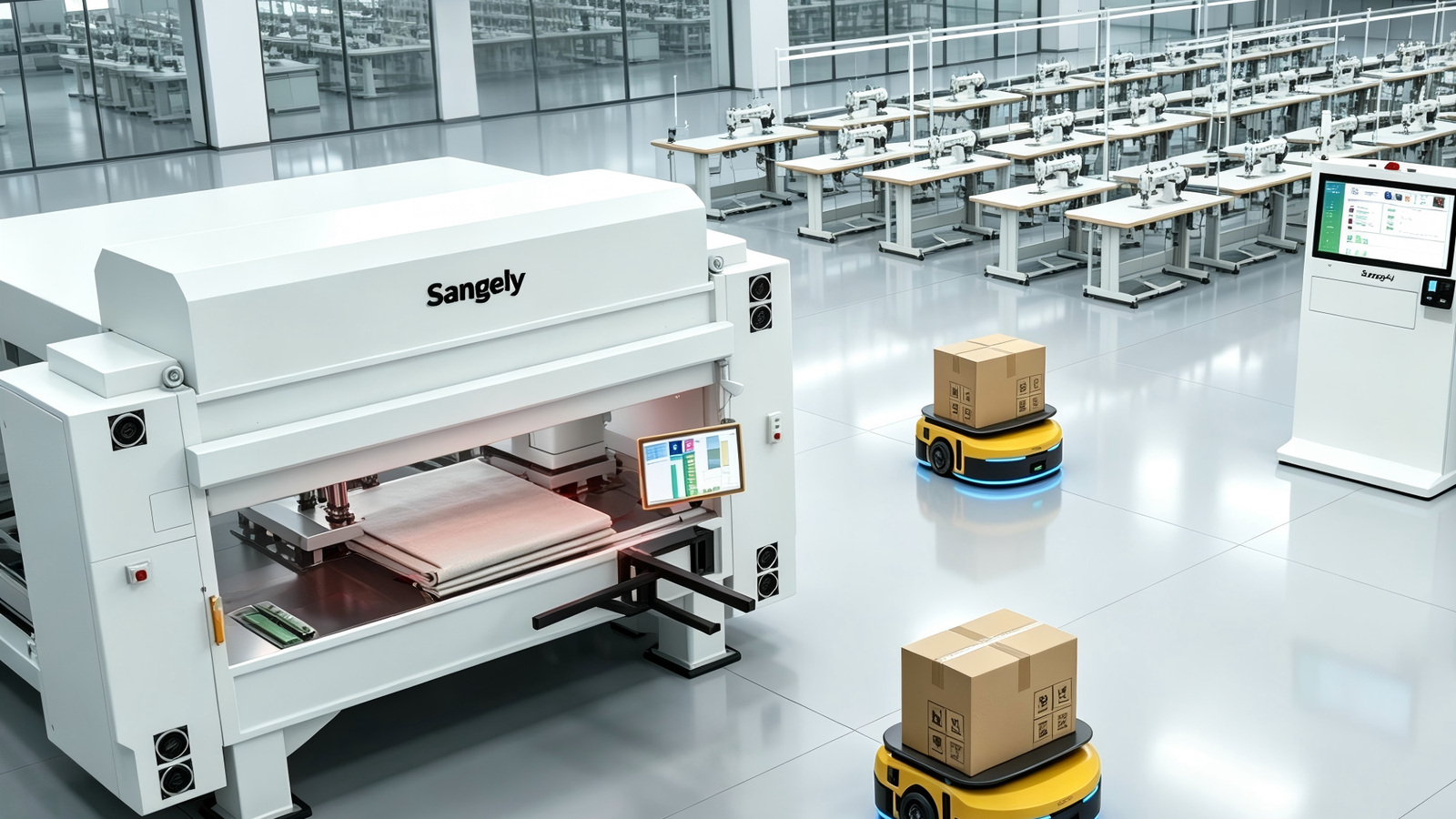
A practical look at a native PDM, ERP and MES architecture—and how every unit of material can contribute to more predictable profit.
Reclaim digital sovereignty so that every unit of material can contribute to predictable profit.
When a bag manufacturer moves from managing a small operation through personal command to running a large-scale organization, the owner's main concern is no longer survival. It is loss of control.
Many owners share the same painful experience: the company has purchased many systems, yet product development, purchasing and production still operate with different versions of the truth. Orders move through chat messages, spreadsheets circulate everywhere, and data becomes distorted as it is passed along. Most critically, the factory may lack precise cost evidence when a brand customer pushes down prices, and may be unable to calculate the profit threshold immediately when material costs change.
Real digitalization is not the assembly of disconnected modules. It is an organic system that grows from one shared data model.
- Three Core Engines Define End-to-End Factory Collaboration
- PDM (Product Data Management)—The Strategic Command Center
Core logic: reclaim control at the product-development stage and strengthen evidence-based price negotiation.
As a supplier, the goal is to become difficult for the customer to replace. Traditional quotations rely heavily on experience. When raw-material prices change, a factory may have little more than a general demand for a price increase, making the customer relationship vulnerable.
• Data asset repository: Sangely PDM retains historical quotations, process parameters and material-price trends.
• Transparent, evidence-based negotiation: when material costs rise, the factory can explain clearly: “Material costs increased by 10%, affecting total cost by X%; we will absorb Y%.” Data changes the discussion from an unsupported price request to a professional negotiation.
• Generate a BOM in 3 seconds: import CAD patterns in DXF format and automatically identify pattern pieces, with a stated error rate below 1%.
- ERP (Enterprise Resource Planning)—The Computing Core
Core logic: reclaim control across the supply chain so that every unit of spending is directed where it creates value.
It is not merely accounting software. It is an algorithm-driven engine for purchasing, inventory and financial operations.
• Nine marker-making algorithms (Q0-Q9): cover scenarios from quotation to production, with stated material-utilization rates of 89%-96% and potential annual savings at million-level scale.
• Automatic coding through 50 programs: reduces inconsistent names for the same material and improves warehouse data accuracy.
• WMS smart warehousing: reads inventory, goods in transit and purchase orders in real time, issues material-shortage alerts and helps turn warehouse inventory into a controlled business asset.
- MES (Manufacturing Execution System)—The Execution Network
Core logic: reclaim control on the shop floor and turn production from a black box into a visible operation.
• Native continuity instead of disconnected interfaces: the BOM in PDM, the plan in ERP and execution in MES use a shared data source, reducing production stoppages caused by unavailable materials.
• Closed-loop exception handling: operators scan to report work, while output, defects and exceptions are uploaded promptly and assigned to responsible personnel.
• Data-driven improvement: cycle analysis and OEE monitoring help identify bottleneck processes so that each operation can be managed with data.
- A Three-Step Implementation Guide That Prevents Systems from Working Against One Another
Digital transformation is most vulnerable when isolated projects are launched without sequence. Based on experience across more than one hundred sizeable factories, Sangely recommends the following implementation order:
Step 1: Introduce PDM—Define the Product Clearly and Stabilize Development
Implementation actions: establish unified material coding, configure BOM templates and build a quotation model based on standard time.
Expected results stated in the original practice summary: sample-development lead time reduced by 50%, rework reduced by 60%, and stronger authority to explain costs to brand customers.
Step 2: Follow with ERP—Let the Supply Chain Operate Through Calculation
Implementation actions: introduce marker-making algorithms to optimize material consumption, enable MRP-generated material recommendations and configure a mobile profit dashboard for management.
Expected results stated in the original practice summary: inventory turnover improved by more than 20%, financial closing shortened from five days to one, and clearer traceability of spending.
Step 3: Deepen MES—Let the Shop Floor Report Its Own Reality
Implementation actions: deploy workstation terminals or tablets, allow operators to scan and report work, connect key equipment and collect operational data in real time.
Expected results stated in the original practice summary: on-time order delivery improved from 70% to more than 92%, with piece-rate payroll disputes reduced to zero.
- Reach Every Terminal and Give Management a More Certain Sense of Control
When PDM, ERP and MES share the same underlying data source, information no longer remains on one department's computer. It can move beyond physical boundaries and reach the relevant people in real time through views suited to their responsibilities.
The value of management should not be consumed by searching for and reconciling data. It should be expressed through precise decisions based on facts.
• Owner's view—transparent operations: whether travelling or negotiating with a customer, management can use a mobile device to understand the overall situation. Daily profit, customer gross-margin rankings and delay warnings for key orders become visible, replacing passive reports with a more immediate view of the factory's operating condition.
• Supervisor's view—precise dispatching: replace shouting, running and repeated chasing with synchronized line progress across large displays and workstation terminals. Bottleneck operations can be highlighted automatically so instructions can be directed to the right place.
• Finance view—automated reconciliation: when business documents are created, the corresponding financial records can be linked. From purchasing receipts and material issue through finished-goods shipment, the flow of funds becomes traceable, reducing repetitive after-hours reconciliation and supporting consistency between records and physical activity.
Real certainty comes from the native power of shared data.
In commonly assembled systems, interface delays and inconsistent definitions can introduce errors as data moves between modules. Sangely's native integrated architecture is designed to keep data from product development through production aligned at the source, synchronized and interpreted consistently.
This is the stable digital foundation a factory needs.