
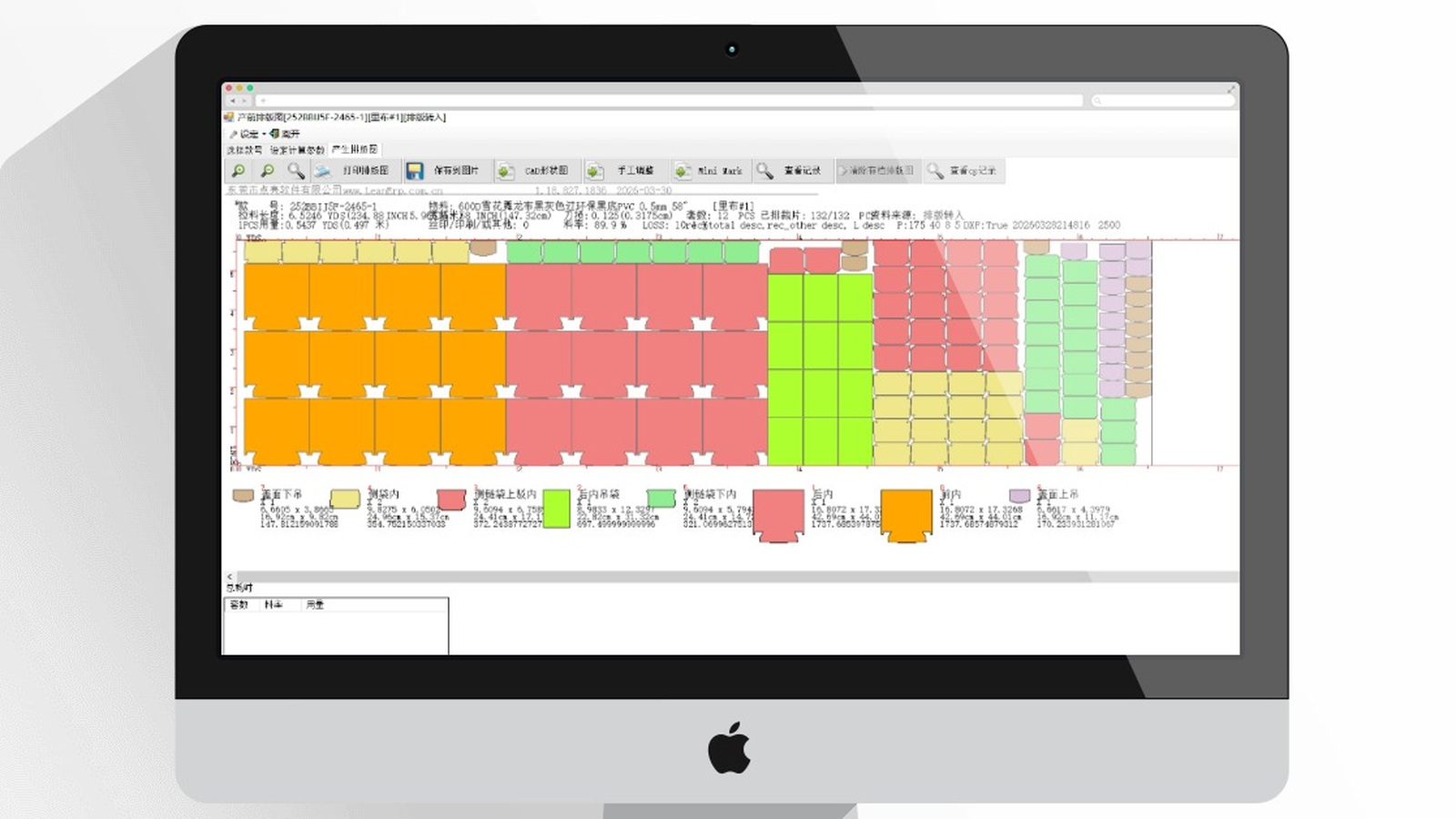
To verify the stability of Sangely advanced nesting across different pattern-piece types and material-utilization scenarios, we conducted practical comparisons using headwear and bag products. The tests included manual nesting, flat layout and mixed nesting to reflect performance in real production environments.
The following are the consolidated findings:
- Headwear Test: Calculation Completed in About Three Seconds
Headwear pattern pieces are relatively regular, making this a category in which nesting systems can perform effectively.
After the pattern pieces were entered, Sangely completed the calculation in approximately three seconds. The results were:
Nesting without Sangely:
Sangely advanced nesting:
Material utilization improvement: +2.6%
Fabric length reduction: 7.2 inches
For high-volume factories, an improvement of this size creates meaningful cost differences across a batch, a season and an entire year of orders.
2. Bag-Industry Tests: Greater Pattern Diversity Provides a Stronger Test of System Capability
Bag products contain many irregular pattern pieces. This is where experienced nesting specialists accumulate much of their expertise, and it is also a major challenge for advanced nesting algorithms.
The following compares two bag-product cases:
Case 1: Medium Complexity
Manual nesting: 85.5%
Sangely advanced nesting: 86.9%
Difference: +1.4%
This case used a moderate number of pattern pieces with a clear structure. Sangely’s advantage mainly came from:
More complete use of gaps;
The ability to test multiple combinations automatically;
Reducing blind spots in visual judgment and limits caused by individual experience.
Case 2: High Complexity
Manual nesting: 82.8%
Sangely advanced nesting: 85.9%
Difference: +3.1%
This case contained more fragmented pieces and greater shape variation, conditions under which manual nesting is most easily constrained.
The result shows that the system can still improve material utilization substantially in a complex scenario.
3. Mixed Nesting versus Flat Layout: An Extended Test
In addition to flat-layout nesting, this test included a mixed-nesting mode to simulate conditions closer to practical production.
Case 1: Manual nesting versus mixed nesting
Case 2: Flat layout versus mixed nesting
Case 3: Flat layout versus mixed nesting
The results show that in both:
Manual nesting versus mixed nesting;
Flat layout versus mixed nesting;
Sangely maintained stable performance across different combination methods and further improved material utilization.
4. Overall Findings: Four Core Advantages of Sangely Advanced Nesting
1. Fast Calculation—Approximately Three Seconds
The speed supports rapid trial calculations for different combinations and reduces the time specialists spend testing layouts.
2. Higher Overall Material Utilization
Whether pattern pieces are simple or complex, the system can provide higher material utilization.
3. More Balanced Use of Gaps
The algorithm reduces visual blind spots common in manual nesting and improves overall layout efficiency.
4. Less Repetitive Work
Reducing repeated trial layouts lowers operating effort and enables more tasks to be completed in the same amount of time.
5. Conclusion: Tests Across Multiple Product Categories Show Stable Performance and Measurable Improvement
Practical cases from headwear to bag manufacturing show that:
Sangely advanced nesting outperformed manual nesting in calculation speed, material utilization and layout quality in these tests.
It is especially useful for factories facing:
Continuously rising fabric costs;
Insufficient time for nesting work;
Large differences in employee experience;
A need to improve planning and nesting efficiency.
Sangely advanced nesting helps factories make layout decisions faster and observe quantifiable improvement in actual production.