
1. Why does the shop floor still require extensive manual handoffs after ERP and MES go live?
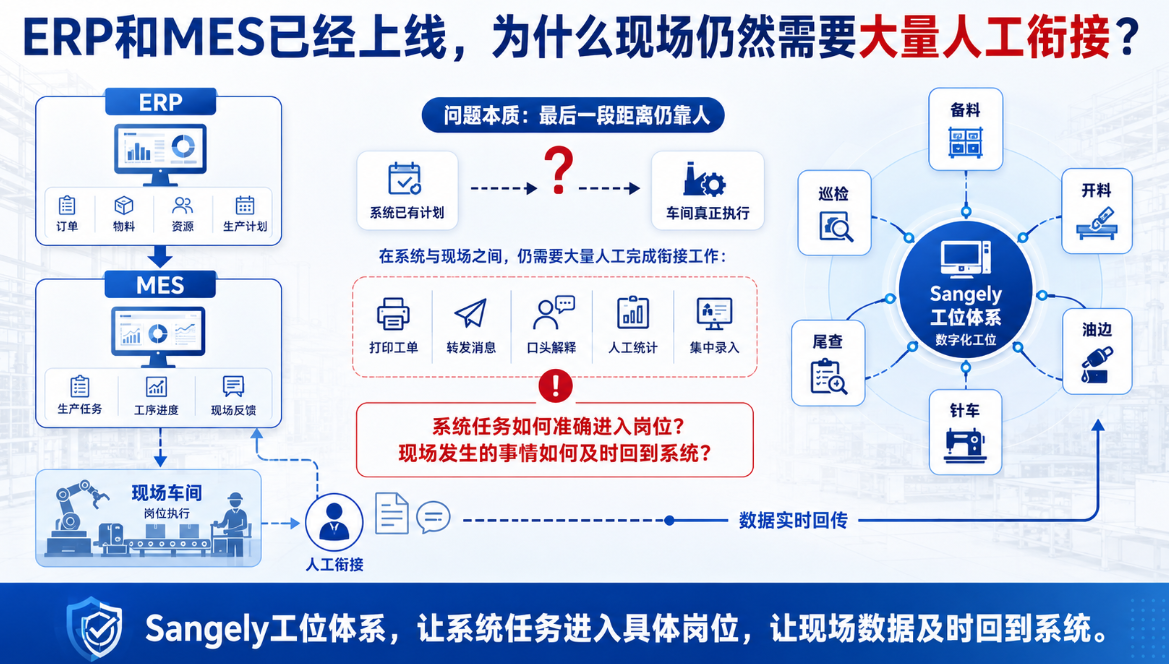
ERP and MES address different levels of manufacturing management.
ERP focuses on orders, materials, resources and production planning. MES manages production tasks, process progress and shop-floor feedback. Between “the system has a plan” and “the workshop is executing,” however, there are many specific roles.
Material preparation, cutting, edge painting, embroidery, sewing, final inspection and patrol inspection are the people, workstations and operations that actually manufacture the product.
If supervisors still print work orders, forward messages and explain tasks after they enter MES, and completion still requires manual statistics and batch entry, a final gap remains between the management system and production.
Shop-floor digitalization must therefore solve two problems:
How system tasks accurately reach specific roles, and how shop-floor events return to the system promptly.
This is the value of Sangely’s workstation architecture.
2. Workstation terminals bring MES from the back end to the role
Sangely MES connects production tasks with specific operating scenarios.
After relevant production information from ERP enters MES, process routings, intelligent-nesting layouts and work orders can continue into shop-floor arrangements and upstream operations such as cutting, edge painting, gluing and embroidery.
A workstation terminal does more than display a task list.
It maps system tasks to on-site roles. Employees see orders, operations and task information relevant to their current work, and after completion their execution status can return to the system.
The workstation terminal is therefore an important execution entry through which Sangely MES connects specific roles.
The relationship can be understood as:
ERP Production Plan → MES Production Tasks → Digital Workstations → Shop-Floor Execution and Feedback
The management system no longer remains in the office; it begins to participate in actual production actions.
3. QR codes and mobile terminals let shop-floor status form during execution
Delivering the task is only the first step. Returning status after completion is equally important.
Traditional workshops use paper registration, manual counting and supplemental entry. These methods can record data, but the information is delayed. By the time managers see it, the shop floor may already have changed.
Sangely MES can use QR codes, workstation terminals and WeChat mini programs for shop-floor dispatching and reporting.
In applicable scenarios, QR codes support material movement and completion reporting; workstation terminals receive assignments; and related tasks can reach mobile terminals for employees to process through WeChat mini programs.
Data can then form progressively as tasks are executed rather than being consolidated only after production ends.
The previous model was:
Production Completed → Manual Statistics → Batch Entry
It gradually becomes:
Task Reaches Role → Shop-Floor Execution → Status Reporting → MES Continuously Forms Production Data
Production management can therefore see a shop floor in motion, not only after-the-fact results.
4. Shop-floor digitalization must connect materials as well as people
Workshops contain not only people and tasks, but also raw materials and work in process that continually move.
If production tasks are in the system but materials still require manual searching, expediting and transport, new waiting time remains.
In relevant production-logistics scenarios, Sangely coordinates team-leader workstations, supermarket workstations and AGVs so work-in-process delivery relates to production tasks.
When a line creates material demand, the workstation can connect the task with logistics, while the AGV participates in delivery to the relevant production area.
The important point is not that “the factory has an AGV.”
It is:
Can the AGV participate in manufacturing operations?
When the system knows the current task, workstation and material requirement, automation becomes an execution node in manufacturing rather than an isolated machine.
This is a more meaningful distinction between intelligent equipment and ordinary stand-alone automation.
5. Final inspection and patrol inspection make quality part of shop-floor data
A digital workshop must answer not only “how much was produced,” but also “how did the process and quality perform?”
Final-inspection and patrol-inspection workstations perform different feedback roles in Sangely MES.
Final-inspection workstations can report production quantity and related shop-floor information. Patrol-inspection workstations support quality inspections at critical operations, and inspection records can form corresponding shop-floor reports.
Production data then includes quality information in addition to completion status and quantity.
Manufacturing data extends from simply:
How much was produced
to:
Where execution stands, what the status is, and how quality is performing.
For supervisors and managers, this continuously formed data is closer to the real manufacturing process than one report filled in after production ends.
6. Sangely MES is a coordination architecture organized around shop-floor execution
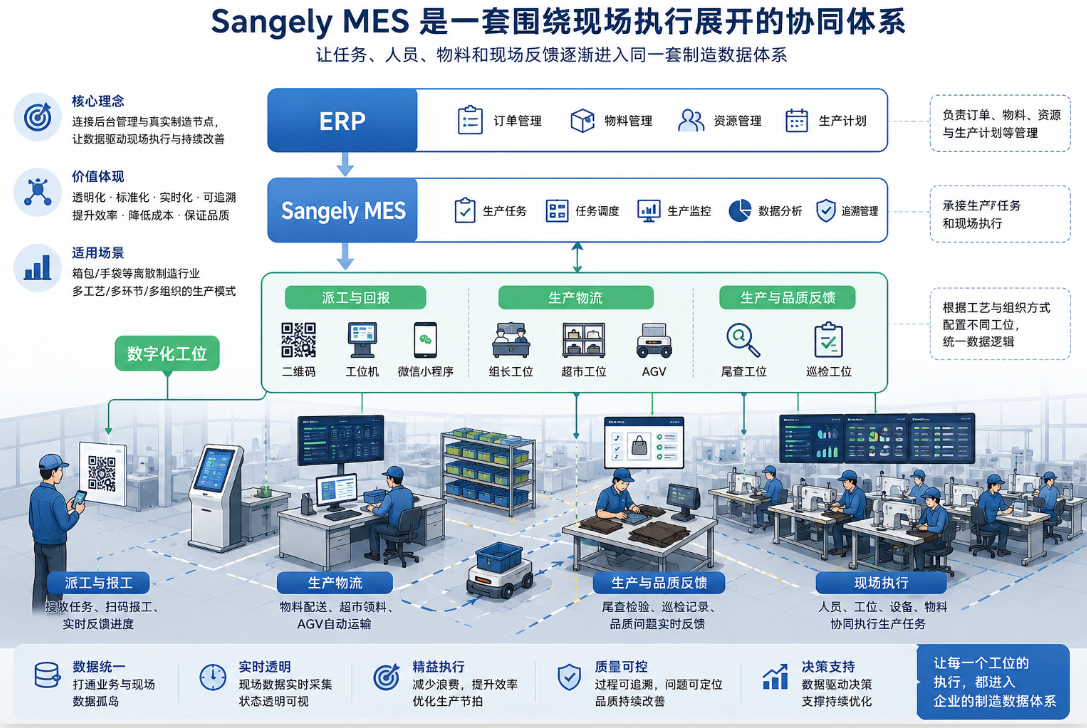
Taken together, Sangely’s shop-floor capabilities do not impose one fixed sequence on every factory. They form a coordination architecture organized around MES.
The core can be understood as:
Sangely ERP manages orders, materials, resources and production plans
Sangely MES manages production tasks and shop-floor execution
Digital workstations connect role-specific shop-floor scenarios:
Dispatching and reporting: QR codes, workstation terminals and WeChat mini programs
Production logistics: team-leader workstations, supermarket workstations and AGVs
Production and quality feedback: final-inspection and patrol-inspection workstations
Factories can configure workstations according to their processes and organization, while the underlying logic remains consistent:
Bring tasks, people, materials and shop-floor feedback into one manufacturing-data system.
Products are manufactured not by ERP pages or MES back ends, but by specific people, workstations and manufacturing operations.
MES connects back-end management with these real manufacturing nodes.
7. Extending beyond the workshop connects warehousing and production logistics
Production and warehousing are not separate worlds.
When production needs material affects warehouse preparation; where materials are stored and how they move affects whether the workshop starts on time.
Beyond the production floor, Sangely uses WMS, ERP, AGV and CTU capabilities to connect warehousing and automated logistics.
Sangely WMS can build operating pages around actual warehouse and site layouts. ERP provides resource and material information, WMS manages warehouse operations, and AGVs or CTUs perform automated transport.
The relationship can be understood as:
ERP Resource and Material Information → Sangely WMS Warehouse Operations → AGV / CTU Automated Transport → Workshop and Workstations
Smart warehousing therefore answers more than “how much inventory remains.”
It also addresses:
Where materials are, when they are needed, how they enter the site, and how movement relates to production demand.
When warehouse logistics enters the data system, production planning, warehouse operations and physical logistics can coordinate more effectively.
8. Smart manufacturing does not simply pursue an “unmanned” factory; it reorganizes people, systems and equipment
As AGVs, CTUs and automation enter factories, companies naturally associate smart manufacturing with reducing labor.
Automation can perform more standardized and repetitive work. In suitable warehouse and logistics operations, lower-labor and unmanned models are important directions.
Automation does not conflict with human value.
Employees once spent substantial time passing work orders, finding materials, expediting progress, counting quantities and entering the same information. As systems, workstation terminals and automation take on this basic work, people can focus more on exceptions, quality judgment, coordination and improvement.
The change is therefore not merely “using fewer people.”
More importantly:
People, systems and equipment find roles better suited to their strengths.
Stable system work goes to systems, repetitive physical execution goes to equipment, and work requiring experience and judgment remains with people.
9. Sangely’s objective is to bring systems into manufacturing
ERP manages resource planning and MES enters manufacturing execution. To create manufacturing value, digitalization must connect every critical node where production occurs.
How do tasks reach roles?
How does completion return as feedback?
How does work in process move on site?
How is quality recorded?
How does automation participate in tasks?
Together, these questions determine whether management systems truly enter manufacturing.
Through ERP, MES, workstation terminals, QR codes, mobile terminals and AGV capabilities, Sangely extends management systems into the actual shop floor.
The workstation terminal plays a critical role:
It brings back-end tasks to a role and returns the role’s actual execution status to the system.
From ERP to MES and then to individual digital workstations, the result is not more software pages, but a chain of:
Plan → Task → Shop-Floor Execution → Data Feedback
for manufacturing.
Around this core chain, production logistics, quality inspection and warehouse automation continue to connect, allowing digitalization to move from back-end systems into the factory.
Conclusion: Make critical manufacturing nodes become data nodes
Having ERP and MES does not mean digital transformation is complete.
Products are still manufactured on the shop floor.
Whether plans reach roles, roles return status promptly, materials move with production rhythm and quality forms continuous data determines whether ERP and MES participate in manufacturing.
Through MES, digital workstations, QR codes, WeChat mini programs and AGVs, Sangely extends systems from management into production. WMS, AGV and CTU capabilities also bring warehousing and manufacturing logistics into the digital architecture.
The objective is not more independent software and equipment, but to let:
Plans, people, workstations, logistics, equipment, quality and shop-floor feedback
work progressively around the same manufacturing logic.
Critical manufacturing nodes become data nodes, and management systems truly enter production.
This is an important step from “having ERP and MES” toward a digital shop floor and smart manufacturing.
FAQ
Q1: Why are workstation terminals needed after ERP and MES are implemented?
ERP manages orders, materials and resource planning; MES manages production tasks and shop-floor execution; actual work occurs at roles. Sangely workstation terminals bring MES tasks to employees and locations and return execution status, extending the system into the workshop.
Q2: Which shop-floor reporting methods does Sangely MES support?
Sangely MES can use QR codes, workstation terminals and WeChat mini programs for tasks and reporting. Roles select appropriate terminals for their context so production status continues to enter the system during execution.
Q3: How does Sangely MES coordinate with AGVs?
In work-in-process logistics, team-leader and supermarket workstations can coordinate with AGVs so material delivery relates to production tasks and workstation demand, making the AGV an execution node in shop-floor logistics.
Q4: Which workstations can Sangely MES cover?
Sangely workstations can support upstream operations such as cutting, edge painting, gluing and embroidery, as well as team-leader, supermarket, final-inspection and patrol-inspection scenarios. Configuration follows the actual production process.
Q5: Does Sangely smart manufacturing mean a completely unmanned factory?
Sangely values both automation and people. QR codes, workstation terminals, AGVs and CTUs reduce repetitive relaying, counting and transport, while appropriate logistics operations can gradually use lower-labor or unmanned models. People can focus on exceptions, quality and improvement.
Q6: What are the respective responsibilities of WMS and MES?
Sangely MES manages production tasks, execution progress and shop-floor feedback. Sangely WMS focuses on warehouse operations and material logistics and connects resource information with transport through ERP, AGV and CTU capabilities. They serve execution and logistics respectively.