
In bag, handbag, footwear, and apparel manufacturing, companies often encounter a situation that seems contradictory:
ERP shows that materials are available, and the production schedule has already been arranged, but the workshop still has to wait for materials before production can start.
Warehouse teams may spend time searching for materials, PMC teams repeatedly check preparation progress, and production managers continue asking when materials can be delivered to the production area.
Although the production plan has already been created, manufacturing execution can still be affected when materials are not prepared and supplied at the right time.
The reason is simple:
Inventory availability in ERP does not always mean that materials are immediately ready for production use.
For manufacturing operations, inventory quantity is only one part of the information required.
Companies also need to know whether the materials are stored in the correct location, whether the specifications meet production requirements, whether the materials are available for use, and whether preparation has been completed according to the production schedule.
This is one of the key differences between a manufacturing-oriented Warehouse Management System (WMS) and a traditional inventory management approach.
ERP provides information about orders, material requirements, and production planning. WMS connects this information with actual warehouse operations, including receiving, storage management, material preparation, issuing, and physical material movement.
Sangely WMS is designed for manufacturing environments where materials frequently change, production schedules are dynamic, and warehouse operations directly affect production efficiency.
By connecting warehouse locations, material information, production requirements, and warehouse activities, Sangely WMS helps manufacturers transform inventory data into actionable information that supports production.

1. Why Can Production Still Wait for Materials When ERP Shows Available Inventory?
ERP is an important foundation for manufacturing management.
It helps companies organize purchasing activities, inventory records, customer orders, material requirements, and production-related information.
However, production operations require more than knowing how many materials are recorded in the system.
For example, a handbag manufacturer receives a production order requiring black fabric. ERP shows that the company has 500 meters of this material available.
Before the warehouse can release the material to production, employees still need to confirm several practical questions:
Where is the fabric physically stored?
Does the material color and specification match the production order?
Is the available quantity suitable for the current manufacturing requirement?
Has the material completed the necessary receiving and warehouse processing?
For bag, handbag, footwear, and apparel manufacturers, these situations are especially common because product structures are often complex.
A single product may involve multiple material types, such as outer fabrics, lining materials, zippers, hardware accessories, and other supporting materials.
In addition, the same material may exist in different colors, specifications, packaging methods, and supplier batches.
When inventory information is not clearly connected with physical warehouse conditions, warehouse employees may know that materials exist in the system but still need to spend additional time searching, checking, and confirming the actual items.
Therefore:Accurate inventory records do not always mean that materials are ready for production use.
A manufacturing warehouse needs to provide more than inventory visibility. It needs to help companies understand where materials are stored, whether they are available, when production requires them, and how they should move into the next stage of manufacturing.
2. How Does Sangely WMS Connect Digital Inventory with Real Warehouse Operations?
In many manufacturing companies, warehouse problems are not caused by incorrect inventory data.
The real challenge is that digital information and physical warehouse activities are often disconnected.
The system may show that materials exist, but warehouse teams still need to manually locate, verify, prepare, and deliver those materials before production can continue.
Sangely WMS focuses on real manufacturing warehouse scenarios by connecting digital warehouse information with actual operational processes.
Instead of only recording inventory quantities, Sangely WMS helps manufacturers manage the relationship between:
- Material information and physical storage locations;
- Receiving activities and warehouse records;
- Production requirements and material preparation;
- Warehouse operations and material movement.
This connection allows inventory data to better reflect what is actually happening inside the warehouse.
2.1 Warehouse Location Management Based on Actual Manufacturing Environments
Manufacturing warehouses are rarely organized in exactly the same way.
Some companies manage storage areas according to material categories.
Some arrange materials based on production frequency.
Others place raw material warehouses, preparation areas, and production lines close to each other.
Therefore, warehouse management systems need to adapt to actual factory conditions rather than forcing every company into the same storage model.
Sangely WMS supports warehouse management based on real warehouse layouts and production environments, helping companies establish a clear relationship between digital warehouse locations and physical storage areas.
After materials enter the warehouse, employees can use system information to identify storage locations instead of relying only on personal experience or memory.
Effective warehouse location management reduces a common manufacturing challenge: the system shows available inventory, but only certain employees know where the materials are actually stored.
As product varieties increase and warehouse operations become more complex, accurate location information also improves material searching, daily preparation, and employee handover.
2.2 Use PDA Scanning to Improve Material Receiving and Traceability
In a manufacturing warehouse, receiving materials is not simply a process of increasing inventory quantities in the system.
When materials arrive at the factory, warehouse teams also need to manage the relationship between physical materials and digital records, including receiving information, packaging conditions, storage locations, and warehouse transactions.
Sangely WMS supports PDA-based receiving operations, helping warehouse employees record material information during the actual receiving process.
Through scanning operations, materials can be connected with relevant warehouse information, allowing companies to establish clearer visibility from receiving to storage.
Instead of only knowing:“How much material has entered the warehouse?”
the company can further understand:“Which material was received, where is it stored, and how can it be prepared when production needs it?”
For manufacturing industries such as bags, footwear, and apparel, where materials often have different colors, specifications, packaging forms, and supplier batches, this type of traceability is especially important.
Sangely WMS focuses not only on recording inventory quantities, but also on connecting physical warehouse activities with digital information.
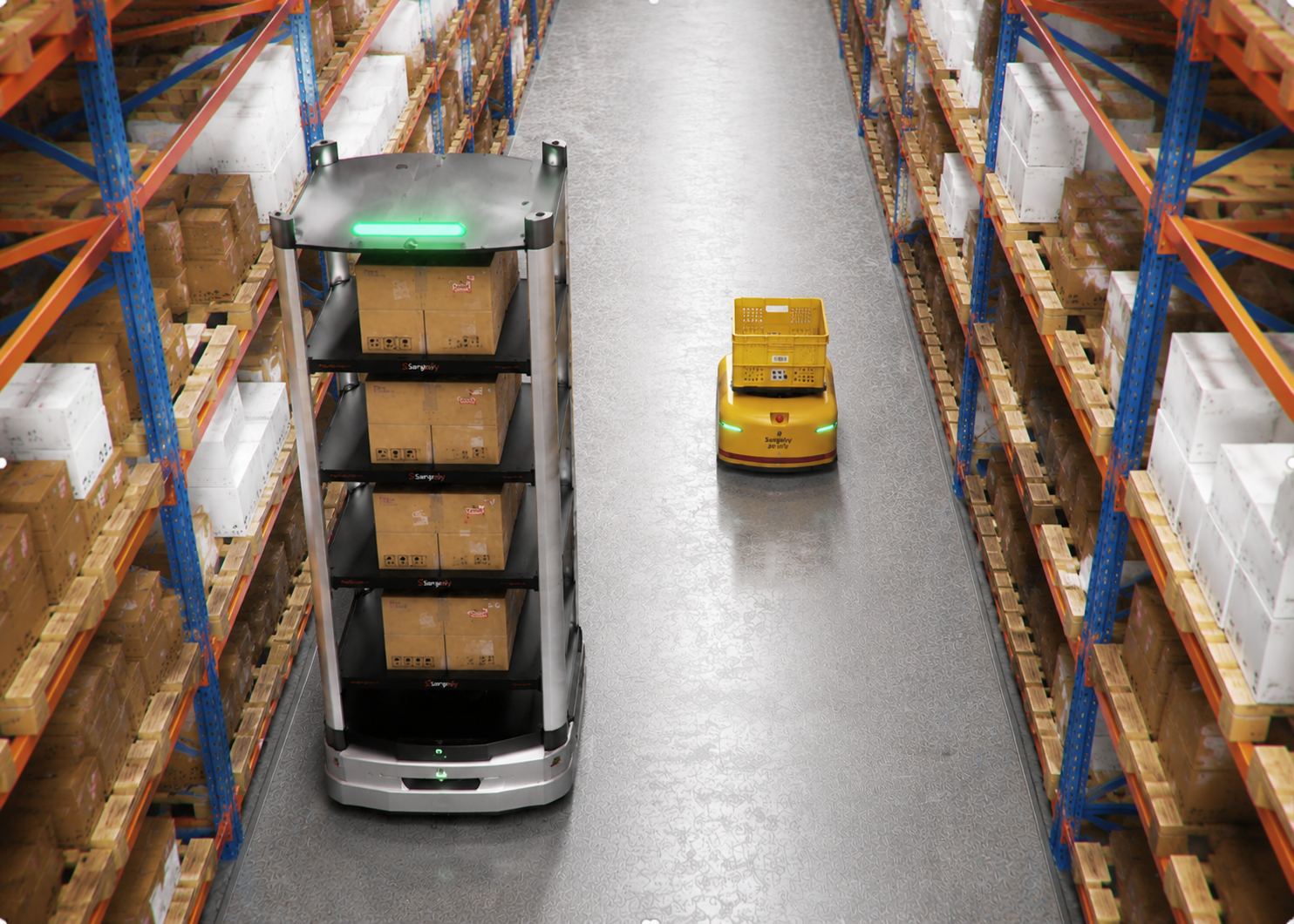
3. How Can Production Planning Become a Basis for Material Preparation?
A manufacturing warehouse has a different role from a traditional storage warehouse.
Its purpose is not only to store materials, but also to ensure that production receives the right materials at the right time.
ERP may already contain production schedules and material requirements, but these plans still need to be connected with warehouse operations.
If warehouse teams only start searching for materials after production requests them, the connection between planning and execution remains incomplete.
For manufacturing companies, an important question is:When will production need the materials, and can the warehouse prepare them before production starts?
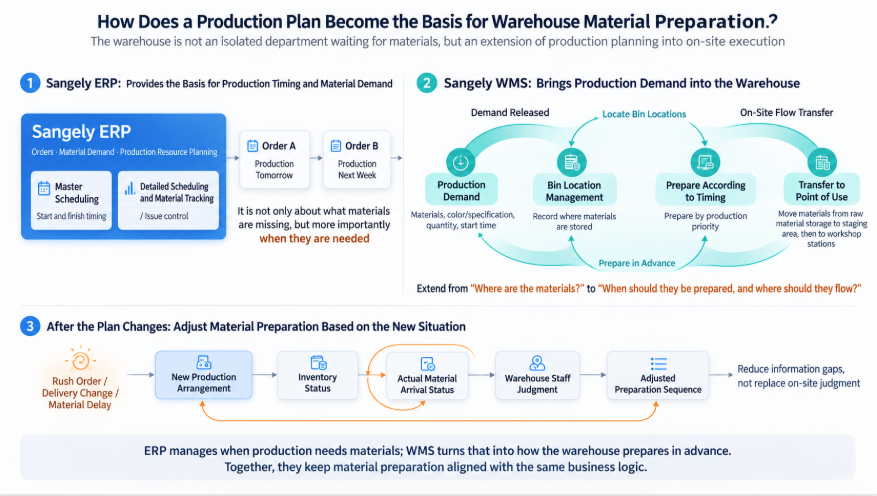
3.1 Sangely ERP Provides Production Timing and Material Requirement Information
Sangely ERP helps manufacturers manage orders, materials, and production resources.
Through production planning and scheduling processes, the system provides information related to production timing, material requirements, and manufacturing arrangements.
For PMC, purchasing, and warehouse teams, the key question is not only:“Which materials are required?”
but also:“When will these materials be needed?”
For example, two production orders may require the same material, but their production dates are different.
The warehouse should not simply prepare materials based on which department asks first. Preparation should be organized according to production priorities and actual manufacturing requirements.
Production schedules provide the basis for material preparation, while material readiness directly affects whether production plans can be executed successfully.
3.2 How Sangely WMS Extends Production Requirements into Warehouse Operations
After production requirements are generated through ERP, they still need to become practical warehouse activities.
Sangely WMS focuses on warehouse execution by connecting material information, storage locations, preparation processes, and physical material movement.
Based on actual factory conditions, companies can organize raw material storage areas, preparation areas, and warehouse operations according to their production requirements.
The goal is not to force every factory to use the same warehouse layout.
Instead, the focus is on helping warehouses move from simply answering:“Where is this material stored?”
towards a more production-oriented question:“When is this material needed, and how should it be prepared for production?”
In Sangely’s manufacturing digitalization approach:
The warehouse should not operate as an isolated department that only reacts to production requests. It should become an integrated part of the production supply process.
3.3 When Production Plans Change, Material Preparation Also Needs to Adapt
Bag, handbag, footwear, and apparel manufacturers often face changing production conditions, including urgent orders, delivery adjustments, and delayed materials.
When PMC changes the production schedule but warehouse preparation continues according to the previous plan, companies may experience a common problem:
Materials for less urgent orders are already prepared, while materials needed immediately for production are still unavailable.
The value of ERP and WMS integration is to help production plans, material conditions, and warehouse operations work with the same business information.
However, this does not mean that the system automatically replaces all warehouse decisions.
Warehouse teams still need to consider:
- Updated production schedules;
- Current inventory conditions;
- Material arrival status;
- Actual factory requirements.
The purpose of Sangely ERP and WMS integration is not to replace human judgment, but to reduce information gaps between production planning, material requirements, and warehouse execution.
4. After Materials Are Prepared, How Can They Reach Production?
Material preparation is not the final step.
For manufacturing companies with multiple production processes, materials still need to move from raw material storage areas or preparation zones to the correct production locations.
If this movement still depends mainly on phone calls, messaging groups, or temporary communication, another common problem may occur:
The warehouse has prepared the materials, but the production line is still waiting.
Sangely WMS builds the foundation for warehouse and material movement management by connecting:
- Materials;
- Storage locations;
- Preparation tasks;
- Movement processes.
Based on actual factory requirements, Sangely WMS can also support further integration with automation equipment such as AGV and CTU in suitable scenarios.
However, automation equipment is not the starting point.
Before introducing automated logistics, companies first need to establish clear relationships between materials, warehouse locations, production requirements, and movement tasks.
A practical approach is:WMS first establishes the business foundation of what should be moved, where materials should move from, and where they should be delivered. AGV and CTU can then participate in the physical movement process according to actual factory conditions.
By building a clear warehouse data foundation first, companies can create a more reliable path toward future logistics automation.
5. What Is the Difference Between a Manufacturing WMS and a Traditional Warehouse System?
Many warehouse systems provide basic capabilities such as receiving, issuing, inventory checking, and stock counting.
However, manufacturing companies need more than a record of inventory quantities.
In a manufacturing environment, the warehouse plays an important role in supporting production. The system needs to connect materials, storage locations, production requirements, and physical material movement.
A manufacturing WMS helps companies understand not only how much inventory is available, but also where materials are stored, when production requires them, how materials should be prepared, and how they can be delivered to the next production process.
This is one of the key differences between manufacturing WMS and traditional warehouse systems.
Unlike e-commerce warehouses, which mainly focus on finished goods storage, order picking, packaging, and shipment, manufacturing warehouses manage a continuous flow of raw materials into production.
For bag, handbag, footwear, and apparel manufacturers, warehouse management is more complex because these industries often involve:
- Multiple product styles;
- Frequent material changes;
- Different colors and specifications;
- Continuous material movement between warehouse and production areas.
Therefore:
A manufacturing WMS is not only designed to improve inventory accuracy. Its purpose is to create a continuous connection between inventory information, warehouse operations, production requirements, and material supply.
6. How Can Manufacturers Evaluate Whether a WMS Truly Supports Production?
When selecting a WMS, manufacturers should not only compare the number of functions or menus provided by different systems.
A more practical evaluation method is to test the system using real production scenarios.
Companies can select an actual production order and follow the complete material process, from receiving materials into the warehouse, storing them in the correct location, preparing them according to production requirements, and finally supplying them to production.
During this process, manufacturers should evaluate whether the system can:
- Connect physical materials with digital records;
- Clearly identify different material variations;
- Support warehouse preparation based on production requirements;
- Adjust preparation activities when production schedules change.
The purpose of evaluating a manufacturing WMS is not simply to confirm whether the system can manage inventory.
The more important question is whether the system can maintain a continuous connection between:
Material information, warehouse locations, production requirements, and actual warehouse operations.
A system that only tells companies:“How much inventory exists?”
is still mainly solving inventory record management.
A manufacturing WMS should help companies understand:Where materials are located, when they are required, how they should be prepared, and how they can reach production efficiently.
7. Does a Small Warehouse Need a WMS?
The need for a WMS should not be determined only by warehouse size or inventory value.
Some bag and footwear manufacturers may operate relatively small warehouses, but their material management can still be highly complex.
A small warehouse may manage many product styles, different material colors and specifications, frequent material issuing and returns, and constantly changing production requirements.
In these situations, management difficulty is not always related to physical warehouse size.
Companies may need to consider WMS when warehouse problems begin affecting production performance, such as:
- ERP shows available inventory, but employees cannot quickly locate materials;
- Different material specifications or batches are difficult to distinguish;
- Production teams frequently request urgent material preparation;
- Material issuing, returns, and replenishment are difficult to verify;
- Warehouse operations still rely heavily on Excel files or paper records after ERP implementation.
The key question is not:“Is our warehouse large enough?”
The more important question is:“Have warehouse management problems already started affecting production efficiency and delivery performance?”
Conclusion: Making Inventory Data Truly Support Manufacturing Production
When ERP shows available inventory but production still waits for materials, the issue is not always the inventory quantity itself.
The real challenge is often the connection between digital inventory information and actual warehouse operations.
Sangely WMS is designed around real manufacturing warehouse scenarios.
Through warehouse location management, PDA-based receiving, material traceability, and warehouse operation management, Sangely WMS helps manufacturers connect system inventory data with physical warehouse activities.
Sangely ERP provides production-related information, including orders, material requirements, production schedules, and manufacturing planning data.
Sangely WMS further connects these requirements with warehouse execution by supporting material preparation, storage management, and physical material movement.
When companies move toward logistics automation, AGV and CTU equipment can be introduced based on actual factory conditions and warehouse requirements.
The goal is not only to know:“How much inventory do we have?”
but also to ensure:Materials can be located, prepared, delivered, and used when production needs them.
For bag, handbag, footwear, and apparel manufacturers, valuable inventory is not simply inventory recorded in a system.
It is inventory that can support real production:
Easy to locate.
Ready to prepare.
Available at the right time.
Delivered to the right production process.
This is the core value of Sangely WMS:
Helping manufacturers transform warehouse data into a reliable foundation for production supply.
FAQ | Manufacturing WMS and Production Material Management
1. Why Can Production Still Wait for Materials When ERP Shows Available Inventory?
Because inventory availability in ERP does not always mean that materials are immediately ready for production use.
ERP can show inventory quantities and material information, but manufacturing operations still need to confirm whether the materials are physically available, correctly located, match production requirements, and have completed the necessary preparation process.
For manufacturing companies, a WMS helps connect inventory records with actual warehouse conditions, allowing teams to understand not only how much inventory exists, but also where materials are stored and whether they are ready for production.
2. If ERP Already Manages Inventory, Why Do Manufacturers Still Need WMS?
ERP mainly manages business information such as orders, purchasing, inventory records, material requirements, and production planning.
However, warehouse operations require more detailed execution management, including receiving, storage location management, material preparation, issuing, and physical material movement.
ERP helps companies understand what inventory exists in the system, while WMS helps answer where materials are located, how they should be prepared, and how they should move through warehouse operations.
For manufacturing companies, WMS is not a replacement for ERP. Instead, it extends ERP information into real warehouse execution and helps reduce the gap between planning and physical operations.
3. What Is the Difference Between Manufacturing WMS and E-commerce WMS?
E-commerce WMS mainly focuses on finished goods management, including order picking, packaging, and shipment processes.
Manufacturing WMS focuses on the movement of raw materials into production, including material receiving, storage management, production preparation, material issuing, returns, replenishment, and workshop supply.
For bag, handbag, footwear, and apparel manufacturers, this difference is especially important because these industries often involve multiple product styles, frequent material changes, different colors and specifications, and dynamic material movement between warehouses and production areas.
A manufacturing WMS is designed not only to manage inventory, but also to support continuous material flow from warehouse operations to production activities.
4. How Does Sangely WMS Work with ERP Production Planning?
Sangely ERP provides the business foundation for production management by connecting customer orders, material requirements, production schedules, and manufacturing planning information.
However, production requirements still need to be translated into warehouse actions.
Sangely WMS extends ERP production requirements into warehouse execution by supporting material preparation, storage management, and physical material movement.
Through this connection, warehouse teams can organize preparation activities based on actual production requirements instead of relying only on manual communication.
The specific preparation process depends on each company’s production planning method, inventory conditions, warehouse layout, and operational requirements.
5. Can Sangely WMS Work with MES?
Yes.
Sangely’s manufacturing digitalization architecture covers ERP, WMS, and MES, helping manufacturers connect business management, warehouse operations, and production execution.
Within this architecture:
ERP focuses on business planning, orders, materials, and production requirements.
WMS focuses on warehouse management and material flow.
MES focuses on workshop production execution and process management.
By connecting these systems, manufacturers can build a more continuous information flow from business planning to warehouse preparation and production execution.
The specific integration scope depends on each company’s actual system deployment and business requirements.
6. Does Sangely WMS Require AGV or CTU Automation Equipment?
No.AGV and CTU automation are not the starting point of warehouse digitalization.
Before introducing automated logistics equipment, manufacturers first need to establish a reliable warehouse data foundation, including clear material identification, warehouse location management, scanning processes, and material preparation workflows.
After warehouse data and material movement processes become more stable, companies can evaluate AGV, CTU, and other automation solutions according to actual factory layout, logistics requirements, and production conditions.
WMS provides the business foundation for automation by defining what materials need to move, where they should move from, and where they should be delivered.
7. Can WMS Completely Eliminate Production Material Shortages?
Not necessarily.
Production shortages can be caused by many factors, including purchasing delays, supplier issues, BOM accuracy, order changes, and production adjustments.
The main value of WMS is improving visibility into material locations, warehouse status, and preparation processes, helping companies organize production supply more effectively.
WMS reduces information gaps between warehouse operations and production requirements, but it does not replace all manufacturing decisions.
8. How Should Manufacturers Test a WMS Before Implementation?
The most effective approach is to test the system using real materials and actual production orders.
Manufacturers should evaluate the complete material process, from receiving and storage to material searching, preparation, and issuing to production.
During testing, companies should verify whether the system can support real manufacturing scenarios, including:
- Connecting materials with actual warehouse locations;
- Identifying different colors, specifications, and batches;
- Supporting production-based material preparation;
- Adjusting warehouse operations when production schedules change.
A suitable manufacturing WMS should not only manage inventory records. It should connect materials, warehouse operations, and production requirements throughout the manufacturing process.