
As manufacturing enterprises expand from a single factory to multiple production facilities, management challenges go far beyond increasing orders, workforce size, and production capacity.
In a single-factory environment, product development, procurement, Production Planning and Material Control (PMC), and manufacturing operations typically operate within a relatively centralized management structure. When orders change, departments can communicate directly. When production issues arise, managers can usually obtain updates from the shop floor quickly.
However, as enterprises establish multiple production facilities, traditional single-factory management approaches begin to face new challenges.
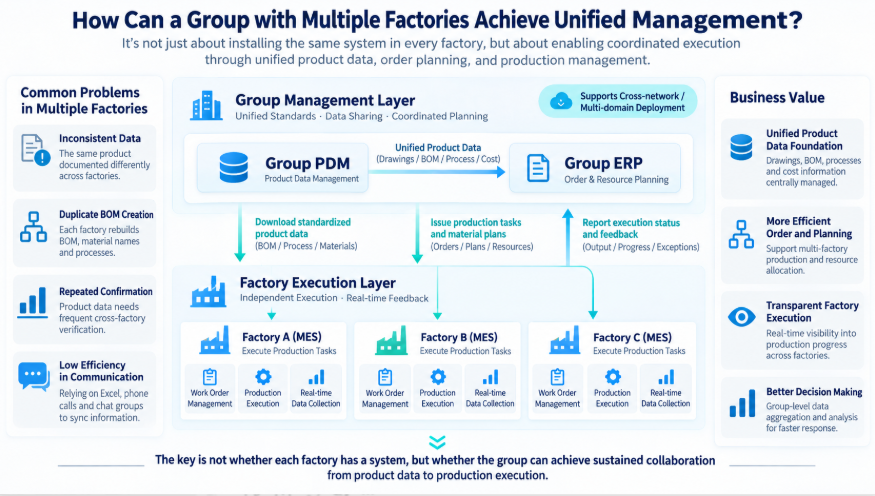
Different factories within the same manufacturing group may use inconsistent product documentation and material codes. A Bill of Materials (BOM) already approved by the group's engineering department may need to be reorganized by another factory. Headquarters may have established production plans, while individual factories continue maintaining their schedules independently.
When group management needs an overall view of production, information often has to be collected repeatedly through Excel spreadsheets, phone calls, and messaging applications.
For manufacturers operating multiple production facilities, the fundamental challenge is not simply whether each factory has its own management system. It is whether group-level product data, order and resource planning, and factory-level production execution can be managed at different organizational levels while maintaining business process continuity.
Sangely adopts a "Group PDM + Group ERP + Multi-Factory MES" architecture.
Group PDM establishes the foundation for product data management. Group ERP manages orders and resource planning. Each production facility uses its corresponding MES to execute manufacturing operations, with support for cross-network and cross-domain working environments.
The objective is not to replicate an existing single-factory system across additional facilities. Instead, the architecture separates group-level management from factory-level execution, allowing product information, orders, and production tasks to flow across different organizational levels.
1. Why Can't a Single-Factory ERP System Simply Be Replicated Across Multiple Factories?
In a single factory, engineering, procurement, PMC, and production departments generally operate within the same business environment. Even when some information must be transferred manually, relatively centralized communication can keep operations moving.
However, when an enterprise expands to multiple production facilities, the boundaries of management change.
The manufacturing group must establish common product data foundations and organize orders and resources across facilities. Individual factories, meanwhile, need to execute production based on their own personnel, equipment, and operating conditions.
Simply replicating a single-factory management approach across a second or third factory can easily create multiple independent sets of business data.
For example, the group engineering department may have already established the BOM and process documentation for a particular bag design. However, Factory A and Factory B may each recreate these documents after receiving their production assignments.
As product specifications change, color variations increase, and customer orders are adjusted, the information maintained by different factories may gradually become inconsistent.
Order management faces similar challenges. Headquarters maintains one production plan, while individual factories maintain separate schedules. When group management needs an overall production status update, information must be collected and consolidated again.
Therefore, multiple independent single-factory ERP systems do not automatically constitute a group-level management system.
Individual ERP installations may support the operations of separate factories, but group-level digitalization must address additional questions:
How can product data follow common standards? How should group-level orders and resources be organized? And how can individual factories execute production while remaining connected to the group's business processes?
2. Why Should Multi-Factory Management Start with a Unified Product Data Foundation?
For manufacturers in the bag, handbag, footwear, and apparel industries, product data is one of the essential foundations of cross-factory collaboration.
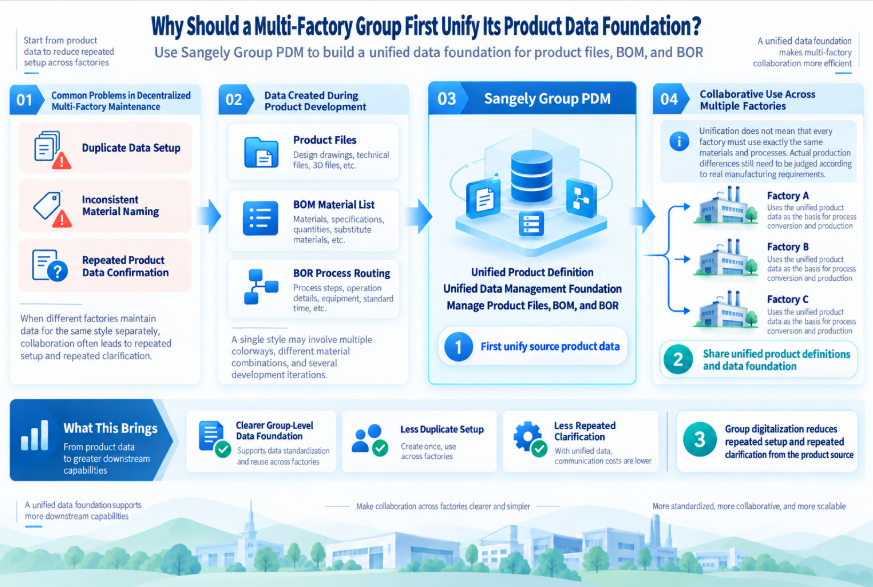
A single product style may involve multiple colorways, different material combinations, and several development revisions. Product development also generates technical drawings, Bills of Materials (BOMs), and Bills of Routing (BORs).
If individual factories establish and maintain this information independently, duplicate product records, inconsistent material naming, and repeated product data verification can easily occur.
For example, the group engineering department may have completed the development of a new handbag style, including its material specifications and manufacturing processes.
If another production facility receives the manufacturing assignment but must recreate the BOM, reconfirm material names, and reinterpret production processes, the original product development data has not truly become a reusable group-level resource.
Sangely Group PDM focuses on product data management at its source, establishing a product development data foundation around technical drawings, BOMs, BORs, and related product information.
Importantly, standardization does not mean every factory must use identical materials or manufacturing processes without exception.
Instead, the objective is to establish common product definitions and a shared data management foundation. Factory-specific manufacturing requirements must still be evaluated according to actual production conditions.
In this way, group-level digitalization goes beyond simply consolidating information from multiple factories.
It helps reduce repeated data creation and interpretation from the earliest stages of product development.
3. What Is the Role of Group ERP in Multi-Factory Management?
As enterprises expand across multiple production facilities, ERP must support a broader management scope than single-factory order processing.
At the group level, manufacturers need to coordinate customer orders, material requirements, and relevant production resources. Individual factories then undertake their assigned manufacturing responsibilities.
Without clearly defined business relationships between group-level planning and factory-level execution, operational duplication can occur.
Headquarters may maintain one production plan, while Factory A creates another schedule and Factory B maintains its own planning records.
When customer delivery requirements change, or when management needs a consolidated production overview, information must once again be collected from separate facilities.
Sangely Group ERP primarily supports order management, material planning, and resource planning, while maintaining business process connections with the MES systems of individual factories.
ERP master scheduling can establish a time-based planning foundation according to customer order requirements, available material conditions, manufacturing processes, and relevant production resources.
The value of Group ERP is not simply to store more orders in a centralized system. It is to establish a unified order and resource planning framework across multiple production facilities.
However, this does not mean that Group ERP automatically compares the production capacity of every factory and independently determines the optimal cross-factory order allocation.
Decisions about which factory should undertake specific production tasks still depend on organizational policies, resource arrangements, and actual manufacturing conditions.
4. Why Does Sangely Use a Layered Architecture of Group PDM, Group ERP, and Multi-Factory MES?
Group-level management and factory-level production execution address fundamentally different operational responsibilities.
The manufacturing group focuses on product information, order requirements, materials, and resource planning.
Individual factories, meanwhile, must translate production assignments into actual shop-floor operations based on their production lines, workforce, equipment, and manufacturing processes.
If a single group-level system is expected to manage every workstation-level detail directly, the management structure can become increasingly complex.
On the other hand, if each factory operates entirely independently, gaps can develop between product data, planning information, and manufacturing execution.
Sangely therefore separates its architecture into three organizational layers.
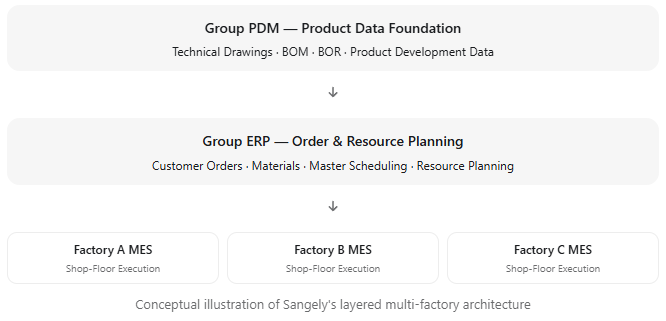
Group PDM establishes the product data foundation. It organizes technical drawings, BOMs, BORs, and related product development information, providing a common reference for subsequent manufacturing activities across the group.
Group ERP manages orders and resource planning. It organizes group-level business activities around orders, materials, and relevant production resources while maintaining connections with factories responsible for manufacturing execution.
Multi-Factory MES supports factory-level production execution. Each production facility uses its corresponding MES to receive production tasks, support workstation operations, and record shop-floor execution results.
This layered design creates clearer responsibilities between group-level management and factory-level operations.
The key principle of Sangely's group architecture is not to duplicate single-factory software installations, but to distinguish the group management layer from the factory execution layer at the architectural level and connect them through business data.
5. How Can Factories in Different Cities and Network Environments Collaborate?
Production facilities belonging to the same manufacturing group are not necessarily located within the same industrial park.
A group's product development center may operate from its headquarters, while production facilities are distributed across different cities, regions, or countries.
Their network environments may also differ.
If an enterprise's software architecture is designed only for a single-factory local area network, establishing a second or third production facility may require the company to reconsider how its systems connect and how business information is shared.
Sangely's multi-factory architecture supports cross-network and cross-domain working environments, connecting Group PDM and Group ERP with MES systems deployed for different factories.
This provides a system foundation for distributed manufacturing organizations.
Manufacturers can design the relationships between product data, order planning, and factory execution according to the group's business structure, rather than allowing every production facility to maintain a completely isolated information environment.
However, cross-network and cross-domain support does not mean that every network environment can operate without configuration, nor does it guarantee automatic real-time synchronization of all shop-floor data.
Network infrastructure, deployment approaches, access permissions, and manufacturing processes vary between enterprises.
Specific implementation arrangements must therefore be determined according to actual project requirements.
6. What Should Manufacturing Groups Actually Standardize Across Multiple Factories?
When discussing group-level digitalization, many manufacturers initially focus on enabling headquarters to view production reports from every factory.
However, consolidating data from multiple facilities into one reporting interface does not necessarily mean that an integrated group management structure has been established.
More importantly, group-level management and individual factories should operate around a common business foundation.
The first priority is product data.
The manufacturing group needs clear product definitions so that technical drawings, BOMs, and manufacturing process documentation can continue supporting different production facilities according to business requirements.
This helps reduce repeated product data creation.
The second priority is order and resource planning.
The group must establish clear relationships between customer orders, production organization, and resource planning, allowing responsible factories to carry out manufacturing activities based on the relevant planning information.
The third priority is production execution.
Each factory executes its assigned manufacturing tasks according to its own production conditions.
Through MES, manufacturing assignments, workstation execution, and shop-floor records can be connected with upstream business processes, providing information for subsequent group-level management.
Therefore, a more meaningful measure of multi-factory digitalization is whether shared product data, group-level resource planning, and factory-level production execution can form continuous business relationships.
For bag, handbag, footwear, and apparel manufacturers preparing to establish their second or third production facility, this consideration is more important than simply adding more ERP user accounts or installing another independent single-factory system.
Conclusion: Group-Level Digitalization Is Not About Replicating More Systems, but Redesigning the Management Architecture
When a manufacturing enterprise expands from one factory to multiple production facilities, the fundamental change is not merely the number of factories.
The group must establish a common foundation for product data and resource planning, while each production facility must continue executing manufacturing operations according to its own conditions.
If a manufacturer continues following a single-factory approach, every new facility may introduce another independent set of product documentation and planning records.
As the organization grows, cross-factory coordination may consequently become more complicated rather than more efficient.
Sangely distinguishes group-level management from factory-level execution through its system architecture:
Group PDM establishes the product data foundation. Group ERP manages orders and resource planning. Multi-Factory MES supports manufacturing execution at individual production facilities.
At the same time, cross-network and cross-domain working environments provide a system foundation for business process connectivity between geographically distributed manufacturing facilities.
The purpose of this architecture is not to increase the number of software installations or user accounts.
It is to address three fundamental questions:
Can product data be established on a common foundation? Can group-level production plans continue into factory operations? And can manufacturing execution across different facilities remain connected through consistent business relationships?
The key to multi-factory manufacturing digitalization is not replicating a single-factory ERP system multiple times. It is establishing an architecture in which group-level management and factory-level execution can operate in coordination.
This is the core design principle behind Sangely's integrated Group PDM, Group ERP, and Multi-Factory MES architecture for manufacturing groups.
FAQ | Frequently Asked Questions About Multi-Factory Manufacturing Management
1. What Is the Difference Between Group ERP and Single-Factory ERP?
Single-factory ERP primarily manages orders, materials, and resources within one manufacturing facility.
Group ERP must additionally address group-level order management, resource planning, and the connections between these business activities and different production facilities.
The main difference lies in organizational structure and management scope, rather than simply the number of system users.
2. Why Does Sangely Use Group PDM, Group ERP, and Multi-Factory MES?
Group-level management and factory-level production execution involve different operational responsibilities.
Group PDM establishes the product data foundation. Group ERP manages orders and resource planning. Individual factory MES systems support production tasks and shop-floor execution.
This layered approach allows group management and individual factories to perform different functions while maintaining business process connectivity.
3. Do Individual Factories Still Need MES After Implementing Group-Level Management?
The requirement depends on the enterprise's manufacturing organization and operational model.
Within Sangely's multi-factory architecture, individual factory MES systems undertake corresponding production tasks and support shop-floor execution.
Group PDM and Group ERP provide the upstream product data and resource planning foundation.
The architecture separates group-level planning from factory-level execution while maintaining business connections between them.
4. Can Factories Located in Different Cities or Network Environments Collaborate?
Yes. Sangely's multi-factory architecture supports cross-network and cross-domain working environments, providing a foundation for business connectivity between Group PDM, Group ERP, and the MES systems of different production facilities.
Specific network deployment, system configuration, and data access permissions must be determined according to the project's operating environment.
5. Does Unified Multi-Factory Management Require Every Factory to Use Exactly the Same Manufacturing Processes?
No.
Group-level management aims to establish common product data foundations, essential business rules, and consistent management relationships.
Standardization does not mean eliminating every difference in factory-level manufacturing operations.
Individual production facilities may still execute manufacturing activities according to their personnel, equipment, and actual production conditions.
6. Can Multiple Independent Single-Factory ERP Systems Be Used as a Group ERP System?
Not necessarily.
Multiple single-factory ERP systems can support the separate operations of individual manufacturing facilities.
However, group-level management must also address shared product data, order planning, and cross-factory business relationships.
If individual systems remain isolated and headquarters still relies heavily on manual data consolidation and coordination, the arrangement cannot automatically be considered integrated group-level management.
7. Can Group ERP Automatically Assign Orders to the Factory with the Most Suitable Production Capacity?
This capability should not be assumed.
Determining which factory should undertake an order requires consideration of organizational policies, resource arrangements, and actual manufacturing conditions.
Sangely's currently established architecture focuses on the layered structure and business connectivity of Group PDM, Group ERP, and Multi-Factory MES.
Automatic optimization of cross-factory order allocation should not be presented as a confirmed capability without further product verification.
8. Which Manufacturers Should Consider a Multi-Factory Management Architecture?
Manufacturers that already operate multiple production facilities, or are preparing to establish their second or third factory, should consider evaluating a group-level system architecture.
This becomes particularly relevant when enterprises experience duplicate product data creation, disconnected planning between headquarters and factories, or heavy dependence on Excel spreadsheets and manual reporting for cross-factory coordination.
For growing manufacturing groups, establishing clear relationships between product data, order and resource planning, and factory-level production execution is an important step toward sustainable multi-factory digitalization.