
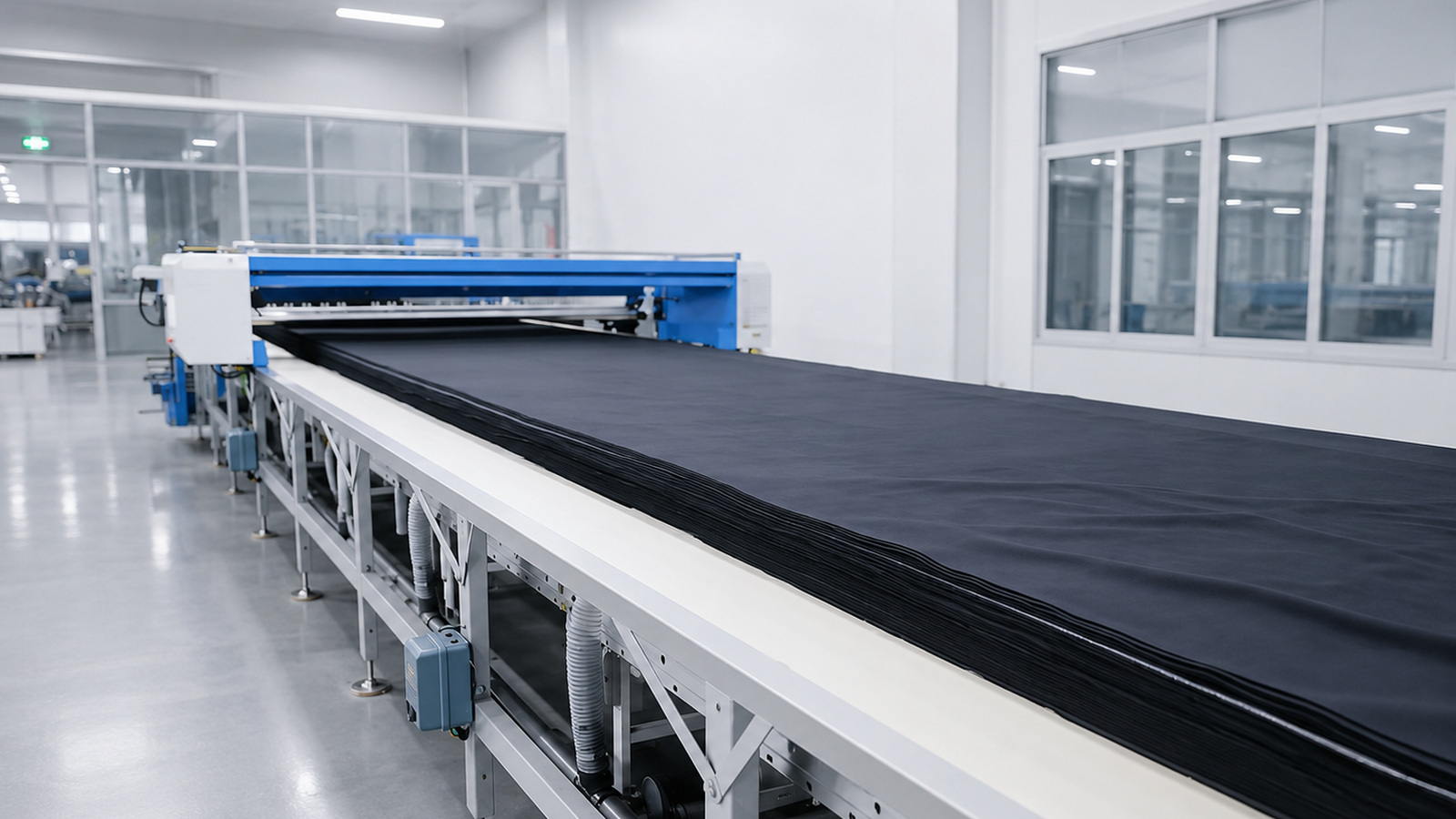
As year-end production peaks approach, low line-shipment efficiency can become a major constraint. A smart fabric spreader that lays multiple material layers in one cycle can support higher-volume production requirements.
In highly competitive footwear and bag manufacturing, factories need systematic control over finished-product quality, cost and efficiency.
The Sangely smart automated fabric spreader is designed to support those production objectives.
The machine is suitable for rigid materials and is designed to lay material flat and evenly, helping control finished-product quality while improving efficiency and reducing manual handling cost.
Machine Advantages
Lays Multiple Material Layers in One Cycle
Unlike people, the machine does not tire in the same way. It can lay multiple layers in one cycle and operate at speed for extended periods while maintaining a more consistent spreading result.
Cost Control
Manual spreading can require several operators and create high labor costs. A smart spreader can reduce manual effort while improving throughput.
Product Quality
The way material is spread before cutting directly affects the quality of finished footwear and bags. Defects discovered after cutting may be impossible to recover, and inconsistent manual spreading can contribute to this problem. Sangely's smart spreader is designed to lay material flat and evenly.
Strengthening the Factory's Image
A smart fabric spreader can demonstrate a factory's commitment to digital operations and automated equipment, providing visible evidence of its focus on quality, cost and efficiency.
Why Choose Sangely
Sangely develops digital-factory capabilities to help footwear manufacturers compete in the future.
Sangely began working toward digital factories years ago by connecting PDF, CAD, ERP, MES and numerical-control technologies. The approach considers the factory as a whole, beginning with lean production and progressing toward digital operations through a practical upgrade strategy.
Sangely's competitiveness framework for footwear factories includes the following areas:
Transforming the Factory's Decision-Making Core
a. In product development and technical transfer, Sangely interprets customer PDF documents, converts them into design information and uses QR codes to track the development process.
b. After CAD grading, Sangely can generate multi-size BOMs, support rapid changes, maintain data accuracy and transfer marker layouts to bulk-production equipment.
c. Patterns imported from CAD can be assembled to establish the BOR process routing. The interface supports calculation of standard time and labor cost and can generate SOP information for bulk production.
Sangely Software
Connecting the Main Arteries of the Production Line
a. QR codes help track raw materials and work in process. A supermarket-style digital dashboard supports more accurate material preparation and more stable lean-production execution.
Raw-Material QR Code
QR CODE
Work-in-Process Dashboard
b. Intelligent-equipment integration connects marker layouts with fabric spreaders and vision cutting machines, warehouse stacker vehicles with material movement, AGVs with line feeding, automated inspection, weighing and packing, and pallet AGVs with warehouse transfer. Sangely continues to develop reduced-labor material-handling and warehousing operations.
Automatic Weighing Station
c. At the workstation, an employee opens the work iPad, checks and maintains tools, and scans the operation QR code to view the SOP. Guidance videos uploaded during development trials can appear at the workstation, and equipment-service requests can be triggered by scanning. QR codes carry task information so work can be completed more accurately and consistently.
About Sangely
Founded in 2005, Sangely Software specializes in digital-factory engineering for the footwear and bag industries and is recognized as a national high-tech enterprise focused on industrial technology innovation.
Sangely's long-term implementation path for footwear and bag manufacturing progresses from lean factory → digital factory → smart factory → increasingly unmanned factory. The objective is to strengthen competitiveness through continuous self-improvement and service to customers.